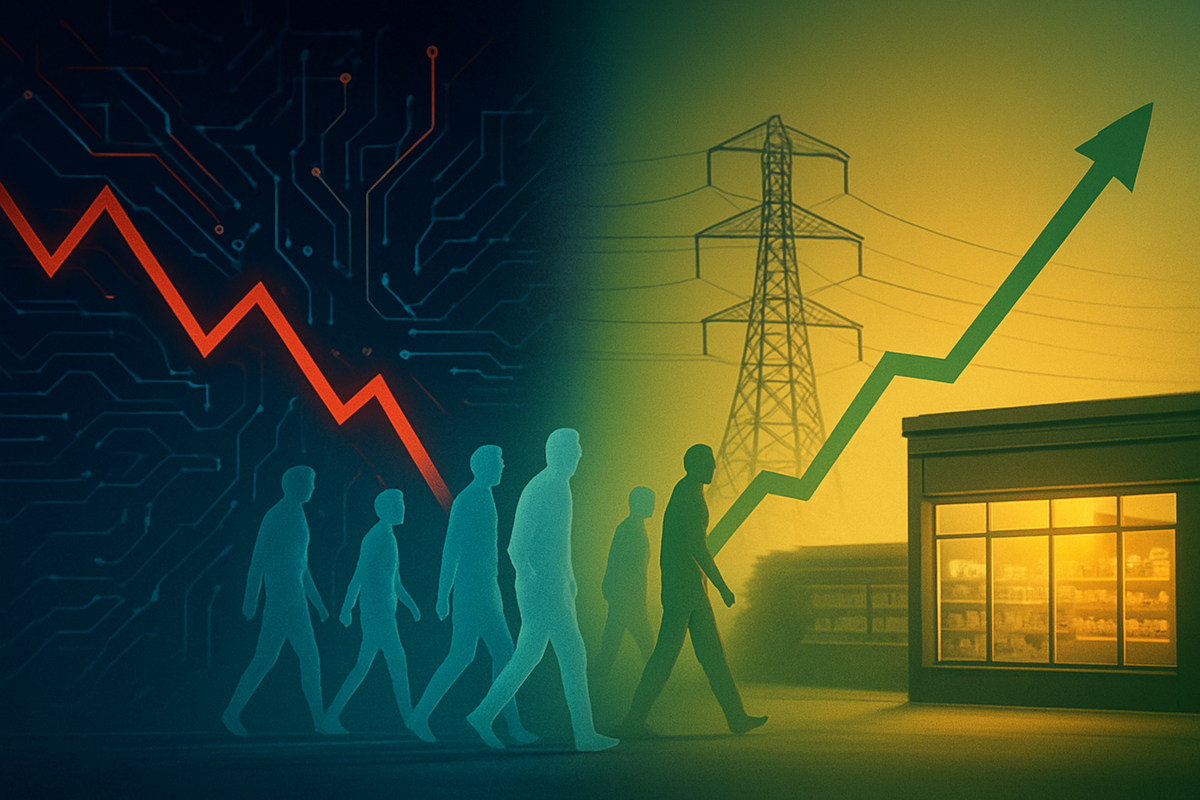
As of February 20, 2026, a profound shift is reshaping the landscape of Wall Street. The high-flying technology sector, which carried the broader markets through much of 2024 and 2025, has hit a formidable wall of valuation fatigue and macroeconomic anxiety. In its place, a "Great Rotation" has taken hold, with institutional and retail capital flooding into the traditionally staid corners of the market: Utilities and Consumer Staples. This migration marks a significant departure from the growth-at-all-costs mentality that defined the early AI era, signaling a new phase of cautious positioning among global fund managers.
The implications of this rotation are immediate and visible across major indices. While the Nasdaq 100 (NASDAQ: QQQ) has struggled with a 3% year-to-date decline and a sharp 2.3% drop in the past week alone, defensive sectors are scaling new heights. The S&P 500 Utilities (NYSE: XLU) and Consumer Staples (NYSE: XLP) sectors have surged by 12% and 15% respectively since the start of the year. This 18-point performance spread between growth and defense represents one of the most aggressive de-risking maneuvers seen in the last decade, as the market grapples with a "show me the money" moment regarding artificial intelligence and a complicated interest rate environment.
The Great De-Risking: A Timeline of the Rotation
The seeds of this rotation were sown in late 2025, when the "Mega Cap 8"—including giants like Nvidia (NASDAQ: NVDA), Microsoft (NASDAQ: MSFT), and Alphabet (NASDAQ: GOOGL)—entered the year trading at nosebleed forward price-to-earnings multiples between 35x and 45x. The catalyst for the current exodus arrived during the January 2026 earnings season. Despite reporting record revenues, the narrative shifted from potential to pragmatism. Investors began questioning the massive capital expenditure plans of the hyperscalers, which are projected to reach nearly $700 billion by the end of 2026. The market’s initial reaction was a "sell-off first, ask questions later" mentality, triggered by concerns that the return on investment for these AI infrastructure spends remains years away.
Compounding the tech sector's woes is the emergence of "Agentic AI" tools that have begun to disrupt traditional Software-as-a-Service (SaaS) business models. As AI agents start automating high-value tasks previously handled by expensive software suites, investors have grown wary of margin compression among former software darlings. This technological uncertainty, combined with a hawkish tilt from the Federal Reserve, has created a volatile environment for growth stocks. Minutes from the Fed’s January meeting revealed that officials are prepared to hold rates at 3.50%–3.75%, or even hike them further if inflation remains "sticky," a prospect that has rattled the long-duration assets of Silicon Valley.
Institutional players have played a key role in this pivot. Quantitative funds and pension plans have been observed rotating out of overextended tech baskets into "real-world" cash flow generators. The appointment of Kevin Warsh as the new Federal Reserve Chair nominee has added another layer of institutional caution, with many market participants bracing for a shift in monetary philosophy. Consequently, the World Uncertainty Index reached record levels this February, driven by these domestic policy shifts and renewed geopolitical tensions in the Middle East, further accelerating the flight to safety.
Winners and Losers in the New Market Regime
In this reshuffled deck, the "Old Economy" is finding new life. Walmart (NYSE: WMT) became a symbol of this shift in early February 2026, when it achieved a historic $1 trillion market cap. The retail giant has successfully captured market share from price-sensitive middle-income households, leveraging its own AI-led logistics to maintain a low-price leadership that competitors struggle to match. Similarly, Costco (NASDAQ: COST) has emerged as a standout, climbing nearly 19% year-to-date on the back of robust membership growth and resilient consumer spending within its "fortress" warehouses.
The Utilities sector is perhaps the most surprising beneficiary of the AI boom, though not for reasons of software. NextEra Energy (NYSE: NEE) and Constellation Energy (NASDAQ: CEG) have become investor favorites as the market realizes that the AI revolution requires an unprecedented amount of electricity. Constellation Energy, in particular, has seen significant inflows due to its nuclear power capabilities, which are increasingly seen as the essential backbone for the data centers power-hungry AI models require. Other traditional utilities like Duke Energy (NYSE: DUK) and Southern Co. (NYSE: SO) are being sought out for their stable 3.4% to 3.7% dividend yields, providing a "yield sanctuary" while the Nasdaq experiences double-digit drawdowns.
Conversely, the losers are concentrated in the formerly untouchable tech elite. Beyond the hardware giants, consumer-facing tech companies and speculative growth stocks have faced the brunt of the rotation. The "Magnificent Seven" names, while still profitable, have seen their collective market cap erode as the "AI premium" evaporates. For companies like Meta (NASDAQ: META), the pressure to prove that multi-billion dollar metaverse and AI investments can translate into immediate bottom-line growth has never been higher. As capital migrates to the 200-year-old brands of Procter & Gamble (NYSE: PG) or the global distribution of Coca-Cola (NYSE: KO), the valuation gap between "boring" stability and "exciting" growth is closing at a rapid clip.
Analyzing the Broader Economic Significance
This event fits into a broader historical trend where markets eventually revert to the mean after periods of intense speculative fervor. Much like the post-2000 dot-com bust or the 2022 inflationary correction, the 2026 rotation represents a "sanity check" on valuations. However, unlike previous cycles, the current move is unique because the defensive sectors are no longer just "places to hide." They are becoming active participants in the new economy. Utilities are being re-rated as "growth" stocks due to the electrification of everything, and Staples are using AI more effectively than many tech firms to optimize supply chains and protect margins.
The ripple effects are being felt across the regulatory and policy landscape. As investors move into heavily regulated sectors like Utilities, there is increased scrutiny on energy policy and grid modernization. The "K-shaped" recovery—where affluent consumers thrive while lower-income households struggle—is also coming into sharper focus. The success of value retailers like Walmart and the resilience of essential brands at PepsiCo (NASDAQ: PEP) highlight a thinning buffer for the average American household, whose personal savings rate has dipped to 3.5%. This economic reality is forcing a reconsideration of "soft landing" narratives that dominated 2025.
Historically, when the spread between Staples and Tech widens this dramatically, it often precedes a broader economic slowdown or a period of prolonged sideways trading. The current surge in the World Uncertainty Index suggests that the market is bracing for a regime of higher-for-longer volatility. While the 2024 rally was built on the "promise" of technology, the 2026 market is being built on the "certainty" of dividends and essential services. This transition underscores a fundamental shift in investor psychology from FOMO (Fear of Missing Out) to FOPL (Fear of Principal Loss).
The Road Ahead: Short-Term Pain or Long-Term Shift?
In the short term, the rotation into defensives is likely to persist as long as the "AI ROI" remains an open question. Investors will be watching the upcoming Q1 2026 earnings reports with a critical eye, looking for evidence that the massive capex from firms like Microsoft and Alphabet is beginning to move the needle on productivity and revenue. If those signs fail to materialize, the exodus from tech could accelerate, potentially leading to a formal "tech recession" even as the broader S&P 500 is supported by the strength of its defensive components.
Longer-term, we may be entering a "Stock Picker’s Market" where the broad index-tracking strategies that worked for the last decade are less effective. Strategic pivots will be required for growth-oriented funds, many of which are now forced to find "defensive growth" in sectors like healthcare or specialized infrastructure. The challenge for these companies will be maintaining innovation while simultaneously returning more capital to shareholders through buybacks and dividends—a balance that many tech giants have not had to strike in years.
Scenario planning for the remainder of 2026 suggests two likely paths. In the first, tech valuations bottom out by mid-year, leading to a "buy the dip" opportunity once interest rate clarity is achieved. In the second, a more protracted stagnation occurs as the market realizes the "AI payoff" is a five-to-ten-year journey rather than a one-to-two-year sprint. In either case, the dominance of the defensive sectors provides a necessary ballast, preventing a total market collapse while the leading edge of the economy recalibrates.
Final Assessment: What Investors Should Watch
The market rotation of February 2026 is a stark reminder that even the most transformative technologies cannot outrun the laws of economic gravity indefinitely. The shift into Utilities and Consumer Staples is a rational response to a high-uncertainty environment characterized by expensive tech stocks and an unpredictable Federal Reserve. The key takeaway for investors is that "defensive" does not mean "dead"; the outperformance of Walmart, NextEra Energy, and Costco demonstrates that there is significant alpha to be found in companies that provide essential services and products.
As we move forward, the market’s health will depend on its ability to broaden out. A healthy bull market cannot rely on seven or eight companies forever. In many ways, the current rotation is a positive development for the long-term stability of the financial system, as it reduces the concentration risk that has plagued the S&P 500 for years. By re-allocating capital to the backbone of the "real economy," the market is building a more diversified foundation for the next leg of the cycle.
In the coming months, investors should keep a close watch on three things: the yield on the 10-year Treasury, the rhetoric from the new Fed leadership under Kevin Warsh, and the pace of "Agentic AI" adoption in the enterprise sector. Any significant cooling of inflation or a surprise "dovish" turn from the Fed could spark a relief rally in tech. However, until the cloud of economic uncertainty lifts, the path of least resistance for capital remains toward the security of the light switch and the grocery aisle.
This content is intended for informational purposes only and is not financial advice