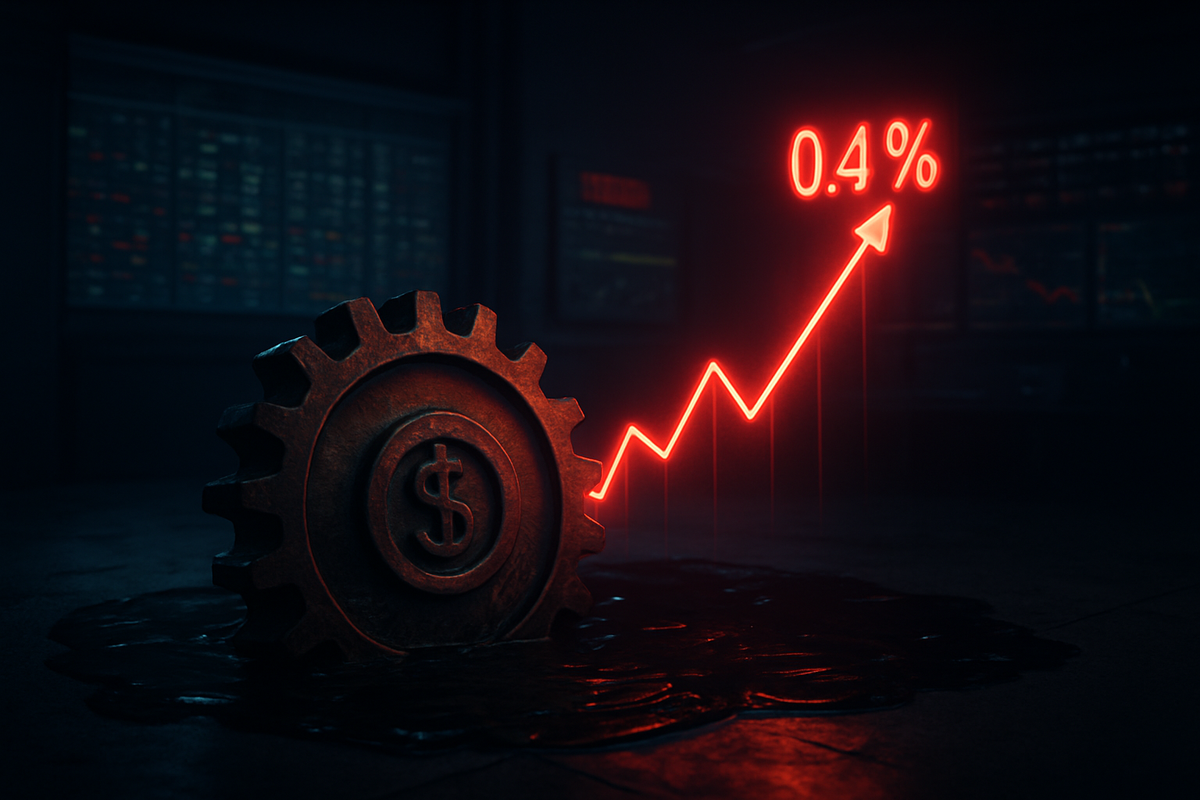
The U.S. economy has entered a precarious new phase as the latest economic data reveals a troubling divergence: inflation is heating up just as economic growth begins to stall. In a report released for the final period of 2025, the Core Personal Consumption Expenditures (PCE) Price Index—the Federal Reserve’s preferred inflation metric—rose by a sharp 0.4% month-over-month in December. This unexpected acceleration coincides with a dramatic cooling of the broader economy, with fourth-quarter Gross Domestic Product (GDP) growth slowing to a mere 1.4% annualized rate.
This "stagflationary" cocktail of rising prices and decelerating output has sent shockwaves through the financial markets, forcing investors to recalibrate their expectations for the Federal Reserve’s interest rate path in 2026. While the market had previously hoped for a series of aggressive rate cuts to support a softening economy, the persistence of core inflation suggests that the central bank may be "boxed in," unable to ease policy without risking a permanent de-anchoring of inflation expectations.
The Collision of Sticky Inflation and Stagnant Growth
The dual data points released this month represent a significant departure from the "soft landing" narrative that dominated much of 2025. The 0.4% monthly jump in Core PCE was the highest reading since February 2025, pushing the annual core inflation rate back up to 3.0%. Analysts point to a combination of factors for this resurgence, including the delayed pass-through effects of recent trade tariffs and a relentless climb in service-sector costs. This "sticky" inflation is particularly concerning for the SPDR S&P 500 ETF Trust (NYSEARCA: SPY), which saw immediate volatility as the "higher-for-longer" rate narrative returned to the forefront of investor consciousness.
On the growth side, the 1.4% GDP figure for the fourth quarter of 2025 was a stark decline from the robust 4.4% growth recorded in the third quarter. The Bureau of Economic Analysis (BEA) noted that the slowdown was largely exacerbated by a 43-day federal government shutdown that paralyzed various sectors of the economy and weighed heavily on consumer and business confidence. The shutdown alone is estimated to have shaved between 1.0 and 1.5 percentage points off the quarterly growth rate. This deceleration has raised fears that the economy is no longer growing fast enough to absorb the impact of restrictive monetary policy, even as prices continue to climb.
The immediate market reaction was one of defensive positioning. Gold prices surged as a hedge against economic malaise, while Treasury yields spiked across the curve as traders priced out the likelihood of a March rate cut. For the Federal Reserve, the timing could not be worse; the central bank had ended 2025 with the federal funds rate in a range of 3.50% to 3.75%, following several late-year cuts intended to support growth. Now, that easing cycle appears to be on an indefinite pause.
Winners and Losers in a Stagflationary Environment
The emergence of stagflationary pressures creates a clear divide between sectors capable of weathering a high-cost, low-growth environment and those that are highly sensitive to interest rates and discretionary spending. High-growth technology stocks, represented by the Invesco QQQ Trust (NASDAQ: QQQ) and giants like Apple Inc. (NASDAQ: AAPL), face a dual threat: their future cash flows are discounted at higher rates due to persistent inflation, while their top-line growth is capped by a slowing domestic economy and reduced consumer purchasing power.
Conversely, defensive sectors and "inflation-proof" assets are seeing renewed interest. Walmart Inc. (NYSE: WMT) stands as a potential winner in this environment, as its value-oriented retail model typically gains market share when consumers are forced to trade down due to rising prices and stagnant wages. Similarly, consumer staple companies with strong pricing power are better equipped to pass on rising input costs to customers. In the commodities space, Newmont Corporation (NYSE: NEM) and other gold miners have benefitted from the flight to "real assets" as a safeguard against the eroding value of the dollar and the uncertainty surrounding the Fed’s next move.
The banking sector presents a more complex picture. For a firm like JPMorgan Chase & Co. (NYSE: JPM), higher-for-longer interest rates can bolster net interest margins in the short term. However, the slowing GDP growth increases the risk of credit defaults and a slowdown in loan demand. If the 1.4% GDP growth continues to trend downward toward contraction, the benefit of higher rates will quickly be outweighed by the necessity of higher loan-loss provisions, making the banking sector a volatile play in the months ahead.
Analyzing the Significance: A 1970s Redux?
The current economic backdrop is drawing uncomfortable comparisons to the stagflationary era of the 1970s. For decades, the dominant economic theory suggested that inflation and unemployment (the inverse of growth) should move in opposite directions. However, the current confluence of tariff-driven price spikes and a government-led growth shock has broken that mold. This event fits into a broader global trend of "de-globalization," where supply chain shifts and trade barriers are structurally increasing the cost of goods, regardless of the domestic growth rate.
Regulatory and policy implications are also looming large. The Federal Reserve is facing a leadership transition, with Chair Jerome Powell’s term set to expire in May 2026. Potential nominees are already being scrutinized for their stance on the "inflation versus growth" mandate. A more hawkish successor might prioritize crushing the 0.4% monthly PCE spike even at the cost of a recession, while a more dovish appointee might face political pressure from the White House to lower rates to stimulate the 1.4% GDP growth, risking a 1970s-style inflationary spiral.
The ripple effects extend beyond the U.S. borders. As the Fed pauses its rate-cutting cycle while other central banks might be forced to continue easing to support even weaker growth in Europe or Asia, the U.S. dollar could see renewed strength. This "divergence" creates additional headwinds for U.S. multinationals that earn a significant portion of their revenue overseas, as their products become more expensive for foreign buyers and their repatriated earnings shrink.
The Road Ahead: Potential Scenarios and Pivots
Looking forward, the Federal Reserve is expected to maintain a "wait-and-see" approach through at least the first half of 2026. The short-term focus will be on whether the 0.4% PCE spike was a one-time "tariff shock" or the beginning of a sustained upward trend. If the January and February data (to be released in March and April) continue to show Core PCE above 0.3%, the Fed may be forced to consider a symbolic rate hike—a scenario that is currently not priced into the markets and would likely trigger a significant correction in equities.
Strategic pivots are already underway in corporate America. Companies are shifting from a focus on expansion to "margin preservation." This involves aggressive cost-cutting, further investment in automation to offset rising labor costs, and a narrowing of product lines to focus on the most profitable segments. For investors, the "60/40" portfolio is under renewed scrutiny, with many shifting toward "alt" assets, real estate, and inflation-protected securities (TIPS) to navigate the lack of clear direction in traditional stock and bond markets.
The best-case scenario for the market would be a "spring rebound" in GDP as the effects of the government shutdown fade, paired with a cooling of Core PCE back toward the 0.2% monthly range. However, if the GDP continues to slide toward 0% while Core PCE remains at 0.4%, the Fed will face the ultimate dilemma: which "mandate" to abandon? The market’s resilience will be tested as it navigates this period of extreme policy uncertainty.
Wrapping Up: What Investors Should Watch
The December economic data has served as a wake-up call for those who believed the battle against inflation was won. The combination of a 0.4% monthly Core PCE rise and a sluggish 1.4% GDP growth rate has effectively ended the "goldilocks" era of the mid-2020s. For the market to move forward, it will need clarity on the Federal Reserve’s leadership and a definitive sign that inflation is returning to its 2% downward trajectory.
As we move into the second quarter of 2026, investors should keep a close eye on three key indicators: the monthly Core PCE prints, the resolution of ongoing trade negotiations that influence tariff costs, and the nomination process for the next Fed Chair. The current "stagflationary" environment demands a more selective approach to equity investing, favoring companies with low debt, strong cash flows, and the ability to dictate prices in a crowded market.
In conclusion, the era of easy monetary policy and predictable growth has hit a significant roadblock. Whether this is a temporary "soft patch" or the start of a prolonged period of stagflation will depend on the Fed’s resolve and the economy’s ability to shake off the shocks of 2025. For now, caution remains the watchword on Wall Street.
This content is intended for informational purposes only and is not financial advice