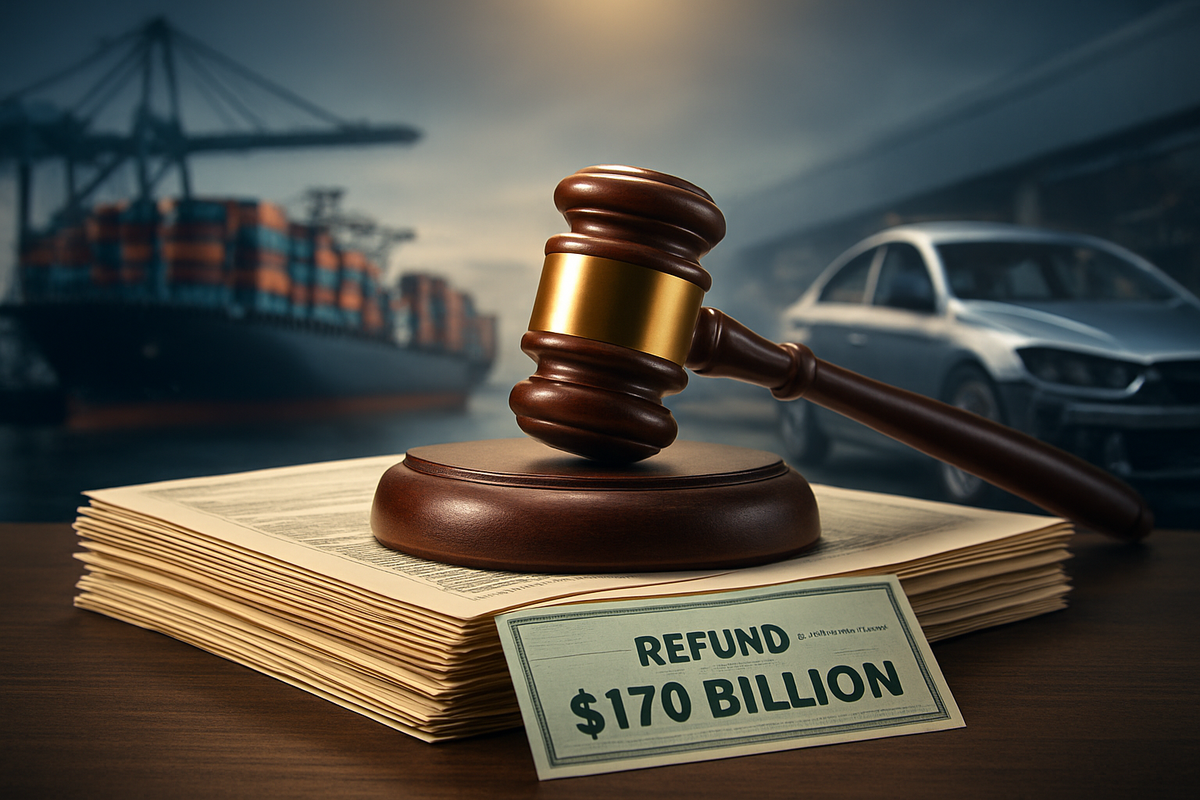
In a landmark decision that has sent shockwaves through the global trade community, the U.S. Supreme Court ruled 6-3 today, February 20, 2026, to invalidate a sweeping regime of tariffs imposed under the International Emergency Economic Powers Act (IEEPA). The ruling in Learning Resources, Inc. v. Trump effectively strips the executive branch of the broad authority it used to bypass Congress and implement high-duty trade barriers, potentially forcing the U.S. Treasury to refund an estimated $170 billion to $175 billion to American businesses.
The decision marks a definitive victory for the retail and automotive sectors, which have shouldered the brunt of these costs for nearly two years. As major players like Costco Wholesale Corporation (NASDAQ: COST) and Toyota Motor Corporation (NYSE: TM) prepare to recoup billions in duties paid since 2024, the market is bracing for a massive injection of corporate liquidity. For investors, the ruling represents one of the most significant regulatory tailwinds in a decade, though the administrative process of "reliquidating" millions of customs entries promises to be a bureaucratic gauntlet.
A Constitutional Check on Trade Policy
The case, which consolidated several challenges including V.O.S. Selections v. Trump, centered on whether the President could use the 1977 IEEPA—a law designed for emergency sanctions like freezing foreign assets—to impose broad "Reciprocal" or "Liberation Day" tariffs. Writing for the majority, Chief Justice John Roberts clarified that the U.S. Constitution "did not vest any part of the taxing power in the executive branch." The Court ruled that because the IEEPA contains no specific mention of "tariffs" or "duties," the administration overstepped its statutory bounds when it hiked the average effective U.S. tariff rate from 2.6% to over 13%.
The timeline leading to this morning’s ruling was fraught with legal maneuvering. Throughout late 2024 and 2025, thousands of U.S. companies filed "protective" lawsuits in the U.S. Court of International Trade (CIT). These filings were essential because customs law typically makes tariff payments "final and unrecoverable" 180 days after a product enters the country—a process known as liquidation. By filing these suits, companies effectively hit a "pause" button on that clock, ensuring they could still claim refunds if the Supreme Court eventually sided with them.
Market reactions were immediate following the news. Shares of heavy importers surged in pre-market trading, with the S&P 500 Retail Index jumping 4.2% within an hour of the ruling's release. However, the ruling has also sparked concern within the Treasury Department. Treasury Secretary Scott Bessent noted in a brief press conference that while the government has the funds, the reliquidation of millions of individual customs entries—some dating back to 2024—will be an "unprecedented administrative challenge" for U.S. Customs and Border Protection (CBP).
The Big Winners: Retail Giants and Auto Titans
Costco Wholesale Corporation (NASDAQ: COST) stands as one of the primary beneficiaries of this ruling. The retail giant, which sources roughly one-third of its sales from imported goods, filed a proactive lawsuit in November 2025 to stop the clock on its tariff liquidations. Trade analysts estimate that Costco could be eligible for a refund of approximately $1 billion. This capital injection is expected to provide Costco with significant flexibility, allowing the company to either stabilize membership fees or accelerate its aggressive international warehouse expansion.
The automotive sector is also poised for a historic windfall. Toyota Motor Corporation (NYSE: TM), through its various North American subsidiaries, was a lead participant in the legal battle. The company had been hit by a "perfect storm" of overlapping tariffs on steel, aluminum, and critical electronic components. With billions of dollars at stake, Toyota and its peers like BorgWarner Inc. (NYSE: BWA) may now see a dramatic improvement in their operating margins. For Toyota, this liquidity comes at a critical time as the company continues its multi-billion dollar transition toward next-generation battery electric vehicles (EVs).
While large-cap companies have the legal resources to navigate the refund process, smaller retailers also stand to gain. Mid-tier companies that struggled to pass tariff costs onto consumers may finally find the breathing room needed to avoid further price hikes. Conversely, domestic steel and aluminum producers, who benefitted from the protectionist measures, saw their shares tumble today. United States Steel Corporation (NYSE: X) and Alcoa Corporation (NYSE: AA) fell sharply as investors realized that the artificial price floor created by the tariffs had been pulled out from under the industry.
Broader Implications for Global Trade and Inflation
Beyond the immediate financial impact on companies like Costco and Toyota, the SCOTUS ruling fundamentally reshapes the future of American trade policy. By reasserting the "Power of the Purse" as a Congressional prerogative, the Court has limited the ability of future presidents to use tariffs as a tool for quick-strike economic diplomacy. This shifts the focus back to the legislative branch, where trade deals and duty changes typically undergo years of debate and lobbying.
The ripple effects will likely be felt in the ongoing battle against inflation. The "Reciprocal" tariffs were widely blamed for keeping consumer prices elevated throughout 2025. With $170 billion flowing back into the private sector, economists expect a "deflationary pulse" to hit the retail sector over the next 12 to 18 months. However, there is no guarantee that companies will pass these savings directly to consumers. Many may use the funds to pay down debt incurred during the high-interest-rate environment of 2024 or to fund stock buybacks.
Historically, this event is being compared to the 2011 "Section 201" challenges, but at a vastly larger scale. The $170 billion figure dwarfs any previous trade-related refund in U.S. history. It also sets a potent precedent for the pending Supreme Court review of Section 301 "List 3" and "List 4A" tariffs on Chinese goods. Following today's logic, legal experts suggest that those tariffs—which were also "modified" by executive action rather than a new Congressional investigation—could be the next to fall.
The Road Ahead: Reliquidation and Strategic Pivots
The short-term reality for retailers and automakers is one of patience. The U.S. Customs and Border Protection agency must now process the "reliquidation" of every entry covered by the lawsuits. This process involves verifying the amount of duty paid and issuing checks with interest. Given the volume of claims, some experts predict it could take until 2028 for the final $170 billion to be fully disbursed. Companies will likely need to hire specialized trade auditors to ensure they are capturing every dollar owed to them.
Strategically, this ruling may lead to a pivot in supply chain management. For the past several years, companies have been "near-shoring" or "friend-shoring" production to avoid the volatility of executive trade actions. With the Supreme Court now requiring Congressional approval for such tariffs, some of the "policy risk" associated with global sourcing has been mitigated. This could lead to a stabilization of global supply chains that were previously in a state of constant flux.
However, the ruling also creates a potential legislative vacuum. If the President can no longer act unilaterally to protect domestic industries from perceived unfair trade practices, Congress will be under immense pressure to pass new, narrower trade legislation. Investors should watch for a surge in lobbying activity as both importers and domestic producers look to influence the next generation of trade laws.
Summary for Investors
The Supreme Court’s invalidation of IEEPA-based tariffs represents a $170 billion pivot point for the U.S. economy. For retailers like Costco and automakers like Toyota, the ruling provides a massive, non-dilutive capital infusion that could bolster balance sheets and fuel R&D for years to come. While the federal government faces a significant budgetary and administrative headache, the broader market is viewing this as a win for corporate earnings and a potential cooling factor for inflation.
Moving forward, the key metrics for investors to watch are the "reliquidation" timelines and the potential for a "Section 301" ruling that could follow this precedent. If the SCOTUS logic is applied to Chinese tariffs as well, the total refund figure could easily double. For now, the "Tariff Windfall" remains the dominant story of early 2026, signaling a return to a more traditional, legislatively-driven trade environment.
This content is intended for informational purposes only and is not financial advice