In a day of breakneck legal and economic shifts, President Donald Trump has reignited his trade war strategy just hours after suffering a major setback at the nation’s highest court. Following a morning ruling by the U.S. Supreme Court that dismantled his administration's broad emergency tariff authorities, the President signed a new executive order on the afternoon of February 20, 2026, imposing a 10% global tariff under Section 122 of the Trade Act of 1974. The move has sent shockwaves through global markets, which had briefly rallied on news of the court’s decision before facing the reality of a persistent "Tariff Train" that shows no signs of slowing down.
The immediate implications are profound for both domestic policy and international commerce. By invoking Section 122—a rarely used "balance-of-payments" authority—the administration is attempting to bypass the legal roadblocks set by the judiciary. However, unlike previous actions, this new 10% levy comes with a built-in 150-day expiration date and a mandate for Congressional approval to extend it beyond that window. This creates an immediate "fiscal cliff" for global supply chains, forcing businesses to navigate a landscape where trade costs could shift dramatically twice in a single year.
A Legal Tug-of-War: From IEEPA to Section 122
The day began with a landmark 6–3 decision in Learning Resources, Inc. v. Trump, where the Supreme Court ruled that the International Emergency Economic Powers Act (IEEPA) of 1977 does not grant the executive branch the unilateral power to impose permanent tariffs. Chief Justice John Roberts, writing for the majority, invoked the "major questions doctrine," asserting that such a massive expansion of economic power requires "clear and express" authorization from Congress. The ruling effectively invalidated the "Liberation Day" tariffs enacted in April 2025, potentially requiring the federal government to refund nearly $200 billion in collected duties.
However, the celebratory mood in corporate boardrooms was short-lived. By mid-afternoon, President Trump held a televised briefing from the White House, criticizing the "judicial overreach" of the court and announcing the immediate implementation of a 10% across-the-board tariff using Section 122. This specific statute allows the president to address "large and serious" trade deficits through temporary import surcharges. Crucially, Section 122 does not require the lengthy investigations typical of other trade laws, allowing for the near-instantaneous pivot that caught many traders off guard.
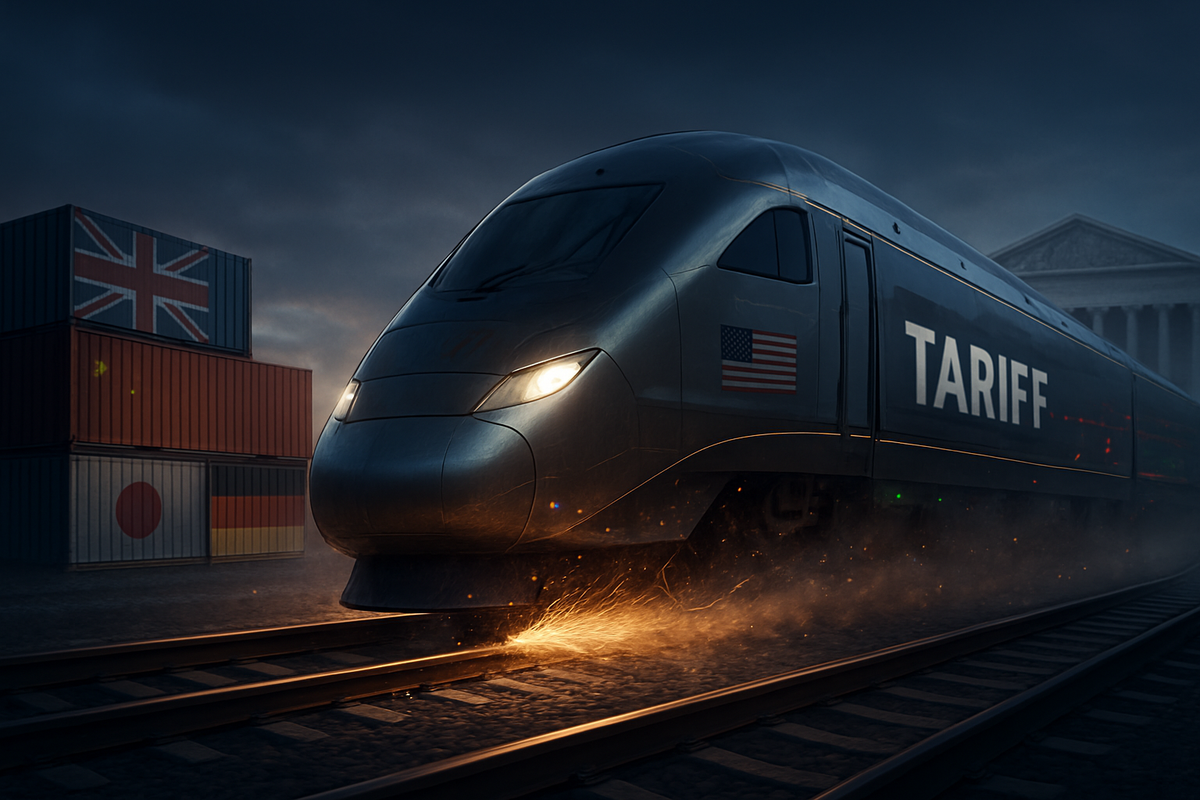
The market reaction was a classic "V-shaped" whip. Initially, the S&P 500 climbed nearly 1% and the Dow Jones Industrial Average rose 200 points as the IEEPA tariffs were struck down. Shares of heavily impacted importers like Hasbro (NASDAQ: HAS) and Mattel (NASDAQ: MAT) surged over 4%. Yet, as news of the Section 122 pivot broke, those gains evaporated. By the closing bell, the market was flat to slightly down, as investors realized the "Tariff Train" had simply switched tracks rather than reaching its final destination.
The Corporate Battlefield: Winners, Losers, and the Squeezed
The return of the 10% global tariff creates a stark divide between domestic producers and globalized giants. In the "win" column, domestic steel and industrial firms saw a renewed protective shield. Nucor (NYSE: NUE) and Cleveland-Cliffs (NYSE: CLF) remain major beneficiaries; because the new 10% tariff is applied uniformly, it stacks on top of existing Section 232 national security protections. These companies now enjoy an even wider price buffer against foreign competitors, though they remain sensitive to potential "rollback" negotiations the administration might use as leverage with allies.
On the losing side, the technology and retail sectors are facing a renewed margin squeeze. Apple (NASDAQ: AAPL) is estimated to face over $2 billion in additional quarterly costs, as the non-discriminatory nature of Section 122 means its diversified supply hubs in India and Vietnam are taxed at the same rate as China. Retailers like Walmart (NYSE: WMT) and Target (NYSE: TGT) are also in the crosshairs. While Walmart’s massive scale and heavy focus on domestic groceries provide a partial hedge, Target’s reliance on discretionary imports like home decor and electronics makes it particularly vulnerable to the new levies.
Small to mid-sized retailers are perhaps the hardest hit, lacking the capital to absorb these costs or the leverage to renegotiate supplier contracts. Companies like Wayfair (NYSE: W) and Williams-Sonoma (NYSE: WSM) are already grappling with how to price their upcoming autumn catalogs, as the 10% tariff adds immediate pressure to their bottom lines. Many smaller firms have expressed "survival anxiety," noting that they cannot sustain another year of fluctuating duty rates while domestic inflation remains a persistent concern.
Broader Significance: The Constitutional Balance of Power
This event marks a pivotal moment in the history of U.S. trade policy, representing a rare direct clash between the executive and judicial branches over the "power of the purse." By using Section 122, the Trump administration is testing a legal loophole that hasn't been significantly challenged in decades. Historically, Section 122 was intended for temporary balance-of-payments emergencies—such as the 1971 "Nixon Shock"—rather than as a long-term tool for trade protectionism. The shift signifies that the "major questions doctrine" is now the primary battleground for executive authority in the 21st century.
The ripple effects extend far beyond the U.S. borders. The requirement for uniform, non-discriminatory application under Section 122 means that even "friendly" trading partners will be hit by the 10% duty. This could trigger retaliatory measures from the European Union and the USMCA partners, potentially leading to a fragmented global trading system. For competitors of U.S. firms, the move creates a bizarre environment where the U.S. market becomes a high-cost island, potentially accelerating the "near-shoring" trend to countries like Mexico, provided they can eventually secure exemptions.
The policy implications also highlight a growing "Tariff-Industrial Complex" in Washington. Even as the Supreme Court attempts to rein in executive power, the administration's ability to pivot between different sections of the 1930 and 1974 Trade Acts demonstrates how deeply embedded trade-related executive discretion has become. This "Tariff Train" phenomenon suggests that even if one legal mechanism is derailed, the administration has an entire station full of alternative statutes ready to be deployed.
The Road Ahead: The 150-Day Fiscal Cliff
The most critical factor for investors to watch in the coming months is the 150-day expiration clock. Under Section 122, these tariffs will automatically expire in mid-September 2026 unless Congress passes a statute to extend them. This sets up a high-stakes political showdown in late summer, just as the 2026 midterm election cycle heats up. Businesses must now plan for three potential scenarios: a full Congressional renewal, a total expiration of the 10% duty, or a transition into even more aggressive Section 301 investigations which could lead to permanent tariffs of 25% or higher.
In the short term, expect a wave of "inventory hoarding." Retailers are likely to front-load their imports for the 2026 holiday season to ensure their goods arrive before the 150-day window closes or the Section 301 escalations begin. This could lead to a temporary surge in shipping volumes and port congestion, followed by a sharp drop-off in the fourth quarter. Strategically, companies are also simplifying product designs and reducing SKU counts to mitigate the impact of the 10% levy, a move that could dampen consumer choice by year-end.
Market opportunities may emerge in "tariff-exempt" niches or companies that provide supply chain optimization software. However, the prevailing sentiment is one of caution. The ability of the "Tariff Train" to keep moving despite a Supreme Court defeat proves that trade volatility is now a structural feature of the market, not a temporary bug. Investors should prepare for a "double-cliff" in September, where both the 10% tariff and the potential for a larger trade war escalation converge.
Conclusion: Navigating a Permanent State of Trade Flux
The events of February 20, 2026, serve as a stark reminder that in the modern era, legal victories in the trade arena are often fleeting. The Supreme Court’s attempt to restore Congressional authority over tariffs was met with an almost immediate executive counter-maneuver, shifting the burden of trade policy back onto a polarized legislature. For the markets, the takeaway is clear: the era of predictable, low-tariff global trade is firmly in the rearview mirror.
As we move forward, the focus will shift from the courtroom to the halls of Congress. Investors must watch for signals of a bipartisan consensus—or lack thereof—regarding the extension of the Section 122 duties. The "Tariff Train" is no longer just an administration policy; it has become a fundamental market force that dictates everything from corporate earnings to consumer price indices.
The coming months will be a litmus test for the resilience of the U.S. economy and the adaptability of its largest corporations. With a 150-day countdown now ticking, the "fiscal cliff" of September 2026 is the new horizon for every supply chain manager and institutional investor. In this landscape, the only certainty is that the battle over American trade policy is far from over, and the volatility is here to stay.
This content is intended for informational purposes only and is not financial advice.