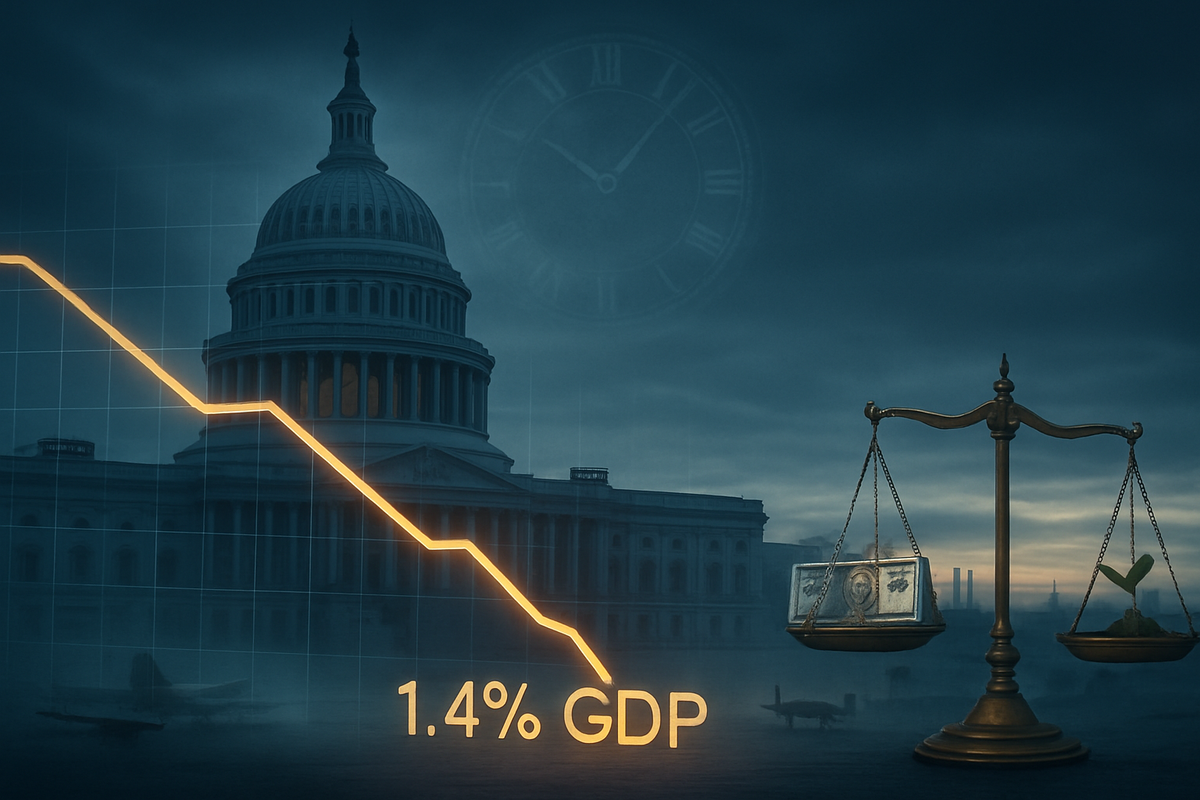
The U.S. Department of Commerce released a sobering report today, February 20, 2026, revealing that the American economy slowed to a crawl in the final months of 2025. According to the Bureau of Economic Analysis (BEA), Real Gross Domestic Product (GDP) increased at an annual rate of 1.4% in the fourth quarter of 2025. This figure represents a dramatic deceleration from the robust 4.4% growth seen in the third quarter, a direct consequence of the longest federal government shutdown in the nation’s history.
The immediate implications for the financial markets are profound. While the 1.4% growth rate narrowly avoids a technical contraction, it underscores the fragility of a post-shutdown recovery hampered by "sticky" inflation and weakened consumer confidence. Investors are now recalibrating their expectations for 2026, as the Federal Reserve faces the unenviable task of managing a stagnant economy while price pressures remain stubbornly above target.
A Season of Stagnation: Breaking Down the Q4 Data
The primary driver behind the disappointing growth was the 43-day partial government shutdown that paralyzed Washington from October 1 to November 12, 2025. Triggered by a fierce fiscal standoff over healthcare spending and trade policy, the shutdown is estimated to have subtracted a full percentage point from the quarterly growth rate. The BEA report highlighted that the reduction in services provided by federal employees, coupled with a freeze on government-led investments, created an economic vacuum that the private sector was unable to fill.
Beyond the direct loss of government output, the shutdown rippled through the broader economy. Consumer sentiment, as measured by the University of Michigan, plummeted to historic lows in December, reaching 52.9—a level not seen since the depths of the 2008 financial crisis. This collapse in confidence led to a significant cooling in consumer discretionary spending, which grew at its slowest pace in two years. Families impacted by delays in the Supplemental Nutrition Assistance Program (SNAP) and workers facing furloughs tightened their belts, leading to a "wait-and-see" approach that persisted through the holiday season.
Initial market reactions to the 1.4% figure were characterized by a flight to safety. As the report hit the wires this morning, gold surged past all-time highs, while Treasury yields remained volatile as traders debated the Federal Reserve’s next move. Institutional investors are particularly concerned about the $100 billion in total economic activity estimated to have been lost during the impasse, much of which—particularly in the service and labor sectors—cannot be recovered through future spending.
Industrial Fallout: Winners and Losers in a Fragmented Market
The defense and government services sectors bore the brunt of the administrative paralysis. Major contractors faced immediate stop-work orders and significant cash flow strains as invoices went unpaid. Companies like L3Harris Technologies, Inc. (NYSE: LHX), Leidos Holdings, Inc. (NYSE: LDOS), and Northrop Grumman Corporation (NYSE: NOC) reported disruptions in their delivery timelines. Similarly, aerospace giants Lockheed Martin Corporation (NYSE: LMT), General Dynamics Corporation (NYSE: GD), and RTX Corporation (NYSE: RTX) are expected to show the scars of the Q4 disruption in their upcoming annual reports, as the lack of contract awards in October and November created a backlog that will take quarters to clear.
The travel industry also suffered a significant blow. Staffing shortages at the Transportation Security Administration (TSA) and the Federal Aviation Administration (FAA) during the shutdown led to widespread flight cancellations and delays. This operational chaos hit the bottom lines of major carriers such as Delta Air Lines, Inc. (NYSE: DAL) and United Airlines Holdings, Inc. (NASDAQ: UAL). Regional banks also faced headwinds; PNC Financial Services Group, Inc. (NYSE: PNC), Fifth Third Bancorp (NASDAQ: FITB), and KeyCorp (NYSE: KEY) saw a tightening in credit conditions as the threat of a prolonged slowdown raised concerns about loan defaults and a decline in new mortgage applications.
Conversely, certain segments of the market demonstrated remarkable resilience. In the technology sector, the push for Artificial Intelligence remained largely insulated from the political dysfunction. Nvidia Corporation (NASDAQ: NVDA) and Meta Platforms, Inc. (NASDAQ: META) continued to benefit from strong capital expenditures by enterprises looking to automate and gain efficiency in a high-cost environment. Furthermore, defensive rotations favored the insurance and utilities sectors, with The Progressive Corporation (NYSE: PGR) and The Allstate Corporation (NYSE: ALL) providing a buffer for portfolios against the volatility seen in the energy sector, where Occidental Petroleum Corporation (NYSE: OXY) and Transocean Ltd. (NYSE: RIG) struggled due to falling crude prices and reduced industrial demand.
The Fed’s Dilemma: Policy in the Wake of Dysfunction
The Q4 GDP data places the Federal Reserve in a precarious "higher-for-longer" trap. Typically, a growth rate as low as 1.4% would prompt the central bank to consider interest rate cuts to stimulate the economy. However, with Core Personal Consumption Expenditures (PCE) inflation still hovering at 3.0%, the Fed cannot easily pivot. This "stagflationary" shadow complicates the transition of power at the central bank, as Chairman Jerome Powell prepares to conclude his term in May 2026.
The leading candidate to succeed Powell, Kevin Warsh, is widely expected to maintain a hawkish stance to ensure inflation does not become entrenched. This fiscal-monetary mismatch is reminiscent of the late 1970s, though the current technological tailwinds provide a much different backdrop. The policy implications are clear: the "easy money" era is not returning anytime soon. Markets are now pricing in a "no-landing" scenario where rates remain at 3.50%–3.75% well into the summer, delaying any hopes of relief for the housing and automotive markets.
Historically, government shutdowns have been followed by "catch-up" growth in the subsequent quarter. However, the sheer length of the 2025 shutdown suggests a more permanent scarring of the labor market and consumer psyche. Unlike the brief 2018-2019 shutdown, the 2025 event occurred during a period of existing monetary tightening, creating a compounding effect that has fundamentally altered the trajectory for 2026.
Looking Ahead: A Pivotal Year for 2026
As we move deeper into 2026, the primary question for investors is whether the Q1 rebound will be strong enough to offset the Q4 malaise. Short-term, market participants are looking for signs of a "spring thaw" in consumer spending. If University of Michigan sentiment data begins to recover in the coming weeks, it may signal that the worst of the shutdown-induced anxiety has passed. However, if retail sales continue to lag, the narrative may shift from a temporary "blip" to a more structural economic cooling.
Strategic pivots are already underway in the corporate world. Many companies are diversifying their revenue streams to reduce reliance on federal contracts, while others are aggressively cutting costs to preserve margins in a low-growth environment. We may see a wave of consolidation in the regional banking and defense sectors as smaller players, weakened by the Q4 volatility, become targets for larger, more liquid competitors.
The potential for a "June Pivot" remains the focal point for the second half of the year. If inflation continues to cool toward the 2% target, the Federal Reserve may finally find the window they need to implement the first of two anticipated 25-basis-point cuts. Investors should remain positioned for a "K-shaped" recovery, where high-tech and essential services outpace traditional cyclicals and discretionary goods.
Final Assessment: Navigating the New Normal
The Q4 2025 GDP report is a stark reminder of how political instability can act as a massive "tax" on economic productivity. The 1.4% growth rate is not just a number; it represents lost wages, delayed innovations, and a dent in the global standing of the U.S. financial system. As we stand on February 20, 2026, the market is effectively in a holding pattern, waiting for the Fed’s next move and the first glimpses of Q1 2026 performance.
Key takeaways for the coming months include the need for defensive positioning and a focus on quality balance sheets. Investors should watch the labor market closely; any uptick in unemployment following the shutdown could force the Fed’s hand earlier than expected. Furthermore, the transition in Fed leadership in May will be a watershed moment for market sentiment.
In conclusion, while the U.S. economy has shown resilience in the face of political headwinds before, the shadow of the 2025 shutdown is long. The path to 2026 growth is narrow, requiring a delicate balance of fiscal responsibility from Washington and monetary precision from the Federal Reserve. For now, the watchword for the market is "caution."
This content is intended for informational purposes only and is not financial advice.