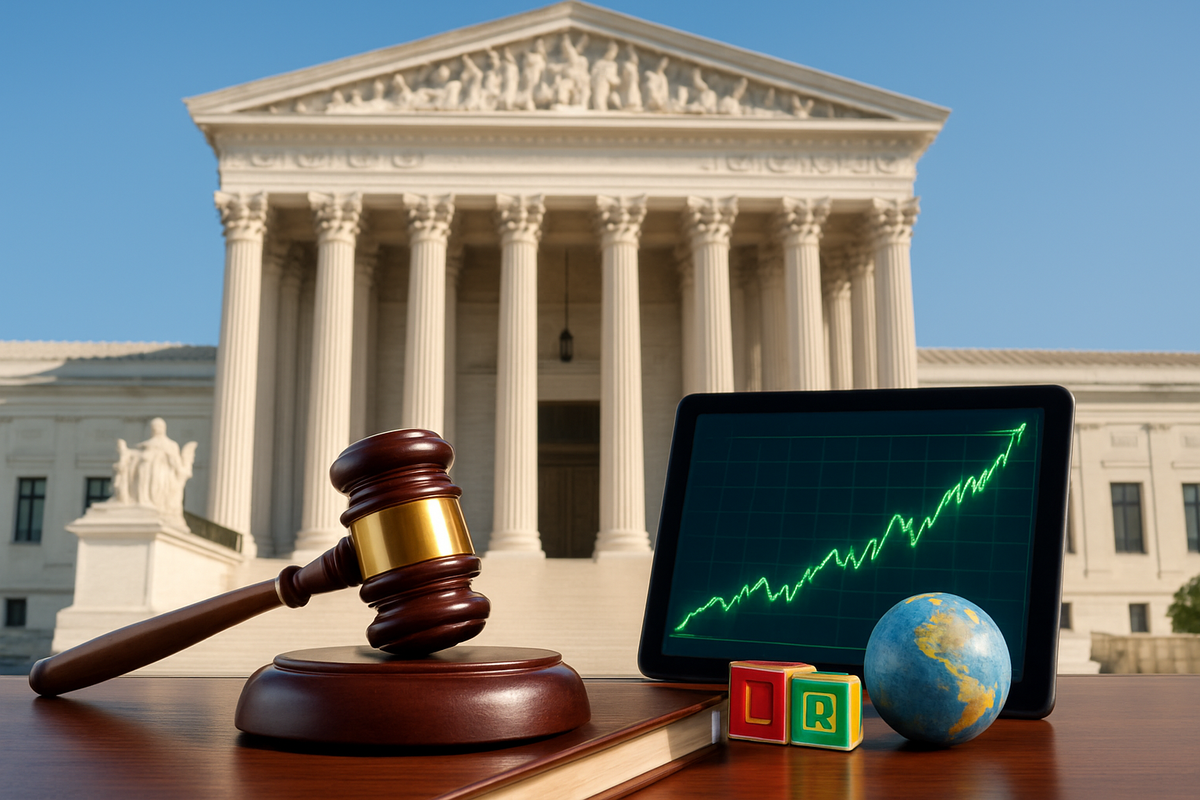
In a monumental decision that has sent shockwaves through global capitals and Wall Street trading floors, the Supreme Court ruled 6-3 on February 20, 2026, that the President cannot use the International Emergency Economic Powers Act (IEEPA) to unilaterally impose global tariffs. The case, Learning Resources, Inc. v. Trump, effectively dismantles the administration’s primary legal mechanism for its aggressive "reciprocal" trade policy, potentially forcing the U.S. Treasury to refund upwards of $200 billion in duties collected over the past year.
The ruling triggered an immediate and massive relief rally across risk assets, with the S&P 500 and Nasdaq posting their strongest three-day gains since 2023. Investors are betting that the judicial check on executive trade authority will lower costs for multinational corporations and ease the inflationary pressures that have dogged the economy. However, the victory for importers was tempered by the President’s swift pivot to Section 122 of the Trade Act of 1974, signaling that while the legal battlefield has shifted, the era of protectionism is far from over.
The End of the IEEPA "Blank Check"
The Supreme Court’s 6-3 decision, authored by Chief Justice John Roberts, centered on the interpretation of "regulating importation" under IEEPA. For decades, IEEPA was viewed as a tool for targeted economic sanctions—blocking the assets of terrorists or rogue states. However, the current administration argued that the law’s broad language allowed for the imposition of sweeping global tariffs under the guise of a national economic emergency. The Court emphatically rejected this view, citing the "Major Questions Doctrine" and the Constitution's Vesting Clause, which grants the "power to lay and collect taxes, duties, imposts and excises" exclusively to Congress.
The legal saga began in early 2025 when Learning Resources, Inc., a family-owned educational toy manufacturer, challenged the administration after their projected annual tariff costs ballooned from $2.3 million to over $100 million. The company argued that the President was bypassing the legislative branch to exercise a taxing power that IEEPA was never intended to delegate. The majority opinion noted that allowing a President to impose unlimited tariffs via a declared emergency would "eviscerate the separation of powers" and render congressional oversight of trade policy moot.
The dissenting justices, led by Justice Clarence Thomas, argued that the executive requires "maximum flexibility" to address modern economic threats, including trade imbalances and fentanyl precursors. Despite the dissent, the ruling was seen as a decisive victory for the rule of law over executive overreach. The immediate market reaction saw the CBOE Volatility Index (VIX) plummet by 15%, while treasury yields dipped as the market priced in a less aggressive inflationary environment.
Winners and Losers: Retail and Tech Breathe a Sigh of Relief
The primary beneficiaries of the ruling are heavy importers and multinational corporations that have been squeezed by rising input costs. Retail giants such as Walmart Inc. (NYSE: WMT) and Target Corp. (NYSE: TGT) saw their shares surge by 6% and 8% respectively following the news. For these companies, the prospect of $200 billion in tariff refunds represents a significant liquidity injection that could be used for stock buybacks or to mitigate consumer price hikes.
The technology sector also saw a substantial bounce. Apple Inc. (NASDAQ: AAPL), which manages a complex global supply chain, and Amazon.com, Inc. (NASDAQ: AMZN), which hosts thousands of third-party sellers reliant on imported goods, both traded significantly higher. Analysts at Goldman Sachs suggested that the ruling could add as much as $1.50 to the annual earnings per share for major consumer electronics firms. Logistics and shipping firms like FedEx Corp. (NYSE: FDX) also benefited, as the ruling suggests a stabilization—or at least a predictable ceiling—on trade costs, encouraging higher shipping volumes.
Conversely, the ruling is a blow to domestic manufacturers who have sought protection from foreign competition. Companies like Nucor Corp. (NYSE: NUE) and United States Steel Corp. (NYSE: X) saw their share prices soften as the "protective wall" of IEEPA tariffs began to crack. While these companies still benefit from other trade protections, the loss of the IEEPA "emergency" mechanism removes a potent, fast-acting tool the administration used to shield domestic industries from price fluctuations.
A Watershed Moment for Constitutional Trade Law
The Learning Resources decision fits into a broader trend of the federal judiciary reclaiming authority from the administrative state. By invoking the Major Questions Doctrine, the Supreme Court has signaled that "vast economic and political" shifts, such as global trade restructuring, cannot be achieved through creative interpretations of old statutes. This mirrors recent rulings that have limited the power of agencies like the EPA and the SEC, reinforcing a strict interpretation of Article I powers.
The ripple effects extend far beyond the $200 billion in potential refunds. The ruling effectively forces a reset in trade diplomacy. Partners in Europe and Asia, who had been bracing for a new round of IEEPA-based "reciprocity" tariffs, are now looking at a more constrained U.S. executive. This may provide a window for new trade negotiations, though any new agreements would likely require the direct involvement and approval of a divided Congress, adding a layer of political complexity that the administration had hoped to avoid.
Historically, this case draws comparisons to the 1970s, when the courts and Congress wrestled with President Nixon’s use of the Trading with the Enemy Act to impose a 10% import surcharge. Just as that era led to the Trade Act of 1974 to limit executive overreach, the Learning Resources ruling is expected to trigger a new wave of legislative proposals aimed at clarifying exactly how much power a President should have to handle "economic emergencies."
The Pivot to Section 122: A New Battleground
While the IEEPA route is closed, the trade war has merely changed venues. Within hours of the ruling, the President announced the invocation of Section 122 of the Trade Act of 1974. This "Balance of Payments" authority allows the President to impose a temporary 15% surcharge on imports for up to 150 days to address a serious deficit. This pivot is a strategic adaptation designed to keep the administration's trade agenda alive while respecting the letter of the SCOTUS ruling.
However, Section 122 comes with significant strings attached. Unlike IEEPA, which the administration treated as indefinite, Section 122 is strictly time-limited. After 150 days, the tariffs must expire unless Congress votes to extend them. Furthermore, legal experts are already questioning whether a "trade deficit" in specific goods qualifies as a "balance of payments" emergency under the statute’s original intent. This sets the stage for a new round of litigation and a looming "fiscal cliff" for trade policy in late 2026.
Investors should prepare for a period of "provisional peace." While the immediate $200 billion refund process will be a boon for corporate balance sheets, the 150-day clock on Section 122 tariffs creates a new deadline for market volatility. The strategic pivot means that the administration will likely focus on extracting concessions from trading partners quickly before their legal authority expires, potentially leading to a flurry of "mini-deals" by the end of the year.
Closing the Chapter on "Emergency" Tariffs
The Learning Resources, Inc. v. Trump decision will be remembered as the moment the judiciary reasserted its role as the final arbiter of trade authority. By stripping the executive of its most potent trade weapon, the Court has forced the administration back to the negotiating table—and back to Congress. The immediate market rally reflects a belief that the "wild west" era of tariff-by-tweet is coming to an end, replaced by a more predictable, if still contentious, legal framework.
Moving forward, the market will be hyper-focused on the 150-day countdown for Section 122 and the logistics of the tariff refund process. Investors should watch for the Treasury Department's guidance on how companies can claim their portions of the $200 billion. For the broader market, the ruling reduces the "tail risk" of an unchecked trade war, but it also ensures that trade will remain the central political and economic issue of 2026.
As we move into the spring, the focus will shift to Capitol Hill. With the President’s trade powers now on a short 150-day leash, the burden of proof has shifted. The administration must now convince a skeptical Congress and a newly empowered judiciary that its trade interventions are not just necessary, but legally sound.
This content is intended for informational purposes only and is not financial advice.