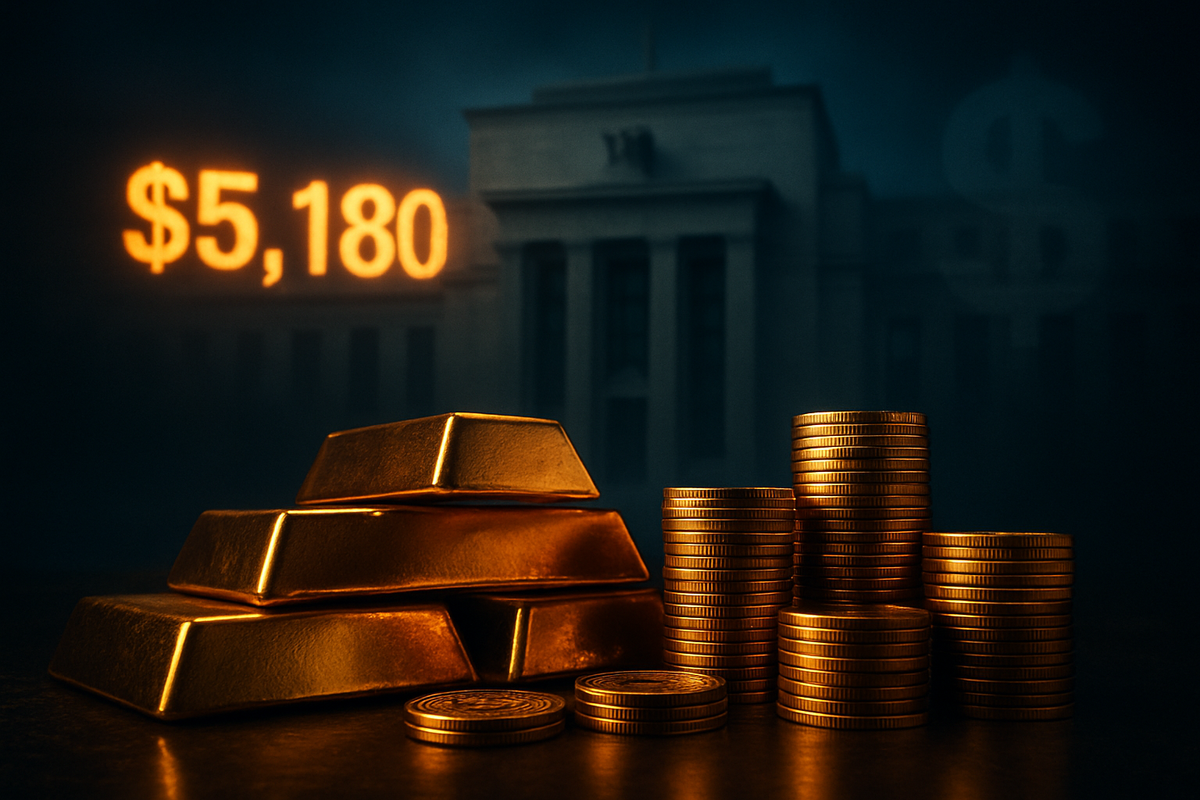
As of late February 2026, the global financial landscape is witnessing a historic decoupling of traditional market correlations. Gold prices have decisively shattered the psychological $5,000 per ounce barrier, trading near $5,180 as investors seek refuge from a perfect storm of geopolitical instability and a direct challenge to the independence of the U.S. central bank. Despite intense and often personal pressure from the executive branch to slash borrowing costs, the Federal Reserve has maintained its target interest rate at 3.5% to 3.75%, signaling a firm stance against "sticky" inflation that threatens to derail the long-awaited economic "soft landing."
This "higher-for-longer" reality, which would traditionally bolster the U.S. dollar and suppress non-yielding assets like precious metals, is currently having the opposite effect. While expectations for an early 2026 round of monetary easing have weakened, gold continues to be buoyed by a massive "risk premium" driven by the perceived politicization of the Federal Reserve. The safe-haven demand is no longer just a hedge against inflation; it has become a hedge against the institutional stability of the U.S. monetary system itself.
The Fed's High-Stakes Hold: A Timeline of Resistance
The Federal Reserve's current posture is the culmination of a volatile 18-month cycle. After a brief easing period in late 2025, where the Federal Open Market Committee (FOMC) delivered three consecutive 25-basis-point cuts, the central bank hit the brakes in January 2026. The decision to hold rates at 3.5%–3.75% came as a shock to markets that had priced in a "stimulus spring." Fed Chair Jerome Powell, whose term is set to expire in May 2026, has maintained that while inflation has stabilized near 2.5%, new tariff policies and fiscal expansion have introduced fresh upward pressure on prices.
The tension reached a boiling point in early February 2026, following months of public attacks on Fed officials. Throughout 2025, the central bank faced unprecedented scrutiny, including a high-profile legal battle over the attempted removal of Fed Governor Lisa Cook and frequent social media broadsides from the White House calling for rates to be slashed to 1%. By holding firm in February, the Fed has signaled that it will not be bullied into premature easing, even as the nomination of Kevin Warsh to succeed Powell introduces new uncertainty about the central bank’s future hawkishness.
Initially, markets reacted with a sharp sell-off in equities, as the "cheap money" narrative for 2026 evaporated. However, the reaction in the commodities sector was the inverse. Gold, which had already been climbing on de-dollarization trends, saw a "flight to quality" as the standoff between the Fed and the White House heightened fears of a constitutional crisis over monetary policy. The result was a decisive break above the $5,000 mark, a level once considered a far-fetched "gold bug" fantasy.
Mining Titans Reap the Rewards of the 'Golden Age'
The primary beneficiaries of this price surge are the major bullion producers, who are seeing profit margins expand to record levels. Newmont Corporation (NYSE: NEM) has emerged as a powerhouse in this environment, with its stock price surging over 150% since the start of 2025. Despite a planned production dip for 2026 as the company sequences its higher-grade ore, Newmont's All-In Sustaining Costs (AISC) remain near $1,500 per ounce. At a spot price of $5,000+, the company is generating unprecedented free cash flow, allowing for aggressive dividend hikes and debt reduction.
Similarly, Barrick Gold (NYSE: GOLD) has seen its valuation catch up to its peers, trading at approximately 12.5x forward earnings as its "Tier One" assets in Nevada and Pakistan's Reko Diq project come online. Analysts view Barrick as a significant winner in the current climate, as its diversified geographic footprint offers a hedge against the domestic U.S. political volatility that is driving the gold rally. For retail and institutional investors unable to manage the operational risks of individual miners, the SPDR Gold Shares (ETF: GLD) has seen record-breaking inflows, with its assets under management crossing the $180 billion threshold in February 2026.
Conversely, the "losers" in this scenario include the traditional regional banking sector and heavily indebted mid-cap tech firms. Companies that relied on the promise of 2% interest rates by mid-2026 are now facing a reality where capital remains expensive. The persistent strength of gold suggests that the market does not believe the Fed can keep rates this high indefinitely without breaking something in the financial system, leading to a "wait-and-see" approach that has paralyzed M&A activity in many sectors.
A Structural Shift: The Weakening of Dollar Dominance
The wider significance of gold’s $5,000 breakthrough lies in the erosion of the U.S. dollar’s dominance as the primary driver of the "risk premium." Historically, gold and the dollar moved in a reliable inverse relationship. In early 2026, however, this correlation has fractured. The dollar remains relatively strong against a basket of currencies like the Euro and Yen, yet gold continues to rise. This suggests that investors are moving into gold not because they fear the dollar will lose value against other fiat currencies, but because they fear all fiat currencies are becoming increasingly subject to political whim.
This trend mirrors the "Great Inflation" of the 1970s but with a modern, populist twist. The "politicization" of the Fed has triggered a scarcity loop; as the public's trust in the central bank's independence wavers, the demand for "hard" assets increases, which in turn fuels inflation expectations, making it even harder for the Fed to lower rates. This feedback loop has effectively neutered the dollar's ability to suppress gold prices, as the metal is now priced as a "geopolitical insurance policy."
Furthermore, the rise of gold is a reflection of broader industry trends toward "real asset" allocation. Central banks in the Global South, led by China and India, have continued their relentless accumulation of gold reserves throughout 2025 and into 2026, seeking to insulate their economies from potential U.S. sanctions or currency instability. This institutional floor has provided the foundation for gold's current rally, ensuring that any temporary dips in price are met with aggressive buying from sovereign entities.
What Lies Ahead: The 'Warsh Pivot' and the May Deadline
The short-term outlook for the market is dominated by the upcoming leadership transition at the Federal Reserve. With Jerome Powell’s term ending in May 2026, all eyes are on the confirmation hearings for Kevin Warsh. If Warsh is perceived as a candidate who will prioritize political alignment over price stability, gold could see a further "credibility gap" rally, with some analysts at Citi and Morgan Stanley projecting a run toward $6,000 by the fourth quarter of 2026.
Strategic pivots are already underway in the corporate world. Large-cap companies are increasingly looking to move away from variable-rate debt, fearing that the "higher-for-longer" regime is now a permanent fixture of the late-2020s economy. Meanwhile, the gold mining sector is expected to enter a period of aggressive consolidation. With mid-tier miners struggling to fund exploration at current interest rates, giants like Newmont and Barrick may use their massive cash reserves to acquire smaller rivals, further centralizing the production of the world’s most sought-after metal.
However, a potential scenario exists where gold could face a sharp correction. If the Fed successfully navigates the leadership transition without losing its independence, and if the 2026 tariff impacts prove to be transitory, a "normalization" of interest rates could eventually take the steam out of the gold rally. Investors should be prepared for extreme volatility, as any sign of the Fed "blinking" in the face of political pressure will likely send gold higher, while any definitive victory for central bank independence could trigger a massive "risk-on" rotation back into equities and bonds.
The Bottom Line for Investors
The break above $5,000 for gold marks a historic shift in the global financial order. It represents a vote of no confidence in the ability of traditional monetary policy to remain insulated from the populist pressures of the 2020s. For the Federal Reserve, the current "hold" at 3.5%–3.75% is a desperate attempt to maintain its reputation as an independent arbiter of the economy, even as it becomes the primary target of political vitriol.
Moving forward, the market will remain in a state of high tension. The "Golden Age" for producers like Newmont Corporation (NYSE: NEM) and Barrick Gold (NYSE: GOLD) appears set to continue as long as the political cloud over the Eccles Building remains. However, the true test will come in May 2026. Investors should watch the Fed leadership transition and inflation data with equal intensity; any deviation from the Fed’s current path could be the catalyst for the next $1,000 move in gold—in either direction.
This content is intended for informational purposes only and is not financial advice.