In a resounding vote of confidence for the retail and cloud giant, Bank of America Corp (NYSE: BAC) has officially reiterated its "Buy" rating on Amazon.com Inc. (NASDAQ: AMZN), designating the company as a "top pick" for the 2026 fiscal year. The endorsement comes at a pivotal moment as Amazon pivots from a heavy infrastructure-building phase into a period of aggressive AI monetization. Analysts at the firm have set a bullish price target of $303, citing a significant re-acceleration in Amazon Web Services (AWS) revenue and the rapid enterprise adoption of the company's proprietary 'Trainium' and 'Inferentia' AI chips as the primary catalysts for near-term growth.
The immediate implications of this rating are clear: Wall Street is increasingly viewing Amazon not just as an e-commerce leader, but as a vertically integrated AI powerhouse capable of challenging the hardware dominance of traditional semiconductor firms. With AWS revenue growth climbing back to 24% year-over-year in the most recent quarter, the narrative surrounding the company has shifted from one of "playing catch-up" in the generative AI race to one of structural advantage. Investors are now closely watching how Amazon’s massive $200 billion capital expenditure plan for 2026 will further widen its lead in the cloud infrastructure market.
The AWS Inflection Point and the Silicon Shift
The core of the Bank of America thesis rests on the performance of AWS, which has seen a dramatic turnaround over the past twelve months. Following a period of relative stagnation in 2024 and early 2025, AWS reported a staggering $244 billion backlog in early 2026—a 40% increase from the previous year. This surge is largely attributed to the successful rollout of the 'Nova 2' model family and the 'Bedrock' platform, which have simplified the deployment of agentic AI workflows for enterprise clients. Leading this charge is a newly unified AI organization under Peter DeSantis, who was appointed in late 2025 to merge the company’s AGI research, custom silicon, and quantum computing divisions.
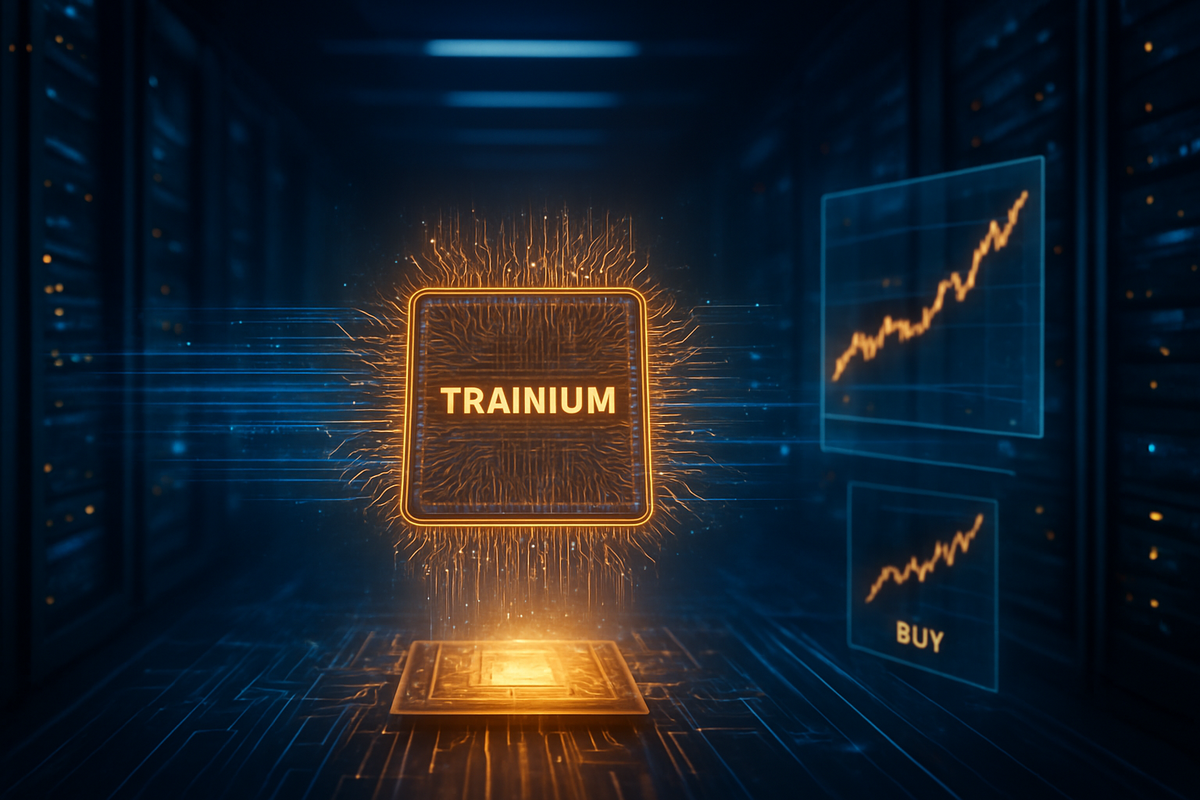
The timeline leading to this buy-rating reiteration is marked by Amazon’s strategic shift toward custom hardware. While competitors were scrambling for allocations of high-end GPUs from NVIDIA (NASDAQ: NVDA), Amazon doubled down on its own 'Trainium 2' and 'Trainium 3' chips. By late 2025, Trainium 2 reached full subscription, and the subsequent launch of Trainium 3 provided a 4.4x increase in compute performance over its predecessor. This hardware enables AWS to offer AI training and inference at a price-performance ratio that is roughly 40% better than standard industry benchmarks, making it the preferred choice for cost-conscious tech giants like Anthropic.
Market reaction to the BofA report has been overwhelmingly positive, with Amazon shares seeing renewed institutional interest. The report highlights that while the stock underperformed for much of 2025, the compression of its valuation multiples has created an ideal entry point. Analysts point to the "Project Rainier" deployment—a cluster of over 500,000 Trainium chips created for Anthropic—as the definitive proof of concept that Amazon can successfully decouple its growth from the broader GPU supply chain.
Winners and Losers in the Custom Silicon Era
The primary winner in this evolving landscape is undoubtedly Amazon.com Inc. (NASDAQ: AMZN). By controlling the entire stack—from the silicon (Trainium) to the infrastructure (AWS) and the application layer (Rufus and Bedrock)—Amazon is capturing margins that were previously ceded to hardware vendors. Furthermore, strategic partners like Anthropic stand to benefit immensely, gaining access to massive compute clusters at a fraction of the market rate, which accelerates their own model development against rivals like OpenAI.
Conversely, the rise of Trainium poses a long-term strategic challenge to NVIDIA (NASDAQ: NVDA). While NVIDIA remains the gold standard for raw performance, the "good enough" performance and superior cost-efficiency of Amazon’s custom chips are beginning to erode NVIDIA’s pricing power within the cloud ecosystem. Similarly, Microsoft (NASDAQ: MSFT) and Alphabet Inc. (NASDAQ: GOOGL) find themselves in an intensified arms race. While Microsoft’s 'Maia 200' and Google’s 'TPU v7 Ironwood' are formidable, Amazon’s deeper integration of AI into its massive retail operations provides a unique data flywheel that its cloud-only competitors lack.
Smaller cloud providers and pure-play hardware distributors may find themselves as the secondary "losers" in this scenario. As the "Big Three" cloud providers move toward vertical integration, the barrier to entry for new infrastructure players becomes nearly insurmountable. For these smaller firms, the cost of developing custom silicon is prohibitive, forcing them to remain dependent on third-party hardware that carries higher operational costs.
Broadening the AI Horizon: Industry and Policy Trends
Amazon’s current trajectory fits into a broader industry trend toward "agentic AI"—systems that do not just generate text but execute complex, multi-step tasks. The BofA report specifically highlights 'Rufus,' Amazon's AI shopping assistant, as a precursor to a "full agentic" retail experience. This shift represents a move away from simple chatbots toward autonomous digital agents capable of managing logistics, travel, and personal finance. This evolution is mirrored across the industry as companies seek to move beyond the "hype phase" of generative AI into practical, revenue-generating applications.
This movement toward vertical integration—where a single company owns the chip, the cloud, and the software—is also likely to draw increased regulatory scrutiny. Policymakers in the U.S. and EU are already examining the competitive advantages inherent in "self-preferencing" within cloud ecosystems. If Amazon continues to prioritize its own hardware for its most popular AI services, it may face antitrust inquiries similar to those seen in the early days of the Microsoft Windows era. However, the historical precedent set by the semiconductor industry suggests that such innovation is rarely slowed by regulation in its early stages, especially when it results in lower costs for consumers.
Furthermore, the scale of Amazon’s $200 billion capital expenditure plan for 2026 is unprecedented. This level of investment is reshaping global energy markets and data center construction. The ripple effects are being felt by utility companies and green energy providers, who are now key stakeholders in Amazon’s ability to power its burgeoning "AI-first" infrastructure.
The Path Forward: 2026 and Beyond
Looking ahead, the short-term focus for Amazon will be the successful deployment of 'Trainium 4,' which is rumored to feature support for NVIDIA’s NVLink. This would allow for "hybrid clusters" that combine the cost-efficiency of Amazon’s chips with the raw power of NVIDIA’s networking technology. Such a strategic pivot would represent a "best of both worlds" scenario, potentially neutralizing the threat of supply constraints while maintaining high performance for the most demanding AI models.
In the long term, the market will be watching for the full integration of AI agents across the Amazon ecosystem. The transition of the Amazon retail site from a search-based platform to an agent-led platform could redefine digital commerce. The primary challenge will be the "supply-constrained" nature of the current market. As CEO Andy Jassy noted, AWS is currently selling capacity as fast as it can build it. The success of the next two years depends entirely on Amazon’s ability to execute its massive construction and silicon manufacturing roadmap without significant delays.
Final Assessment: The Investor’s Watchlist
The reiteration of the "Buy" rating by Bank of America serves as a reminder that the AI revolution is moving into its second, more mature act. The key takeaways for investors are clear: AWS is back on a high-growth trajectory, and custom silicon is the engine driving that growth. Amazon’s vertical integration strategy is providing a blueprint for how a legacy tech giant can reinvent itself as an AI-native organization.
As we move through 2026, investors should keep a close watch on AWS operating margins, which are expected to expand as more workloads migrate to Trainium and Inferentia. Additionally, any updates regarding the "Project Rainier" partnership with Anthropic will serve as a bellwether for the broader adoption of non-NVIDIA hardware. While the journey is capital-intensive and fraught with competitive and regulatory risks, Amazon’s current momentum suggests it is well-positioned to remain the dominant force in the cloud-AI era for the foreseeable future.
This content is intended for informational purposes only and is not financial advice.