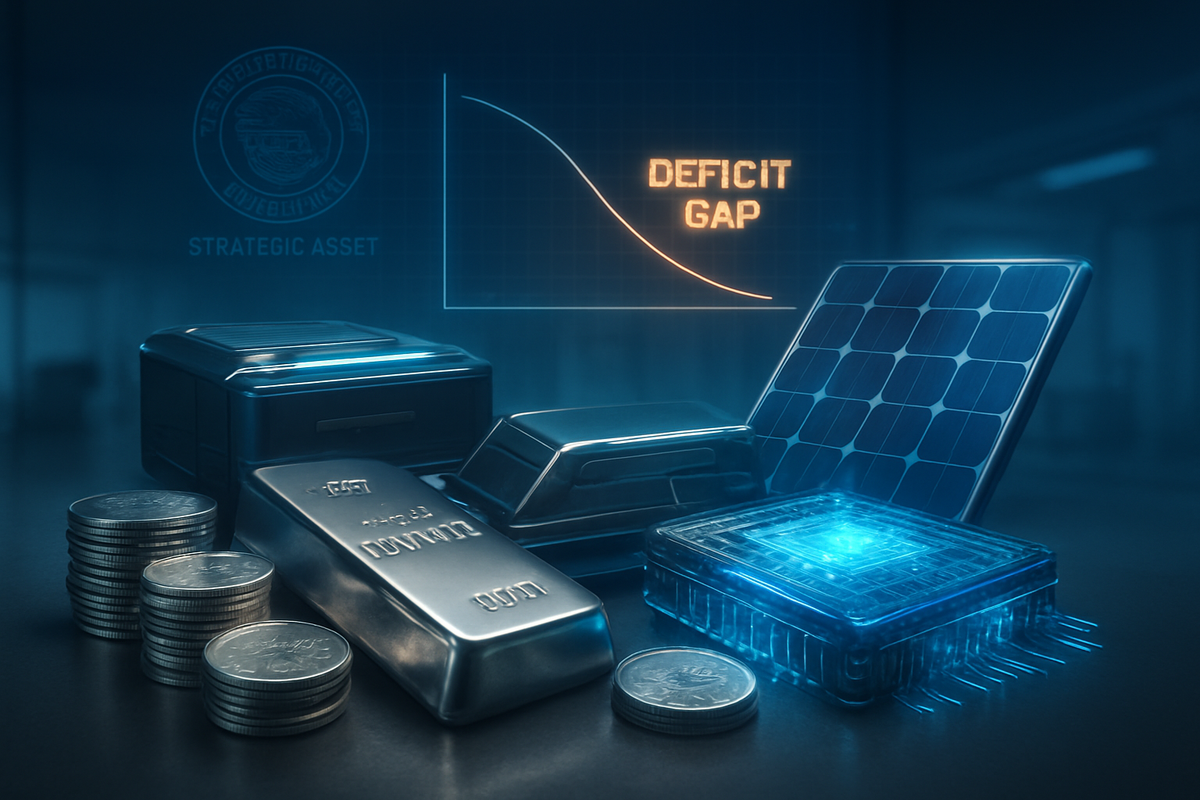
As of early February 2026, the global silver market has officially transitioned from a speculative precious metal into one of the world's most vital industrial commodities. Following a landmark decision by the U.S. Geological Survey (USGS) to add silver to its Critical Minerals List (CML), the metal has gained a new status as a "Strategic Asset." This reclassification comes at a time when the market is grappling with a staggering 95-million-ounce structural deficit—the sixth consecutive year where demand has outpaced mine production—driven by the relentless expansion of the green energy sector and the burgeoning infrastructure requirements of Artificial Intelligence.
The immediate implications are profound for both national security and global trade. By designating silver as a critical mineral, the U.S. government has signaled that the metal is essential to the economic and national security of the country and that its supply chain is vulnerable to disruption. This shift has already begun to trigger a wave of policy changes, ranging from fast-tracked domestic mining permits to potential federal stockpiling initiatives, as the race to secure silver supplies intensifies among the world's leading industrial powers.
The Path to Criticality: A Timeline of Silver’s Reclassification
The journey to silver's strategic designation reached its climax in November 2025, when the USGS finalized its triennial update to the Critical Minerals List. The decision was not merely a reaction to high prices but the result of a rigorous "economic model assessment" that factored in silver’s irreplaceable role in high-tech manufacturing and the significant supply risks posed by geopolitical instability. While silver has historically been viewed as a byproduct of lead, zinc, and copper mining, the USGS recognized that the metal's unique electrical and thermal conductivity makes it a "single-point-of-failure" material for the 21st-century economy.
The timeline of this escalation was accelerated by global trade tensions. In early January 2026, China—a major refiner and consumer of the metal—implemented strict export licensing on silver, citing "national strategic necessity." This move mirrored previous restrictions on gallium and germanium, effectively forcing the U.S. and its allies to prioritize domestic and North American production. The U.S. Department of Defense and Department of Energy have since pivoted to treat silver with the same level of urgency as lithium or rare earth elements, unlocking new federal grants for silver-focused exploration and processing.
Market reaction has been swift. Since the USGS announcement, institutional investors have increasingly treated silver as an industrial "tech play" rather than a mere hedge against inflation. Industrial consumers, particularly in the solar and automotive sectors, are no longer buying on the spot market but are instead seeking long-term "offtake agreements" directly with miners to ensure their assembly lines do not go dark. This shift has fundamentally changed the pricing mechanics of the metal, decoupling it from the traditional "gold-silver ratio" and linking it more closely to industrial production indices.
First Majestic Silver Leads the Charge in a Deficit Era
In this environment of scarcity, First Majestic Silver (NYSE: AG) has emerged as a primary beneficiary of the strategic pivot. The company, which has long championed the value of silver as an industrial powerhouse, is reaping the rewards of its aggressive expansion strategy. For the 2026 fiscal year, First Majestic has issued a robust production guidance of 13.0 to 14.4 million silver ounces. This projection is bolstered by the successful integration of the Cerro Los Gatos mine in Chihuahua, Mexico, which the company acquired in early 2025 for approximately $970 million.
The acquisition of Gatos Silver—formerly Gatos Silver, Inc. (NYSE: GATO) before its integration—has proven to be a "needle-moving" event for the company's portfolio. First Majestic now holds a 70% interest in the Los Gatos Joint Venture, a high-grade, long-life asset that has significantly lowered the company’s consolidated All-In Sustaining Costs (AISC) to an estimated $26.15 to $27.91 per ounce. By adding one of the world's premier primary silver mines to its existing Mexican operations, First Majestic has positioned itself as the dominant pure-play silver producer in North America, a region now favored by U.S. policymakers seeking "friend-shoring" of critical minerals.
Furthermore, First Majestic has capitalized on the silver bull market by implementing a shareholder-friendly capital return program. Starting January 1, 2026, the company doubled its quarterly dividend policy from 1% to 2% of net quarterly revenues. This move is designed to provide investors with direct leverage to the rising price of silver. Notably, the dividend calculation for the Los Gatos mine is based on the 70% revenue portion attributable to First Majestic, ensuring the policy is both aggressive and sustainable. With the first payout under this new 2% policy scheduled for May 2026, the company is effectively signaling its confidence in a sustained high-price environment.
The Triple Threat: Solar, EVs, and the AI Revolution
The 95-million-ounce deficit that defined the market at the start of 2026 is the direct result of a "Triple Threat" of industrial demand sources. First, the solar energy sector has undergone a massive technological shift. The industry has largely transitioned to TOPCon (Tunnel Oxide Passivated Contact) and HJT (Heterojunction) solar cells, which require significantly higher silver "loading" than older technologies. With global solar installations reaching record highs in late 2025, the photovoltaic sector now consumes nearly 300 million ounces of silver annually, effectively devouring nearly a third of all global mine supply.
Second, the transition to electric vehicles (EVs) has reached a tipping point. Every modern EV contains between 25 and 50 grams of silver—nearly double the amount found in traditional internal combustion engine vehicles. Silver is critical for everything from power electronics and battery management systems to the intricate sensors required for autonomous driving. By 2026, automotive silver demand has become a permanent floor for the market, as manufacturers prioritize silver's unmatched conductivity to maximize battery efficiency and charging speeds.
Finally, the newest and perhaps most aggressive driver of demand is the explosion of Artificial Intelligence and data center infrastructure. Silver’s electrical conductivity is essential for the high-performance semiconductors and dense connector networks that power AI-specialized servers. As tech giants race to build out massive data centers to support generative AI models, the demand for silver in cooling systems and high-speed connectors has surged. This "AI demand" was the wild card that pushed the market into its current 95-million-ounce shortfall, as it grew faster than even the most optimistic analysts predicted in previous years.
Looking Ahead: Permitting Reform and Supply Realities
The short-term outlook for the silver market is characterized by a scramble for supply. With the USGS Critical Mineral designation, we expect to see a surge in "fast-track" permitting for silver-rich projects across the United States and Canada. This regulatory shift could breathe new life into dormant projects, though the lead time for bringing a new mine online remains 7 to 10 years, meaning the current deficit is unlikely to be resolved by new supply in the immediate future.
Strategically, the industry may see a move toward "vertical integration," where large technology and automotive companies take direct equity stakes in silver mining companies to secure their supply chains. We may also see the emergence of national silver stockpiles, similar to the Strategic Petroleum Reserve, as governments realize that a lack of silver could paralyze their energy transition and defense capabilities. For companies like First Majestic, this provides a powerful negotiating position, as they control the very molecules required for the modern world to function.
Market Wrap-Up and Investor Outlook
The 2026 reclassification of silver as a Strategic Asset marks the end of an era for the metal. No longer just a "poor man's gold," silver is now the indispensable backbone of the green and digital revolutions. The combination of a 95-million-ounce deficit, a sixth year of structural shortfall, and the inclusion on the USGS Critical Minerals List has created a fundamental floor for silver prices that the market has never seen before.
Investors should closely watch the first-quarter 2026 earnings reports, particularly from pure-play producers like First Majestic Silver (NYSE: AG), to see how the increased dividend policy and the Los Gatos integration impact the bottom line. Moving forward, the key metrics to monitor will be industrial inventory levels and any further export restrictions from major producers like China or Peru. In a world where AI, EVs, and Solar are non-negotiable, silver has become the most critical "missing link" in the global supply chain.
This content is intended for informational purposes only and is not financial advice.