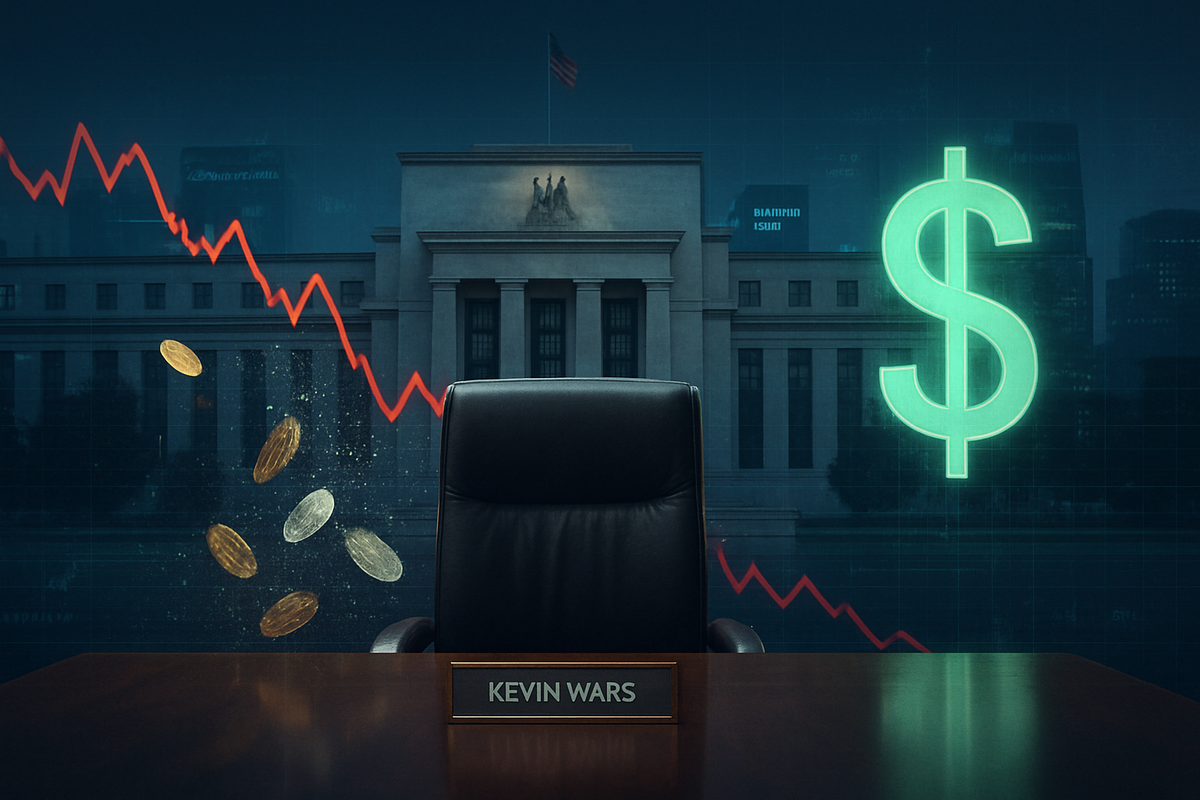
The financial world is currently navigating the "Warsh Shock," a period of intense market recalibration following President Donald Trump’s nomination of Kevin Warsh as the next Chairman of the Federal Reserve on January 30, 2026. As the successor to Jerome Powell, Warsh represents a dramatic shift in monetary philosophy, moving the central bank toward a regime that prioritizes a smaller balance sheet and a more deregulatory stance. The immediate aftermath has seen a sharp "de-risking" across global asset classes, as investors scramble to price in a Fed that may look fundamentally different from any seen in the post-2008 era.
The implications of this nomination extend far beyond simple interest rate adjustments. Warsh, a former Fed Governor and Morgan Stanley executive, is widely viewed as a "hawkish dove"—a unique blend of a critic of central bank interventionism and a proponent of pro-growth, low-rate policies fueled by technological advancement. His arrival has already triggered a "flash crash" in precious metals and a significant strengthening of the U.S. Dollar, signaling that the "liquidity-at-any-cost" era may be coming to a definitive end.
The Timeline of a "Warsh Shock"
The transition began in earnest on January 29, 2026, when rumors of the nomination first leaked, causing an immediate spike in Treasury yields. By the time the official announcement was made on January 30, the markets were already in a tailspin. Gold prices plummeted by more than 10% in a single day, while silver saw an even more dramatic 30% sell-off. This was not merely a reaction to potential rate hikes, but a wholesale unwinding of the "currency debasement" trade that had protected investors against years of quantitative easing (QE).
As the news settled, the global impact became clear. On February 2, 2026, the South Korean Kospi index dropped 5.3%, reflecting fears that a more aggressive Fed balance sheet reduction would drain dollar liquidity from emerging markets. Within the U.S., the nomination has faced immediate political friction. Senator Thom Tillis (R-N.C.) and other members of the Senate Banking Committee have signaled they may delay the confirmation process until ongoing investigations into the current Fed leadership are resolved. This political gridlock has only added to the atmosphere of uncertainty, keeping market volatility indicators like the VIX at elevated levels as of February 5.
Winners and Losers in the New Regime
The "Warsh era" promises to be a boon for the nation's largest financial institutions. JPMorgan Chase & Co. (NYSE: JPM), The Goldman Sachs Group, Inc. (NYSE: GS), and Wells Fargo & Company (NYSE: WFC) are poised to benefit from Warsh’s stated desire to "privatize quantitative easing." His proposal involves easing banking regulations to allow private commercial banks to absorb assets currently held on the Fed's $6.6 trillion balance sheet. This deregulation, coupled with skepticism toward the "Basel III endgame" capital requirements, has turned bank stocks into a rare bright spot in the current market sell-off.
Conversely, the "losers" list is extensive, led by the precious metals sector. Mining giants like Newmont Corporation (NYSE: NEM), Pan American Silver Corp. (NASDAQ: PAAS), and Gold Fields Limited (NYSE: GFI) have seen their valuations crater as the narrative shifts away from hedging against inflation. High-growth technology stocks have also felt the heat; Apple Inc. (NASDAQ: AAPL), Microsoft Corp. (NASDAQ: MSFT), and Meta Platforms, Inc. (NASDAQ: META) have been pressured by rising long-term bond yields, which discount the value of future earnings. Furthermore, high-leverage fintech firms like Robinhood Markets, Inc. (NASDAQ: HOOD) and AppLovin Corp. (NASDAQ: APP) are facing a "liquidity drain" as the Fed prepares to shrink its footprint.
A Bet on AI and a Breach of Independence
The wider significance of Warsh’s nomination lies in his "productivity bet." Much like Alan Greenspan in the late 1990s, Warsh argues that AI-driven productivity gains act as a powerful disinflationary force. This perspective allows him to advocate for lower interest rates—aligning with the Trump administration’s preferences—while simultaneously demanding a drastic reduction in the Fed’s balance sheet. It is a high-stakes experiment: can the economy grow at a rapid clip with cheap money if the central bank is no longer providing the underlying liquidity through asset purchases?
Furthermore, Warsh has floated the idea of a "New Treasury-Fed Accord," similar to the 1951 agreement that ended the Fed’s obligation to peg interest rates for the Treasury. However, critics fear this new version might do the opposite, more explicitly coordinating government financing with monetary policy and potentially compromising the Fed's traditional independence. This shift mirrors broader industry trends toward "fiscal dominance," where central bank actions are increasingly dictated by the needs of government debt management. Historically, such transitions are rarely smooth; leadership changes under Ben Bernanke in 2006 and Jerome Powell in 2018 were both marked by significant market drawdowns—5% to 16%—within the first six months.
Navigating the Path to Confirmation
In the short term, investors must brace for continued volatility as the Senate confirmation hearings begin. The primary strategic pivot for many firms will be moving away from "liquidity-sensitive" assets and toward "regulatory-sensitive" ones. If Warsh is successfully confirmed, we could see a massive migration of capital into the banking sector and a continued exodus from safe-haven assets like gold. The "carry trade" in emerging markets may also face further stress as the U.S. Dollar remains the dominant, high-yield choice for global investors.
Long-term, the market will be watching for the first signs of the "privatized QE" model. If commercial banks are able to successfully take over the Fed's role in the bond market without causing a systemic credit crunch, it could lead to a more resilient, private-sector-led financial system. However, the risk of a "liquidity hole" remains high. If the Fed retreats too quickly and the private sector cannot fill the void, the result could be a sharp spike in borrowing costs that stalls the very AI-driven growth Warsh is betting on.
Summary and Investor Outlook
The nomination of Kevin Warsh represents a fundamental challenge to the monetary status quo. While his pro-growth stance and belief in AI productivity offer a glimmer of optimism for equity bulls, his commitment to shrinking the Fed's balance sheet has introduced a level of volatility not seen in years. The "Warsh Shock" has already reshaped the landscape for precious metals and tech, while offering a potential renaissance for major banking institutions.
As we move deeper into 2026, investors should keep a close eye on the Senate Banking Committee and any rhetoric regarding the "New Treasury-Fed Accord." The transition period for a new Fed Chair is historically a "danger zone" for the S&P 500, and this time appears to be no exception. The key takeaway is that the era of the "Fed Put"—the idea that the central bank will always step in to save the markets with more liquidity—is being replaced by a much more complex and potentially more volatile regime. Strategy, rather than mere participation, will be the hallmark of successful investing in the months ahead.
This content is intended for informational purposes only and is not financial advice