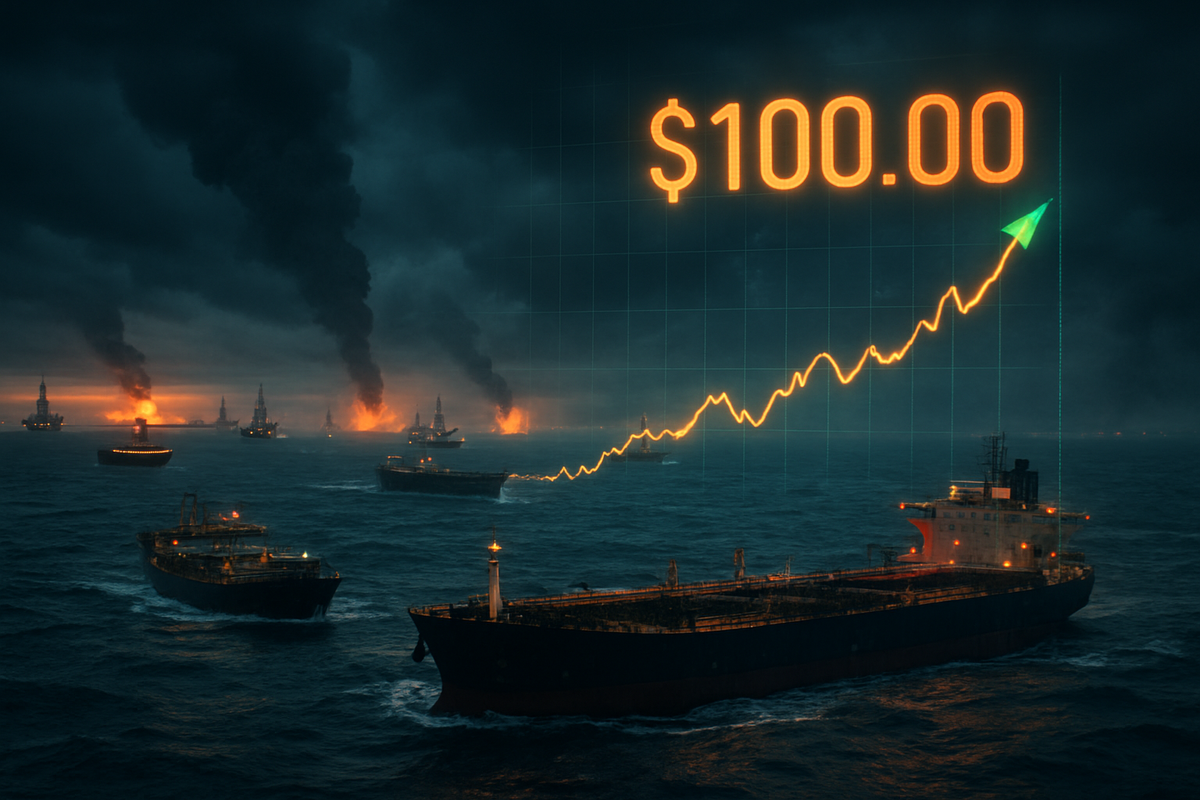
The global energy landscape shifted violently this week as crude oil prices barrelled toward $100, driven by an escalating military confrontation in the Middle East that has effectively paralyzed the world’s most vital maritime chokepoint. With the Strait of Hormuz now considered a "no-go zone" following a series of devastating tanker attacks in the Arabian Sea, the geopolitical risk premium has returned to the markets with a vengeance. As of March 16, 2026, Brent Crude is trading at roughly $105.15 per barrel, while West Texas Intermediate (WTI) has breached the triple-digit floor, settling near $100.32—levels not seen with such consistency since the onset of the Russia-Ukraine war years ago.
The immediate implications are far-reaching: a sudden spike in global inflation expectations and a dramatic reshuffling of capital within the equity markets. The effective closure of the Strait, through which nearly 20% of the world’s oil supply flows, has left over 500 tankers idling in the Persian Gulf, unable to navigate a sea lane now patrolled by hostile drones and naval assets. As "Operation Epic Fury"—a joint U.S.-Israeli military campaign—intensifies against Iranian targets, traders are bracing for a prolonged period of high prices, with technical indicators pointing to a sustained "bull channel" that could push energy costs even higher in the coming weeks.
The Strait in Flames: A Timeline of Escalation
The current crisis traces its roots to late February 2026, when decades-old tensions between the United States and Iran reached a breaking point. The catalyst for the recent price surge was the launch of "Operation Epic Fury," which targeted key Iranian infrastructure, including the near-total destruction of Kharg Island—Iran’s primary oil export hub—on the weekend of March 14. In retaliation, Tehran’s Islamic Revolutionary Guard Corps (IRGC) declared the Strait of Hormuz closed to all traffic, backed by a series of lethal strikes against commercial shipping.
In the days leading up to today, March 16, the Arabian Sea has become a graveyard for maritime stability. Seven tankers have been confirmed struck by projectiles or explosive-laden boats. Notable casualties include the Safesea Vishnu and the Zefyros, both hit near the Iraqi port of Basra, and the Skylight, which was targeted by Iranian drones near the coast of Oman. These attacks have not only halted physical supply but have also sent maritime insurance premiums to astronomical levels, making commercial passage through the Gulf of Oman virtually unviable for the private sector.
The market reaction was instantaneous. Oil prices entered a steep bull channel, a technical formation where price action moves consistently upward between two parallel lines of resistance and support. Analysts noted that WTI has firmly held its ground above the 50-day Exponential Moving Average (EMA50), which is now acting as a floor for the current rally. While the International Energy Agency (IEA) has authorized the release of 400 million barrels from strategic reserves to combat the shock, the market has largely dismissed the move, viewing it as a temporary fix for a structural geopolitical crisis.
Winners and Losers: Corporate Fallout from Triple-Digit Oil
The surge in energy costs has created a stark divide on Wall Street, with a clear separation between those profiting from the supply crunch and those being hollowed out by it. Among the primary beneficiaries are the integrated oil majors. ExxonMobil (NYSE: XOM) has seen its stock rise over 23% since the start of the year, reaching $151 as it leverages its massive Permian Basin production and global trading arm to fill the void left by Middle Eastern crude. Similarly, Chevron (NYSE: CVX) hit an all-time high near $200 this week, bolstered by its recent acquisition of Hess and its relatively low exposure to the direct conflict zone compared to European peers.
The maritime sector is also seeing historic gains. Tanker companies like Frontline (NYSE: FRO) and Nordic American Tankers (NYSE: NAT) have seen their share prices climb more than 60% year-to-date. As the Strait of Hormuz closes, oil must be rerouted on longer, more expensive voyages around the Cape of Good Hope, a phenomenon known in the industry as increasing "tonne-mile" demand. Spot rates for Very Large Crude Carriers (VLCCs) have skyrocketed to nearly $170,000 per day, providing a massive windfall for vessel owners.
Conversely, the transportation and technology sectors are reeling. United Airlines (NASDAQ: UAL) suffered a catastrophic 33% drop in share price on March 12 alone, as its "zero-hedging" fuel policy left it fully exposed to the price spike. Delta Air Lines (NYSE: DAL) fared slightly better due to its ownership of the Trainer refinery, but still faces significant margin compression. Beyond travel, the "higher-for-longer" interest rate narrative driven by energy-induced inflation has pressured high-multiple stocks. Even industry leaders like Nvidia (NASDAQ: NVDA) and Apple (NASDAQ: AAPL) have seen multi-percentage point sell-offs as investors fear a contraction in consumer spending and higher operational costs for energy-intensive data centers.
Geopolitical Contagion and the Return of Stagflation
This event is not merely a localized conflict; it represents a significant disruption to the global transition toward cleaner energy. As oil nears $100, the economic logic for the "green shift" is being tested by the immediate need for energy security. Historically, this situation mirrors the oil shocks of 1973 and 1979, where geopolitical embargoes led to a fundamental restructuring of global trade. Today, the crisis is accelerating a shift toward domestic production in the Americas, with companies like Occidental Petroleum (NYSE: OXY) gaining renewed strategic importance as "safe" suppliers.
The regulatory implications are equally significant. The U.S. government is facing immense pressure to curb inflation, leading to discussions about further releases from the Strategic Petroleum Reserve (SPR) or even emergency export bans to prioritize domestic supply. However, such moves often have the unintended consequence of alienating international allies and further tightening global markets. Furthermore, the "bull channel" in oil prices is fueling fears of "stagflation"—a period of stagnant economic growth coupled with high inflation—which could force central banks to keep interest rates elevated, even if the broader economy begins to slow down.
The Road Ahead: Potential Scenarios for Global Markets
Looking ahead, the trajectory of the energy market depends entirely on the duration of the blockade in the Strait of Hormuz. In the short term, if the U.S. Navy is unable to guarantee safe passage for tankers, $120 per barrel is within reach, a price point that many economists believe would trigger a global recession. Strategic pivots are already underway; expect to see a surge in investment toward pipelines that bypass the Strait, such as the East-West Pipeline in Saudi Arabia, although these assets remain vulnerable to drone and missile attacks.
In the longer term, this crisis may ironically accelerate the adoption of electric vehicles and alternative fuels, but only after a period of intense economic pain. For the next several months, the market will remain hyper-sensitive to any diplomatic or military shifts. If a ceasefire is brokered, we could see a "crash" back toward the $75 range as the geopolitical premium evaporates. However, should the conflict expand to include direct attacks on Saudi or Emirati production facilities, the ceiling for oil prices may not exist.
Summary: A World Realigned by Energy Security
The events of March 2026 serve as a stark reminder of the fragile nature of global energy security. The transition of oil from a commodity to a weapon of war has once again paralyzed markets and forced a re-evaluation of corporate risk. For investors, the key takeaways are the resilience of the U.S. energy sector and the extreme vulnerability of the global logistics and aviation industries to fuel shocks.
As we move forward, the "bull channel" and the $100 psychological barrier will remain the focal points for market sentiment. Watch for the next major resistance level at $110.65; a breach above that point would likely signal that the market expects a multi-month, if not multi-year, disruption. For now, the world remains in a holding pattern, waiting to see if "Operation Epic Fury" will bring a swift conclusion to the conflict or if the Arabian Sea will remain a contested zone for the foreseeable future.
This content is intended for informational purposes only and is not financial advice.