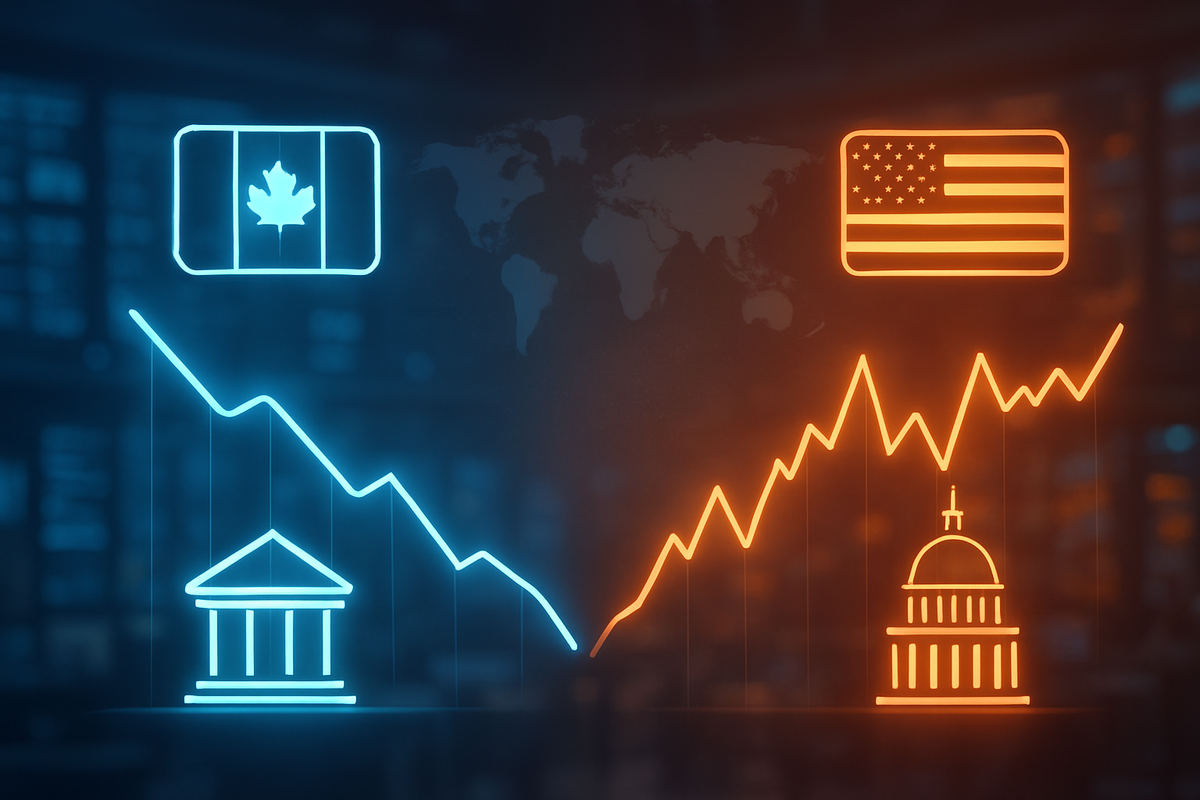
The economic border between Canada and the United States has rarely looked more defined than it does this March. New data released for February 2026 reveals that Canada’s headline inflation rate has cooled significantly to 1.8%, marking a nine-month low and the first time the figure has dipped below the Bank of Canada’s 2% target since last summer. This surprising deceleration has ignited a fierce debate among economists regarding whether the Bank of Canada (BoC) will finally break ranks with the U.S. Federal Reserve, which continues to grapple with "sticky" inflation that remained lodged at 2.4% last month.
The immediate implications of this divergence are profound for currency markets and cross-border investment. While the Canadian dollar faced immediate downward pressure on expectations of an earlier rate cut, the underlying economic reality is clouded by a sudden geopolitical crisis in the Middle East that began in late February. Investors are now weighing a "Goldilocks" cooling in Canadian consumer prices against the looming threat of a global energy spike that could reverse months of progress in a matter of weeks.
A Tale of Two Retracements: Breaking Down the February Data
The drop in Canada’s Consumer Price Index (CPI) to 1.8% in February 2026—down from 2.3% in January—was sharper than most Bay Street analysts had predicted. A significant driver of this cooling was the "base effect" created by the expiration of a temporary federal GST/HST tax holiday that had distorted prices in early 2025. With that volatile period now out of the year-over-year calculation, the true cooling of the Canadian economy has become visible. Specific relief was felt by households in essential categories; cellular service costs rose a meager 1.5%, while grocery price growth moderated to 4.1%, providing a much-needed reprieve for overleveraged consumers.
In contrast, the U.S. inflation story remains one of stubborn resilience. The U.S. Bureau of Labor Statistics reported that while headline inflation hit its lowest level since mid-2025 at 2.4%, "core" inflation—which strips out volatile food and energy costs—remained uncomfortably high at 2.5%. The primary culprit south of the border continues to be the services sector and shelter costs, which have proven more difficult to dislodge than the goods-based inflation that dominated the post-pandemic era. This has left the Federal Reserve in a restrictive stance, with Chairman Jerome Powell signaling that the "last mile" of the inflation fight is proving to be the most arduous.
The timeline leading to this divergence has been building since late 2025, as Canada’s GDP began to contract in the fourth quarter while the U.S. economy continued to defy recessionary fears. By the time the February 2026 data hit the wires, the market consensus shifted rapidly. Before the release, traders were split on the timing of the first BoC rate cut; now, swaps markets are pricing in a 65% chance of a reduction by July, even as the Fed appears likely to remain on hold until the end of the year.
Winners and Losers in a Diverging Interest Rate Environment
The banking sector remains the primary theater for these shifting dynamics. Royal Bank of Canada (TSX: RY) recently reported blockbuster Q1 2026 results, with net income hitting $5.8 billion, a 13% year-over-year increase. The bank has benefited from a robust 17.6% Return on Equity (ROE) and widening net interest margins. However, a potential BoC rate cut could begin to compress those margins in the second half of the year. Similarly, Toronto-Dominion Bank (TSX: TD) outperformed expectations with an 18% jump in revenue, fueled by record domestic loan volumes. For Canadian lenders, the cooling inflation is a double-edged sword: it reduces the risk of mass loan defaults but signals an end to the high-rate environment that has padded their bottom lines.
On the other side of the border, JPMorgan Chase & Co. (NYSE: JPM) faces a different set of challenges. While high rates keep interest income elevated, CEO Jamie Dimon recently cautioned that sticky inflation and rising tech investment costs—projected to hit $105 billion for the firm in 2026—are tightening the belt. U.S. banks are currently operating in an environment of "decaf stagflation," where growth is present but costs are rising just as fast.
The retail sector is also witnessing a distinct bifurcation. In Canada, discount retailers are the clear winners as consumers remain cautious despite the headline inflation drop. Meanwhile, mid-tier retailers are struggling with a "flight to value." In the real estate market, Canadian developers are hopeful that lower rates will revitalize a stagnant housing market, where housing starts fell 3% in February. In the U.S., commercial real estate is seeing a "flight to quality," where prime "Class A" office spaces are seeing dipping vacancy rates, even as higher interest rates continue to stifle new construction in secondary markets.
Geopolitical Jolts and the Ghost of Inflation Past
The broader significance of the February cooling cannot be analyzed without acknowledging the "black swan" event of February 28, 2026: the sudden escalation of conflict in Iran. This geopolitical shock sent oil prices surging in early March, creating a "before and after" narrative for the current inflation data. While the February numbers look promising, they represent a world before a projected 15% jump in gasoline prices. This creates a policy trap for the Bank of Canada; cutting rates to support a cooling economy could be seen as premature if energy-led inflation returns with a vengeance in the April report.
Historically, this situation mirrors the "false dawns" of the late 1970s, where central banks moved to ease policy at the first sign of cooling, only to see inflation roar back due to external supply shocks. The divergence between the BoC and the Fed also risks significantly devaluing the Canadian dollar. If the BoC cuts while the Fed holds, the "loonie" could drop toward the 70-cent USD mark, which would ironically fuel inflation by making imported U.S. goods more expensive for Canadians—a phenomenon known as "imported inflation."
Furthermore, the divergence highlights a fundamental structural difference in the two economies. Canada’s sensitivity to interest rates is far higher due to shorter-duration mortgage cycles compared to the U.S. 30-year fixed-rate standard. This means BoC policy transmits to the real economy much faster, explaining why Canadian inflation is hitting target levels months ahead of its southern neighbor.
The Road Ahead: Strategic Pivots and Policy Paradigms
Looking forward, the next 90 days will be a crucible for North American monetary policy. The Bank of Canada’s meeting on March 18 is now the most anticipated event on the financial calendar. While a "hold" is the most likely outcome given the recent oil price spike, the language used by Governor Tiff Macklem will be scrutinized for any "dovish" pivot. Financial institutions are already preparing for a "lower for longer" growth environment in Canada, shifting their portfolios toward high-yield corporate bonds and defensive utilities.
Short-term volatility is almost guaranteed as markets digest the dual impact of cooling domestic demand and rising global energy costs. We may see a "tactical pause" in consumer spending in Canada as households wait to see if the 1.8% inflation reading translates into actual interest rate relief. For investors, the opportunity lies in identifying companies with strong "pricing power" that can withstand energy fluctuations while benefiting from an eventual easing of borrowing costs.
The long-term scenario remains a "transition year" for 2026. If the BoC manages to navigate a "soft landing" by cutting rates just as the energy spike fades, Canada could lead the G7 in an economic recovery. Conversely, if they wait too long and the economy slides further into contraction, the "nine-month low" in inflation will be remembered not as a victory, but as a warning sign of a deepening recession.
Final Assessment: A Fragile Victory
The cooling of Canadian inflation to 1.8% is a milestone that marks a significant divergence from the U.S. economic engine. It validates the Bank of Canada’s restrictive campaign over the last two years but does so at a moment of extreme global instability. The key takeaway for investors is that the "inflation fight" has entered a new, more complex phase where domestic success can be easily overshadowed by international turmoil.
Moving forward, the market will be hyper-focused on the March and April CPI prints to see if the energy shock from the Middle East negates the progress seen in February. Investors should watch the CAD/USD exchange rate closely; a rapid depreciation of the loonie could force the BoC's hand, regardless of how low domestic inflation goes. For now, Canada stands as a lone beacon of price stability in North America, but it is a fragile status that will be tested by the fires of geopolitics in the months to come.
This content is intended for informational purposes only and is not financial advice