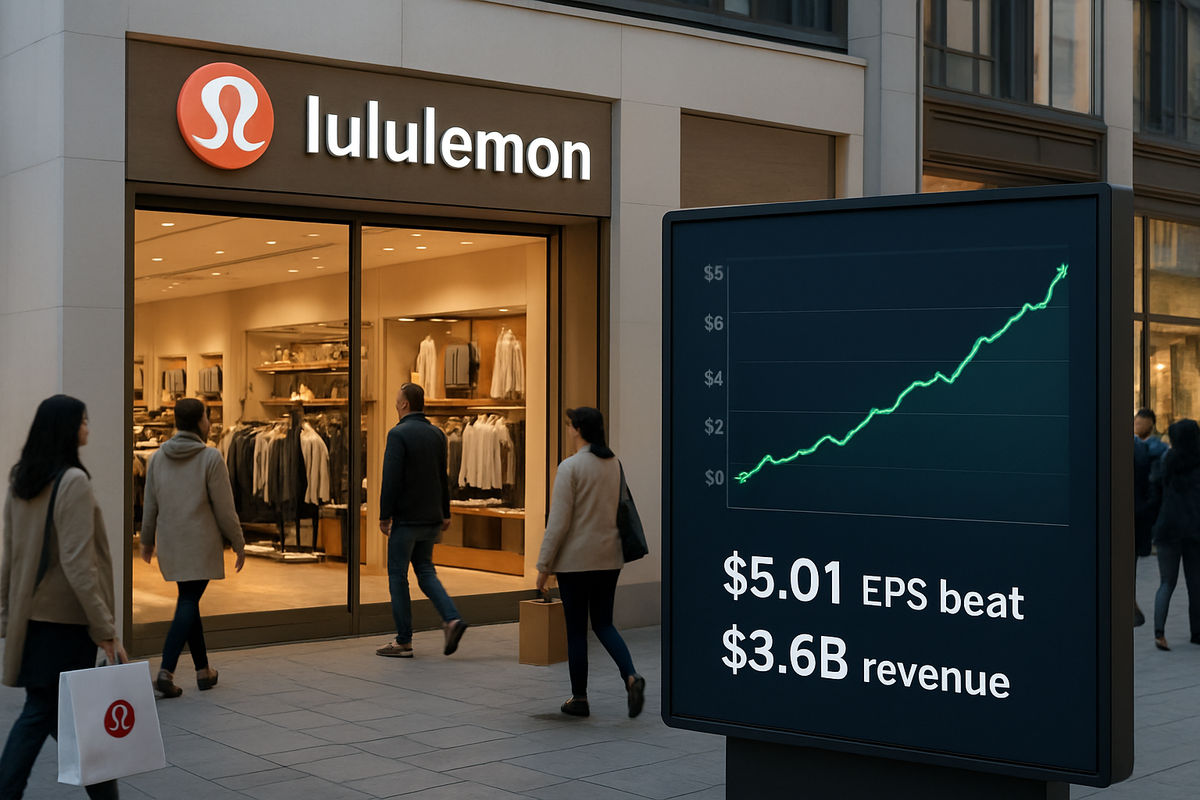
In a high-stakes reveal for the future of "athleisure," Lululemon Athletica (NASDAQ: LULU) reported its fourth-quarter and full-year fiscal 2025 results on March 17, 2026, signaling the start of an aggressive turnaround effort. The Vancouver-based apparel giant posted a fourth-quarter revenue of $3.6 billion, paired with a diluted earnings per share (EPS) of $5.01. These figures comfortably cleared the dampened expectations of Wall Street analysts, who had grown wary after two years of stagnant growth in the company's largest market.
The earnings report arrives at a pivotal moment for the brand, which has spent much of the last 18 months grappling with internal leadership transitions and a cooling of consumer demand in the United States. While the financial "beat" provided immediate relief to investors, the focus of the post-earnings call was squarely on the company's "2026 Action Plan." This strategy prioritizes a recovery in the North American segment and a staunch commitment to maintaining brand health through a return to full-price sales, marking an end to the promotional environment that defined Lululemon’s 2025 fiscal year.
A Resilience Story: Breaking Down the Q4 Numbers and the Path to Today
The $3.6 billion revenue mark represents a slight but significant uptick in a year characterized by macro-economic headwinds and intense competition. The $5.01 EPS figure was particularly notable, outperforming the consensus estimate of $4.76 and suggesting that the company’s cost-cutting measures and supply chain optimizations are beginning to bear fruit. However, the path to these results was far from smooth. The timeline leading up to this report was marked by the 2024 failure of the "Breezethrough" legging line—which was pulled from shelves within weeks of its launch due to design flaws—and the subsequent departure of Chief Product Officer Sun Choe.
These missteps allowed more agile "lifestyle" competitors to chip away at Lululemon’s market share throughout 2025. By the third quarter of last year, inventory levels had swelled to nearly $2 billion, forcing the company into uncharacteristic markdowns that eroded gross margins. The March 17 announcement serves as a symbolic "valuation reset." The current interim leadership, spearheaded by CFO Meghan Frank, emphasized that the Q4 performance was driven by a surge in international demand, particularly in China, which helped bridge the gap while the domestic team overhauled its seasonal assortments for 2026.
Initial market reactions have been cautiously optimistic, with the stock seeing a mid-single-digit lift in after-hours trading. Investors seem to be rewarding the company’s transparency regarding its previous "newness" deficit. Management admitted that a lack of color variety and the absence of trend-right silhouettes in 2025 contributed to the U.S. slowdown, and they have committed to a "product-first" mentality to win back the core domestic customer base in the coming months.
Industry Ripple Effects: Winners, Losers, and the Competitive Landscape
Lululemon’s pivot toward a "North America recovery" has significant implications for its peers. Chief among those who may feel the pressure is Nike (NYSE: NKE), which has also been undergoing a massive strategic overhaul to reclaim its dominance in the performance apparel space. As Lululemon reinvests in its "technical luxury" roots, Nike may find its high-end leggings and yoga offerings under renewed scrutiny from a consumer who is increasingly looking for "lifestyle" versatility over pure gym performance.
Conversely, the "losers" in this scenario could be the mid-tier retailers and discount-heavy brands. Gap Inc. (NYSE: GPS), through its Athleta brand, had managed to snag bargain-seeking shoppers during Lululemon’s 2025 promotional phase. However, if Lululemon successfully retreats from the markdown game and re-establishes its "full-price" prestige, Athleta may struggle to maintain its recent momentum without deeper discounting. Meanwhile, private challengers like Alo Yoga and Vuori—the latter of which is rumored to be preparing for an IPO—will now face a Lululemon that is significantly more aggressive in its marketing spend, which is projected to rise to 7-9% of revenue in 2026.
The broader retail sector is watching Lululemon’s "full-price" mandate closely. If the brand can successfully transition back to a scarcity model—reducing the frequency of its "We Made Too Much" sales—it will serve as a bellwether for the health of the premium consumer. If it fails, it may signal that the high-end apparel market has moved into a permanent state of promotional reliance, a development that would squeeze margins across the entire industry, from boutique labels to global conglomerates.
Analyzing the Macro Shift: Technical Luxury and Agile Supply Chains
Lululemon’s 2026 strategy reflects a broader industry trend toward "agile merchandising." One of the most striking details of the recovery plan is the goal to slash product development cycles from the industry-standard 18–24 months down to a lean 12–14 months. This shift is a direct response to the "TikTok-ification" of fashion, where trends emerge and dissipate in a matter of weeks. By shortening its lead times, Lululemon is attempting to bridge the gap between its heritage as a slow-fashion, technical innovator and the fast-paced demands of modern social commerce.
Historically, Lululemon has benefited from a near-monopoly on the "premium yoga" category. However, the 2024–2025 slump mirrored the historical precedents seen by other luxury leaders who lost their way by over-expanding or diluting their brand equity through excessive discounting. The current move to prioritize brand health over raw volume is a page taken directly from the luxury playbook of European fashion houses. The company is betting that its "Guest" (the Lululemon term for customer) values the status and technical superiority of the product enough to pay full price, provided the "newness" and "exclusivity" are present.
Regulatory and policy shifts also loom over this recovery. With new tariffs on imports from key manufacturing hubs in Vietnam and China impacting gross profits by hundreds of millions in 2025, Lululemon’s push for higher-margin, full-price sales is not just a brand strategy—it is a financial necessity. The company’s ability to pass these costs onto the consumer without losing market share will be the ultimate test of its brand power in a post-inflationary economy.
The Road Ahead: 2026 Guidance and the Newness Inflection
Looking forward, the success of the "North America recovery" hinges on the Spring and Summer 2026 product launches. Management has promised a "35% new style penetration" in its assortment, a massive increase intended to rectify the stale inventory issues of the previous year. In the short term, this means investors should expect higher marketing expenses and potential margin pressure as the company spends heavily to re-engage the American consumer.
The long-term scenario for Lululemon involves a delicate balancing act. The company has provided a 2026 revenue guidance of $11.35 billion to $11.50 billion, representing a conservative 2–4% growth rate. This suggests that while Q4 2025 was a "beat," the recovery will be a marathon, not a sprint. A potential strategic pivot may involve further expansion into men’s apparel and footwear, categories that have shown more resilience than the core women’s yoga market during the recent downturn.
Challenges remain, particularly regarding the permanent leadership structure. With the search for a permanent CEO and Chief Product Officer still underway as of March 2026, the company’s creative direction remains in a state of transition. Market opportunities lie in the potential "halo effect" of a successful domestic recovery, which could provide the springboard for even more aggressive international expansion in 2027 and beyond.
Summary: A Critical Inflection Point for the Athleisure King
Lululemon’s Q4 2025 earnings report is a testament to the brand's enduring strength, but it also serves as a stark reminder of the volatility in the premium apparel sector. By delivering a $5.01 EPS and $3.6 billion in revenue, the company has bought itself the breathing room necessary to execute its 2026 turnaround. The focus on North American recovery and the restoration of a full-price sales culture are the right moves for a brand that built its reputation on exclusivity and technical excellence.
Moving forward, the market will be watching two key metrics: U.S. comparable store sales and gross margin expansion. If Lululemon can successfully integrate its "newness" strategy and reduce its reliance on markdowns, it will likely reclaim its spot as the gold standard of the athleisure industry. However, any further product delays or leadership instability could see the brand permanently lose ground to the hungrier, more agile competitors waiting in the wings.
For investors, the coming months will be a period of "watch and wait." The true test of the 2026 Action Plan will come with the Q1 and Q2 results, which will reveal whether the new product assortments are resonating with the fickle North American shopper. For now, Lululemon has proven it can still outrun expectations, even when the wind is in its face.
This content is intended for informational purposes only and is not financial advice.