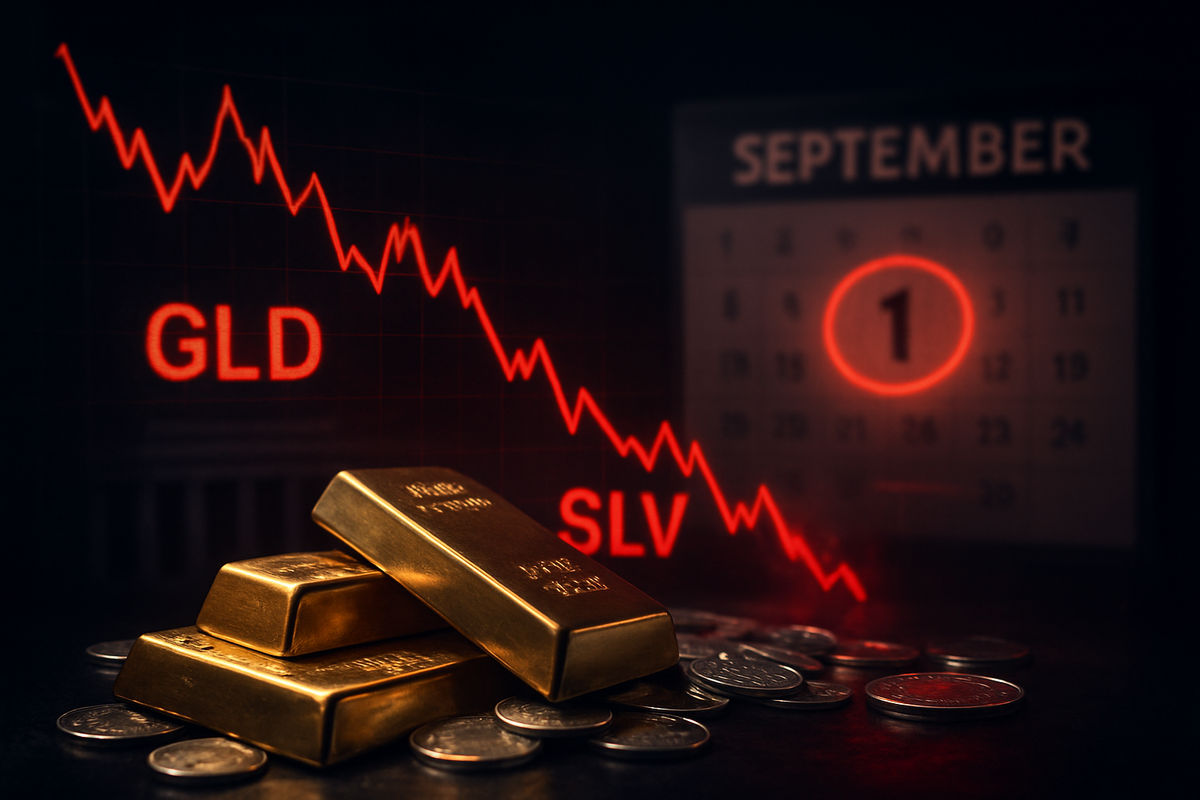
The long-standing "Golden Age" of precious metals met a brutal reality check today, March 19, 2026, as gold and silver exchange-traded funds (ETFs) suffered one of their most violent single-day sell-offs in years. Driven by a dramatic recalibration of interest rate expectations, major vehicles like the SPDR Gold Shares (NYSE Arca: GLD) and the iShares Silver Trust (NYSE Arca: SLV) plummeted by as much as 8% during intraday trading. This "ETF Exodus" represents a sharp reversal of the 2025 bull run, as institutional and retail investors alike scramble to adjust their portfolios to a Federal Reserve that appears increasingly committed to a "higher-for-longer" monetary stance.
The immediate trigger for the rout was a startling update to the CME FedWatch Tool, which now prices in a 0% chance of a rate cut before September 2026. Just weeks ago, the market was betting heavily on a June easing cycle. However, a combination of stubborn inflationary data and a hawkish shift in central bank leadership has effectively pulled the rug out from under the non-yielding asset class. As the U.S. dollar and Treasury yields surged in response, gold and silver—once the darlings of the 2025 inflation trade—found themselves discarded in a frantic race for liquidity.
The 'Warsh Shock' and the Death of the June Pivot
The roots of today’s crash can be traced back to the "Warsh Shock" of early 2026, following the nomination of Kevin Warsh to succeed Jerome Powell as Federal Reserve Chair. Warsh’s arrival has heralded a return to "institutional discipline," prioritizing balance sheet normalization and inflation suppression over market support. This policy shift was solidified this morning when the latest Producer Price Index (PPI) data revealed that core inflation remains stubbornly stuck at 3.9%, far above the Fed's 2% target. The data effectively ended the debate over a mid-year rate cut, forcing a massive repricing across all asset classes.
The timeline leading to this "Exodus" has been a volatile one. After gold touched an all-time high of over $5,600 per ounce in January 2026, the metal began to soften as geopolitical tensions in the Middle East, specifically "Operation Epic Fury," caused a spike in energy prices. Paradoxically, rather than acting as a safe haven, gold became a source of liquidity for traders facing margin calls in other sectors. This set the stage for today’s 8% plunge, as the breach of critical technical support levels triggered a wave of automated sell orders across the major ETFs.
Market participants were caught off guard by the speed of the sentiment shift. In late 2025, the narrative was dominated by "de-dollarization" and central bank accumulation. By today, that narrative has been replaced by a singular focus on the Fed’s aggressive posture. The CME FedWatch data now reflects a stark reality: nearly 50% of market participants believe there may be no rate cuts at all in 2026, a scenario that was considered unthinkable at the start of the year.
Winners and Losers: Miners and the Liquidity Crunch
The primary casualties of today’s sell-off are the major mining corporations, which had been enjoying "super-margins" during the 2025 rally. Newmont Corporation (NYSE: NEM), the world’s largest gold miner, saw its shares dive as the falling spot price threatened its 2026 earnings guidance. Despite record-breaking profits in the previous fiscal year, the company’s high-cost production outlook for 2026 has left it vulnerable to a sustained price correction. Similarly, Barrick Gold (NYSE: GOLD) faced intense selling pressure, despite its ongoing efforts to unlock value through the IPO of its North American assets.
The silver sector fared even worse, given the metal's higher volatility and industrial exposure. Pan American Silver (NASDAQ: PAAS) and First Majestic Silver (NYSE: AG) both saw double-digit percentage drops as silver prices careened toward the $65–$70 per ounce range. For these companies, the "Exodus" represents more than just a stock price decline; it signals a potential tightening of credit conditions and a re-evaluation of future mining projects that were greenlit when silver was trading above $100 per ounce.
On the winning side of the ledger, inverse ETFs and the U.S. dollar have emerged as the primary beneficiaries. Short-biased precious metals instruments saw record inflows today as hedge funds moved to capitalize on the momentum shift. Additionally, cash and cash-equivalent instruments, yielding significantly more than they did eighteen months ago, are once again attracting capital that had previously fled to the "safety" of bullion.
Broader Significance: Inflation Persistence and the Liquidity Trap
Today’s events fit into a broader trend of "sticky inflation" that has plagued the global economy throughout 2025 and into 2026. The 8% tumble in GLD and SLV is a vivid illustration of the "liquidity trap" that gold can fall into during periods of extreme market stress. When energy prices spike—as they have following recent disruptions in the Strait of Hormuz—the resulting inflationary pressure forces the Fed to remain hawkish. This, in turn, boosts the dollar and crushes gold, even if the underlying geopolitical situation would normally favor safe-haven assets.
The ripple effects of this exodus are likely to be felt across the commodities complex. If gold and silver cannot find a floor, other "inflation hedges" like copper and platinum may be next to face a de-rating. Furthermore, the aggressive stance of the Federal Reserve under the Warsh-led transition suggests that the era of "easy money" is not coming back anytime soon. This has significant implications for global trade, particularly for emerging markets that have spent the last year diversifying away from the dollar into gold.
Historically, such sharp corrections in the precious metals space have often preceded broader market volatility. In many ways, the 2026 ETF Exodus mirrors the "taper tantrum" or the gold sell-offs of 2013, where a shift in Fed rhetoric led to a multi-year bear market for metals. Investors are now forced to consider whether the 2025 rally was a structural shift or merely a speculative bubble fueled by temporary central bank policies.
Looking Ahead: The Road to September
In the short term, the precious metals market will likely remain in a "price discovery" phase as it tests new support levels. The potential for further liquidations remains high, especially if the 10-year Treasury yield continues its march toward 5%. Strategic pivots will be required for both miners and investors; mining companies may need to delay capital expenditures and focus on cost-cutting, while portfolio managers are likely to rotate further into high-yield fixed income.
Long-term, the focus remains squarely on the September Fed meeting. If the Federal Reserve manages to cool inflation without triggering a deep recession, the case for gold as an inflation hedge may continue to erode. However, if the "higher-for-longer" policy eventually causes a systemic break in the credit markets, gold could see a "V-shaped" recovery as it re-asserts its role as the ultimate safe haven. The coming months will be a period of intense scrutiny for both the Fed's resolve and the resilience of the global economy.
Market opportunities may emerge for contrarian investors who believe the sell-off is overdone, but for now, the momentum is firmly with the bears. The "September or later" narrative is the new baseline, and until the Fed signals a genuine pivot, the precious metals space remains a high-risk environment.
Conclusion: A Market in Transition
The "ETF Exodus" of March 19, 2026, marks a definitive end to the unbridled optimism that defined the precious metals market for the past year. With GLD and SLV tumbling 8% in a single session, the reality of a more aggressive, inflation-focused Federal Reserve has finally set in. The key takeaway for investors is that the "Fed Pivot" is no longer a guaranteed catalyst, and the macro environment has shifted from one of "de-dollarization" to one of "dollar dominance" fueled by high rates.
Moving forward, the market will be characterized by heightened volatility and a renewed focus on fundamental economic data. Investors should keep a close eye on the monthly PPI and CPI prints, as well as any rhetoric from the incoming Fed leadership. The "Golden Age" may not be over, but it has certainly entered a period of deep hibernation, and the path to recovery will be paved with caution rather than conviction.
This content is intended for informational purposes only and is not financial advice.