The European natural gas market, long considered to be stabilizing after the energy shocks of the early 2020s, has been plunged back into a state of high-alert volatility. As of March 2, 2026, the Dutch Title Transfer Facility (TTF) benchmark—the primary pricing index for European gas—has seen a dramatic reversal in sentiment. Just days ago, the market was celebrating a 5% decline driven by unseasonably mild weather and robust flows from Norway, but a sudden geopolitical crisis in the Middle East now threatens to propel prices toward the €90/MWh mark.
The immediate implications are severe for a European Union still recovering from industrial stagnation. While high storage levels were expected to buffer the transition into spring, the reported closure of the Strait of Hormuz—a vital artery for global Liquefied Natural Gas (LNG)—has effectively removed a safety net for the continent. With nearly 20% of global LNG trade at risk, analysts from ICIS and PricePedia warn that the "bearish narrative" of late February has been completely erased by a "supply-security panic."
The Calm Before the Geopolitical Storm
In the final week of February 2026, the European gas market appeared to be entering a period of prolonged dormancy. TTF prices had drifted lower, touching multi-month lows as meteorologists forecasted a "heat dome" over Northwest Europe, significantly reducing residential heating demand. During this period, Equinor ASA (NYSE: EQNR) maintained record-level output from the Norwegian Continental Shelf, with the massive Troll field operating at peak efficiency. This combination of low demand and high pipeline supply led to a 5% price retreat, convincing many traders that the risk of a late-winter price spike had passed.
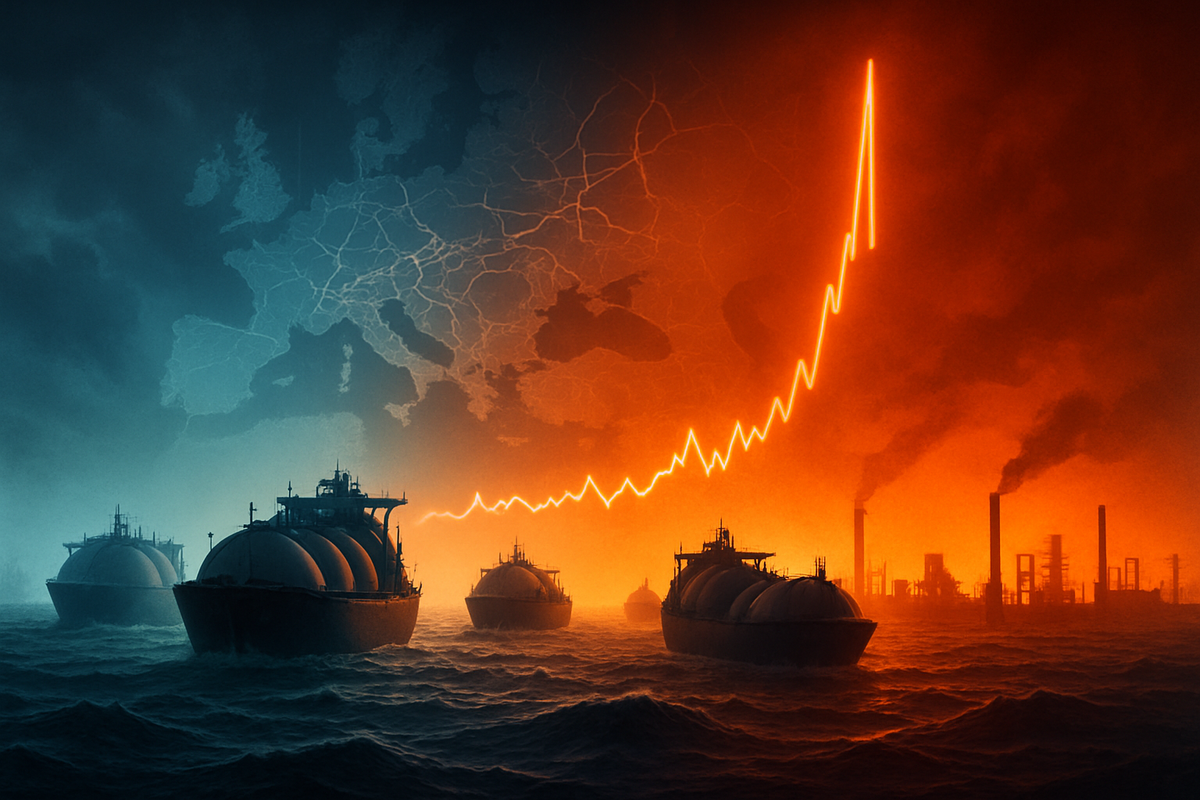
However, the landscape shifted violently over the weekend of February 28 to March 1. Following an escalation of military activity in the Middle East, Iran announced the closure of the Strait of Hormuz. By the market open on Monday, March 2, the TTF front-month price surged by roughly 45% to reach €46.41/MWh, up from Friday’s close of approximately €32/MWh. The timeline reflects a classic "black swan" event: on Thursday, the market was pricing in a surplus; by Monday, it was pricing in a blockade.
Key stakeholders, including the European Commission and major industrial energy consumers, are now scrambling to assess the impact of losing Qatari LNG cargoes. According to ICIS head of gas analytics Andreas Schroeder, the market is no longer trading on current fundamentals but on the "worst-case scenario" of a 90-day blockade. This scenario, modeled by ICIS just last week as a theoretical risk, suggests a price floor of €92.00/MWh if the chokepoint remains impassable, a level not seen since the height of the 2022 energy crisis.
Winners and Losers in a Blockaded Market
The sudden price surge creates a stark divide between energy producers with diversified assets and industrial consumers exposed to spot prices. Chevron Corporation (NYSE: CVX) and Cheniere Energy, Inc. (NYSE: LNG) are positioned to see increased demand for U.S.-sourced LNG, which now accounts for over 60% of Europe’s total LNG imports. As European buyers compete with Asian markets for non-Middle Eastern cargoes, these U.S. giants may see significant margin expansion, though they face the logistical challenge of redirecting global fleets.
Conversely, major European energy utilities and industrial firms are facing a renewed margin squeeze. Shell PLC (NYSE: SHEL) and TotalEnergies SE (NYSE: TTE), while benefiting from higher upstream prices, must navigate the extreme risks associated with their massive LNG trading portfolios. For Eni S.p.A. (NYSE: E), the focus shifts to North African pipeline flows as a critical alternative to lost LNG volumes. The biggest "losers" in this scenario are the energy-intensive industries in Germany and Italy, where companies like BASF SE (OTC: BASFY) may once again face the prospect of production curtailments if prices sustain the €90/MWh trajectory.
Infrastructure operators like Snam S.p.A. (OTC: SNMRY) and Fluxys are also under the spotlight. While they do not directly profit from the price of gas, the volatility increases the cost of "cushion gas" for storage operations and complicates the balancing of national grids. For these stakeholders, the priority is not profit but maintaining the physical integrity of a system that is being stretched to its limits by sudden supply-route shifts.
A Structural Vulnerability Re-Exposed
This event highlights a broader industry trend: Europe’s structural dependence on global LNG has traded its former reliance on Russian pipelines for a reliance on volatile maritime chokepoints. While the EU successfully diversified away from Gazprom, the current crisis proves that the "LNG solution" is only as stable as the shipping lanes it travels. The Strait of Hormuz is the world's most sensitive energy chokepoint, and its closure effectively severs the link between the world's largest gas reserves and their most desperate customers.
Regulatory implications are likely to be swift. The European Securities and Markets Authority (ESMA) and national regulators may reconsider market "circuit breakers" to prevent the kind of 45% single-day jumps seen this week. Furthermore, the crisis may accelerate the "REPowerEU" mandates, pushing for even faster adoption of renewables and hydrogen to decouple the European economy from the whims of Middle Eastern geopolitics.
Historical precedents, such as the 1973 oil embargo and the more recent 2022 Nord Stream disruptions, suggest that when energy becomes a geopolitical weapon, the market rarely returns to its previous "normal." The ICIS and PricePedia analysis indicates that even if the Strait is reopened quickly, a "risk premium" will likely be baked into TTF prices for the remainder of 2026, permanently raising the cost of energy for European consumers.
The Road Ahead: Scenarios and Strategic Pivots
In the short term, the market will remain hyper-sensitive to any military or diplomatic developments in the Gulf. If the blockade lasts more than 14 days, the industry will likely see a mandatory drawdown of EU gas storage, which currently sits at a precarious 30.1% capacity—significantly lower than the 40% levels seen this time last year. This would force a massive re-injection program over the summer, keeping prices elevated throughout 2026 regardless of weather patterns.
Strategically, companies like BP PLC (NYSE: BP) and Repsol S.A. (OTC: REPYY) may accelerate their pivot toward "bridge" fuels and domestic production in the North Sea and North Africa. The market opportunity now lies in "supply certainty." Any company that can guarantee delivery—whether through pipeline infrastructure or long-term U.S. LNG contracts—will command a massive premium. We may also see a resurgence in long-term contracting, a move away from the spot-market obsession that has dominated European gas trading for the last decade.
The most likely scenario for the coming months is a "high-plateau" price environment. Even if the €90/MWh peak is not sustained, the floor for TTF is likely to shift from the €25–30 range to a much higher €45–55 range. Investors should prepare for a period of "deglobalization" in gas markets, where regional prices decouple based on their physical proximity to supply and the security of their transport routes.
Summary and Investor Outlook
The events of March 2, 2026, serve as a stark reminder that the global energy transition is fraught with geopolitical peril. The 5% decline seen in late February was a mirage of stability, quickly evaporated by the reality of a closed Strait of Hormuz. The jump to €46.41/MWh is just the beginning if the blockade persists; the ICIS-modeled €90/MWh threshold is now a very real possibility.
Moving forward, investors should watch for two key signals: the duration of the Hormuz closure and the speed of EU storage depletion. A failure to reopen the Strait within 30 days would likely trigger a full-scale industrial crisis in Europe. For the market, the era of "cheap and easy" gas is officially over. The focus has shifted from price optimization to survival, and the companies that own the molecules and the pipes will hold the cards in this new, more dangerous era of energy trading.
This content is intended for informational purposes only and is not financial advice