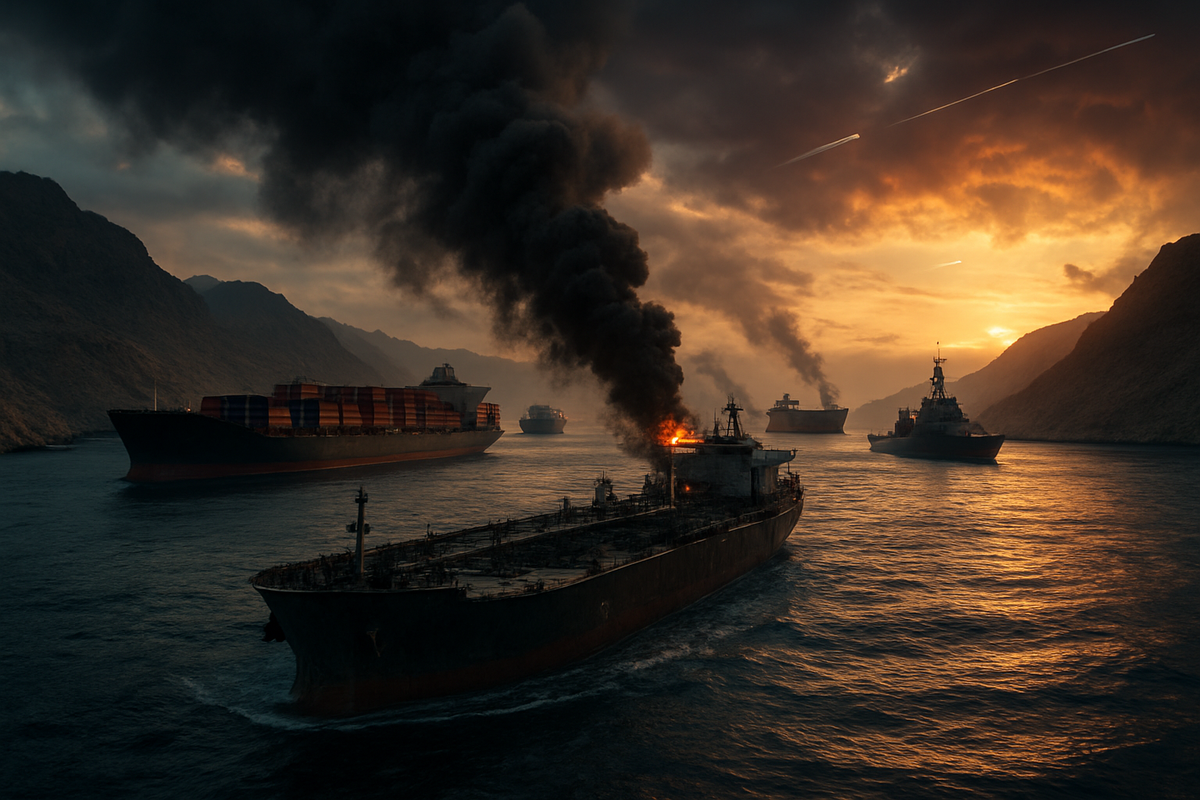
MANAMA, Bahrain — The world’s most critical energy artery is at a virtual standstill today, March 2, 2026, as the Strait of Hormuz faces a de facto closure following a series of high-stakes military escalations. Following the launch of a massive joint military operation by the United States and Israel against Iranian command structures, Tehran has retaliated with direct strikes on commercial vessels linked to the West. The immediate fallout has triggered a 70% collapse in vessel traffic through the waterway, sending global oil and gas markets into a state of panic as shipping giants scramble to reroute fleets around the southern tip of Africa.
The crisis, which marks the most significant disruption to maritime trade since the 1970s, follows the Iranian military’s "Operation True Promise 4." In a series of drone and missile attacks over the last 48 hours, at least three tankers—including the MKD Vyom, managed by V.Ships Asia, and the UK-linked Hercules Star—were struck in the Gulf of Oman and near the UAE coast. As of this morning, the price of Brent crude has surged 10%, briefly touching $82 per barrel, with analysts warning of a triple-digit spike if the blockade persists beyond the week.
Escalation in the Gulf: A Timeline of Conflict
The current paralysis is the direct result of a rapid military escalation that began on February 28, 2026. Codenamed "Operation Epic Fury," a joint US-Israeli coalition conducted precision strikes against Iranian targets, reportedly resulting in the death of senior leadership within the Islamic Revolutionary Guard Corps (IRGC). Iran’s response was swift: a broadcast warning via VHF radio declaring that "no ship is allowed to pass the Strait of Hormuz." While not a formal legal blockade, the credible threat of IRGC missile batteries has effectively halted commercial transit.
Specific attacks have already claimed lives and damaged critical infrastructure. The MT Skylight, a Palau-flagged oil tanker, was hit off Oman’s Musandam peninsula, resulting in four injuries. Furthermore, the IRGC claimed to have targeted the USS Abraham Lincoln and launched drones at vessels in the Jebel Ali Port, UAE. These events follow a tense two-year lead-up, including the "Twelve-Day War" in mid-2025, during which symbolic strikes were traded over Iranian nuclear facilities in Natanz and Isfahan. This morning, the U.S. Fifth Fleet, headquartered in Bahrain, remains on "highest alert" as retaliatory missiles targeted military installations across Kuwait, Qatar, and the UAE.
Market Winners and Losers: Shipping Giants and Energy Majors
The sudden closure has created a polarized landscape for public companies. Major container lines were the first to blink; A.P. Møller - Mærsk A/S (CPH: MAERSK-B) and Hapag-Lloyd AG (XETRA: HLAG) have officially suspended all transits through the region, ordering vessels to seek immediate shelter or begin the 3,500-mile detour around the Cape of Good Hope. While this rerouting adds 10 to 14 days to transit times and significantly increases fuel costs, it has created a supply-side squeeze that is driving up freight rates.
Conversely, pure-play tanker companies and specialized shippers are seeing a dramatic surge in valuation. ZIM Integrated Shipping Services Ltd. (NYSE: ZIM) and Frontline PLC (NYSE: FRO) have seen their stock prices climb as demand for available "clean" tonnage outside the conflict zone skyrockets. On the energy side, integrated majors like Shell PLC (NYSE: SHEL) and Exxon Mobil Corporation (NYSE: XOM) face a dual reality: while rising crude prices bolster their upstream margins, the logistical nightmare of diverted Qatari LNG and Saudi crude threatens their downstream refining stability. Meanwhile, Asian conglomerates heavily dependent on Persian Gulf feedstock, such as Mitsubishi Chemical Group Corp. (TYO: 4188) and Mitsui O.S.K. Lines, Ltd. (TYO: 9104), are bracing for a prolonged period of high input costs and supply chain delays.
The 20% Factor: Analyzing the Global Significance
The strategic importance of the Strait of Hormuz cannot be overstated. According to reports from The Independent, the strait handles roughly 20.5 million barrels of oil per day—nearly 20% of global consumption. Even more critical is the flow of Liquefied Natural Gas (LNG); research from ICIS highlights that 22% of the world’s LNG trade, primarily from Qatar, passes through this narrow choke point. ICIS shipping analysts using the LNG Edge platform have already tracked several major tankers, including the Al Sahla and Mraikh, performing U-turns in the Arabian Sea to avoid the conflict zone.
This disruption fits into a broader trend of "weaponized geography" seen in recent years. The ICIS report suggests that if the closure remains in place for 30 days, Europe’s TTF gas benchmark could soar above €90.00/MWh, a three-fold increase from previous averages. Unlike the Red Sea crisis of 2024, there are fewer viable bypasses for Hormuz. While Saudi Arabia and the UAE possess pipelines that can move oil to the Red Sea or the Gulf of Oman, these have a combined capacity of only about 6.5 million barrels per day, leaving over 14 million barrels per day entirely "stranded" within the Persian Gulf.
The Path Ahead: Strategic Pivots and Potential Outcomes
In the short term, the maritime industry is shifting toward a "war footing." Shipping companies are already implementing "Emergency Conflict Surcharges"—with some reaching $2,000 per container—to cover the surging cost of war risk insurance and extended voyages. Strategically, this may lead to a permanent relocation of some logistics hubs away from the Persian Gulf toward ports like Salalah in Oman or even East African facilities, reducing the reliance on the narrow strait.
The medium-term outlook depends heavily on the US-led coalition’s ability to establish "Operation Prosperity Guardian II," a maritime escort service similar to efforts seen in 2024 but on a much larger scale. If the coalition cannot guarantee safe passage, the global economy may face a prolonged inflationary period. We may see a strategic pivot toward accelerated renewable energy deployment in Europe and Asia as a national security imperative, or conversely, a desperate rush to increase North American oil production to fill the Middle Eastern void.
Conclusion: A Turning Point for Global Trade
The crisis in the Strait of Hormuz as of March 2, 2026, represents a "black swan" event that has effectively severed the world's most vital energy artery. The immediate reaction of the markets—spiking oil prices and the mass rerouting of the global fleet—underscores just how fragile the just-in-time energy model remains. With Iran demonstrating its ability to strike US and UK-linked assets with impunity, the era of "safe passage" in the Middle East has come to an abrupt end.
Investors should closely monitor the "war risk" premiums and the movements of major tanker fleets like Frontline PLC (NYSE: FRO) in the coming weeks. The ability of the US and its allies to provide security will be the primary determinant of whether this remains a temporary price shock or becomes a structural shift in global trade. For now, the world watches the waters off the Musandam Peninsula, where the future of global energy security currently hangs in the balance.
This content is intended for informational purposes only and is not financial advice.