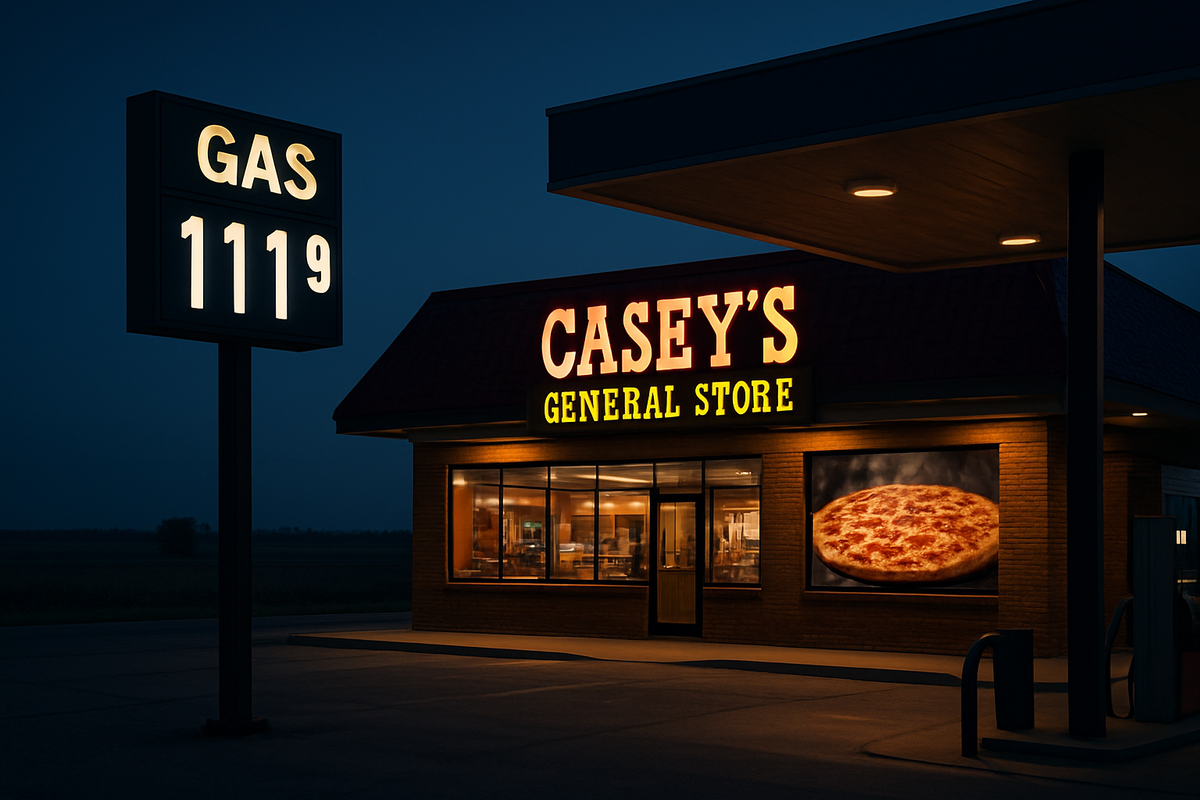
In a day marked by extreme energy market volatility, Casey’s General Stores (Nasdaq: CASY) reported its third-quarter fiscal 2026 earnings on March 9, 2026, delivering a performance that surpassed analyst expectations despite a geopolitical shock that sent oil prices soaring. As WTI crude eclipsed the $111-per-barrel mark in weekend trading—driven by a deepening supply deficit in the Middle East—the Midwestern convenience giant proved that its unique "rural moat" and food-centric business model provide a significant hedge against rising input costs.
The earnings report, released after the market close, revealed a diluted EPS of $2.98, a significant jump from the $2.33 reported in the same quarter last year. Revenue climbed to $4.10 billion, buoyed by the successful integration of nearly 200 CEFCO store locations and a resilient 4.1% growth in same-store prepared food sales. While high gas prices typically act as a "tax" on consumer discretionary spending, Casey’s specialized focus on high-margin pizza and breakfast offerings has allowed it to capture "replacement" dining dollars from families trading down from full-service restaurants.
Navigating the Crude Spike: Q3 by the Numbers
The third quarter of 2026 will likely be remembered as the moment Casey’s General Stores solidified its transition from a traditional fuel retailer to a "kitchen that sells gas." The company reported a sector-leading fuel margin of 41 cents per gallon (CPG), maintaining profitability even as wholesale costs fluctuated wildly due to the effective closure of the Strait of Hormuz. This margin stability is a direct result of Casey’s dominant position in rural markets, where lower competition allows for "stickier" retail prices at the pump compared to urban centers.
The timeline leading up to today’s announcement was fraught with uncertainty. Oil prices, which began the year in the low $80s, spiked to $115 in weekend futures following reports of a structural deficit in global supply. Investors initially feared that such a rapid ascent would crush retail fuel margins and deter store traffic. However, Casey’s leveraged its 9-million-member loyalty program—Casey’s Rewards—to drive foot traffic through targeted digital offers, effectively decoupling store visits from gas price anxiety. The market reacted favorably in after-hours trading, with CASY shares ticking up 2.4% as investors digested the company's ability to maintain high margins amidst the chaos.
Winners and Losers in a High-Cost Environment
The current energy landscape is creating a sharp divide in the convenience sector. Large-scale, well-capitalized operators like Casey’s and Murphy USA (NYSE: MUSA) are emerging as the primary winners. Murphy USA, known for its high-volume, low-cost model, has also seen resilience, though it lacks the high-margin prepared food engine that fuels Casey’s bottom line. Meanwhile, Alimentation Couche-Tard (TO: ATD) continues to expand its global footprint, investing heavily in EV-charging infrastructure to future-proof its business against the very volatility currently rocking the markets.
On the losing side of this equation are single-site independent operators and smaller regional chains. These entities lack the sophisticated fuel procurement strategies and the scale to negotiate with vendors that major players possess. As labor costs and technology requirements for loyalty programs rise, many of these "mom-and-pop" stores are becoming acquisition targets for Casey’s and its peers. The "Gas Tax" effect is also hitting general retailers like Target (NYSE: TGT) and rural hardware stores harder, as consumers prioritize "needs" like fuel and quick meals over discretionary household goods.
The Rural Moat and the "Pizza-Forward" Strategy
Casey’s performance fits into a broader industry trend where convenience stores are increasingly competing with quick-service restaurants (QSRs). Now the fifth-largest pizza chain in the United States, Casey’s has effectively created a defensive staple out of a convenience store. This strategy is particularly significant in the Midwest, where the company serves as a primary dining destination for small communities. By diversifying its revenue streams, Casey’s has mitigated the risks associated with the cyclical nature of the oil market.
The wider significance of this earnings report lies in its reflection of the "new normal" for energy-dependent businesses. Historical precedents, such as the 2022 oil spike, showed that volatility often benefits large operators with the logistics and pricing power to manage rapid cost changes. However, the 2026 surge is different due to the added pressure of stagflation fears in manufacturing hubs. Regulatory scrutiny on "price gouging" at the pump remains a potential headwind, though Casey’s rural concentration often keeps it below the radar of urban-focused policy debates.
Looking Ahead: Strategic Pivots and Market Risks
In the short term, Casey’s must navigate the continued escalation of crude prices, which some analysts at JPMorgan predict could reach $150/barrel if supply routes remain blocked. The company’s immediate challenge will be maintaining its prepared food margins as ingredient costs (flour, cheese, and proteins) are often correlated with energy-driven transportation costs. Strategic pivots toward more automated "grab-and-go" kiosks and expanded private-label offerings may be required to keep prices attractive for budget-conscious Midwesterners.
Long-term, the market will be watching Casey’s expansion into the South following the CEFCO acquisition. Success in Texas and Alabama will depend on whether the "pizza-forward" Midwest culture can be replicated in markets with different culinary traditions and higher concentrations of competitors like 7-Eleven (TYO: 3382). Furthermore, as the transition to electric vehicles (EVs) continues—albeit more slowly in rural areas—Casey’s will eventually need to prove that its "kitchen" can sustain the business once the "gas" component begins its long-term decline.
A Resilient Path Forward for Investors
Casey’s General Stores has once again proven its mettle as a defensive powerhouse in the retail sector. By delivering an EPS beat during one of the most volatile periods for energy in recent years, the company has validated its move toward a high-margin food service model. The key takeaway for investors is that Casey’s is no longer just a proxy for the price of gas; it is a sophisticated retail and logistics operation with a loyal, data-driven customer base.
Moving forward, the market will remain focused on two primary metrics: fuel margin sustainability and loyalty member engagement. If Casey's can keep fuel margins in the high 30s while growing its membership toward the 10-million mark, it will likely continue to outperform the broader S&P 500 (NYSEARCA: SPY). While the $111 oil price presents a formidable challenge, the "rural moat" and the smell of fresh pizza seem to be a winning combination for navigating the uncertainty of 2026.
This content is intended for informational purposes only and is not financial advice.