The Federal Reserve’s carefully managed "soft landing" was thrown into turmoil this morning as the New York Fed released its February Survey of Consumer Expectations. The data, published at 10:00 a.m. ET on March 9, 2026, reveals a sharp reversal in consumer sentiment. One-year inflation expectations, which had been trending downward toward the Fed’s 2% target, have spiked to 4.2%, driven primarily by the sudden explosion in global energy costs.
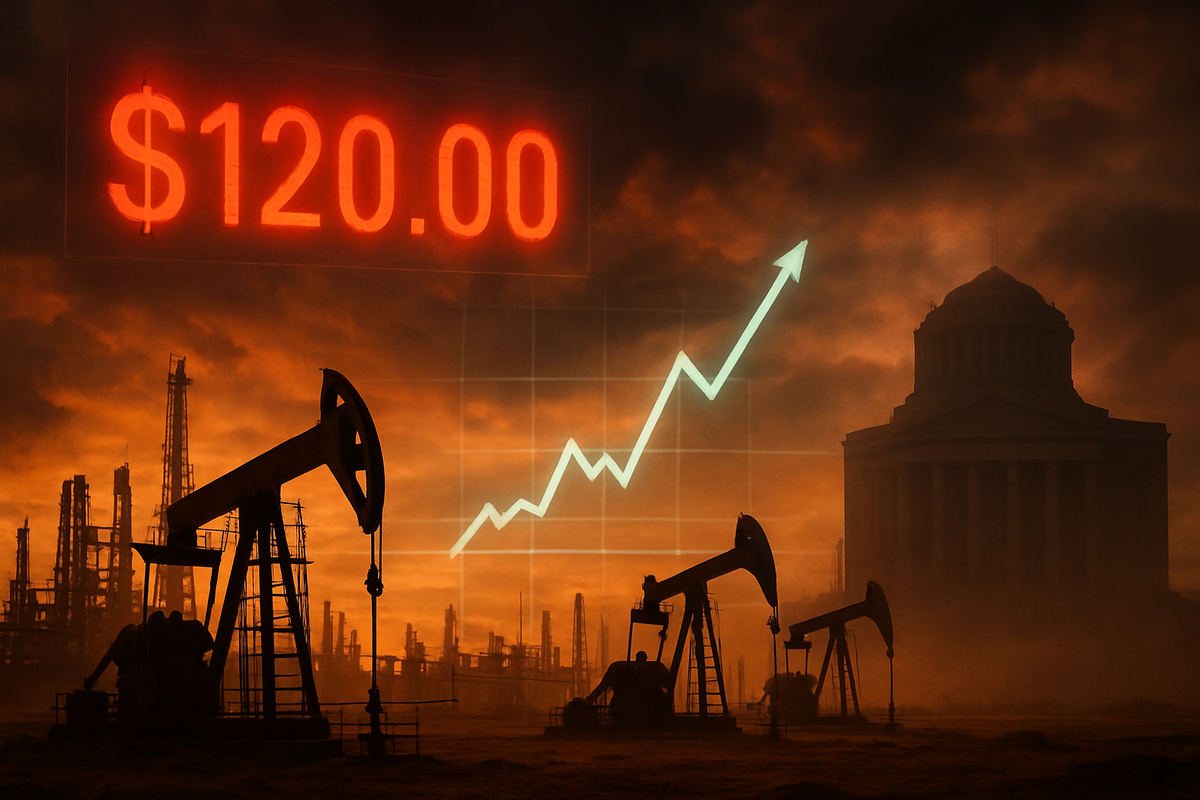
This dramatic shift follows a chaotic ten-day period in the Middle East that saw Brent crude prices skyrocket to $120 per barrel. For the American consumer, the immediate impact at the pump has translated into a psychological pivot; the optimism of early 2026 has been replaced by a "sticky" inflation narrative that threatens to derail the Federal Reserve’s planned cycle of interest rate cuts. With headline inflation now projected to climb through the second quarter, the market is bracing for a potential "stagflationary" trap where rising costs collide with cooling economic growth.
The Perfect Storm: War, Oil, and the February Data
The February data release captures a pivotal moment in the 2026 economic cycle. Just weeks ago, consensus among economists was that the Federal Reserve would implement at least three interest rate cuts by year-end. However, the escalation of the US-Israel-Iran conflict in late February changed the calculus. As missile strikes targeted critical energy infrastructure near the Strait of Hormuz, the maritime insurance market effectively froze, causing a 40% surge in oil prices in less than a fortnight.
The New York Fed’s survey reflects this volatility with precision. Median one-year inflation expectations jumped from 3.1% in January to 4.2% in February, the largest month-over-month increase since the post-pandemic supply chain crisis. Perhaps more concerning for the Federal Reserve is the de-anchoring of three-year expectations, which rose to 3.5%. Consumers are no longer viewing the current price spike as a "transitory" event but as a structural shift in the global economy, fueled by persistent geopolitical instability.
Market participants were quick to react as the 10:00 a.m. data hit the wires. Treasury yields spiked as traders aggressively priced out the possibility of a rate cut at the Fed’s upcoming March meeting. Key players in the central bank, including regional presidents who had previously leaned "dovish," have signaled that the "last mile" of the inflation fight has suddenly become an uphill marathon. The "sticky" nature of this inflation is exacerbated by secondary effects; as fuel costs rise, the cost of transporting food and consumer goods is expected to follow, creating a multi-month lag that will keep the Consumer Price Index (CPI) elevated well into the summer.
Energy Giants Gain Ground While Transports Bleed
In the wake of $120 oil, the equity markets have become a landscape of stark contrasts. Energy sector titans like ExxonMobil (NYSE: XOM) and Chevron (NYSE: CVX) have emerged as the primary beneficiaries. These companies are seeing their profit margins expand exponentially as global supply tightens. Investors have flocked to the sector not just for the immediate windfall of higher crude prices, but as a hedge against the broader inflationary environment. ConocoPhillips (NYSE: COP) has also seen a significant uptick in valuation as its domestic production profile becomes increasingly valuable amidst international instability.
Conversely, the transportation and logistics sectors are facing a brutal margin squeeze. United Airlines Holdings (NASDAQ: UAL) and Delta Air Lines (NYSE: DAL) saw their shares retreat sharply this morning as jet fuel costs—often the largest variable expense for carriers—threaten to wipe out projected 2024 earnings. The "travel revenge" era of the mid-2020s is facing its toughest test yet, as higher ticket prices may finally begin to dampen consumer demand.
Retail and e-commerce giants are also on the defensive. Amazon.com Inc. (NASDAQ: AMZN) faces the dual threat of rising last-mile delivery costs and a consumer base that is increasingly forced to prioritize gasoline over discretionary spending. Similarly, the automotive sector is seeing a shift in momentum; while Tesla Inc. (NASDAQ: TSLA) might eventually benefit from a renewed interest in electric vehicles (EVs) as gas prices soar, the immediate impact of high interest rates and supply chain bottlenecks for battery minerals is weighing heavily on the stock in the short term.
A Return to Stagflation Fears and Policy Paralysis
The current situation bears a haunting resemblance to the energy shocks of the 1970s, a historical precedent that Federal Reserve Chairman Jerome Powell has frequently cited as a "what-not-to-do" guide. The broader significance of the February data lies in its potential to trigger a "wage-price spiral" if consumers demand higher pay to offset the $120 oil reality. This puts the Fed in a policy straightjacket: cutting rates to support a softening labor market could pour gasoline on the inflation fire, while holding rates "higher for longer" risks tipping the economy into a deep recession.
The "sticky inflation" environment of early 2026 is fundamentally different from the 2021-2022 period. Back then, inflation was driven by excess liquidity and supply chain snags; today, it is driven by a fundamental scarcity of energy and a breakdown in global security. Regulatory and policy implications are already emerging, with renewed calls in Washington for emergency releases from the Strategic Petroleum Reserve (SPR) and potential windfall taxes on energy producers. However, with the SPR already at historically low levels, the government’s toolkit is significantly more limited than it was four years ago.
Furthermore, this event is accelerating the "deglobalization" trend. Competitors and partners in the Eurozone and Asia are similarly reeling from the oil shock, leading to a coordinated slowdown in global trade. The ripple effects are being felt in the semiconductor and manufacturing sectors, where energy-intensive production processes are becoming cost-prohibitive in certain regions, potentially leading to further "onshoring" of critical industries to North America.
What Comes Next: The Fed’s High-Stakes Pivot
In the short term, all eyes are on the Federal Reserve’s "blackout period" and any leaked sentiment through favored media channels. The market’s base case has shifted from a 25-basis-point cut in June to a "hold" for the remainder of the year. If the Middle East conflict escalates further, or if the Strait of Hormuz remains contested, the possibility of an "insurance hike" could even return to the table—a scenario that was unthinkable just 60 days ago.
Strategic pivots will be required for both corporations and investors. Companies with high pricing power and low energy intensity will likely outperform, while heavily leveraged firms in the industrial and consumer discretionary sectors face a period of intense restructuring. We may see a renewed surge in capital expenditure toward alternative energy and nuclear power as "energy security" replaces "green transitions" as the primary political and economic driver.
Long-term, the scenario remains binary. If a diplomatic solution is reached in the Middle East and oil prices retreat to the $70–$80 range, the Fed may still find a path to easing. However, if $120 oil becomes the new floor, the "Great Moderation" of inflation will be officially over, ushering in a decade of higher volatility and structurally higher interest rates.
Summary and Investor Outlook
The February Consumer Inflation Expectations report is a sobering reminder of how quickly geopolitical events can upend economic stability. The jump to 4.2% inflation expectations, fueled by the $120 oil shock and the ongoing Middle East war, has effectively ended the market's honeymoon period with the Federal Reserve.
Key Takeaways for Investors:
- The "Higher for Longer" Narrative is Back: Rate cuts in 2026 are no longer a certainty; the "sticky" inflation data provides the Fed with all the justification it needs to remain restrictive.
- Energy is the New Defensive Play: As long as geopolitical tensions remain high, (NYSE: XOM) and (NYSE: CVX) will act as essential hedges for any portfolio.
- Watch the Consumer: The next few months of retail sales data will be critical. If the consumer "breaks" under the pressure of high gas prices and high interest rates, the risk of a hard landing becomes the dominant market theme.
Moving forward, investors should closely monitor the weekly EIA petroleum status reports and any shifts in the Fed's "Dot Plot" projections. The era of predictable disinflation has ended; the era of the "Geopolitical Risk Premium" has returned.
This content is intended for informational purposes only and is not financial advice.