As we cross the midpoint of January 2026, the landscape of American finance and political discourse has been fundamentally rewritten. What was once a niche corner of the internet for statistics nerds and high-stakes contrarians has become the primary lens through which the public views reality. Today, "market-implied probability" is no longer just a metric; it is the headline.
The 2026 Midterm elections are already seeing unprecedented volume, with over $8 billion positioned across various House and Senate control markets. This "marquee year" for prediction markets didn't happen by accident. It is the direct result of a legal domino effect that began in October 2024, when a federal court order shattered the regulatory shackles holding back Kalshi and the broader industry. Looking back, that court victory was the "Big Bang" for what we now call Information Finance.
The Market: What’s Being Predicted
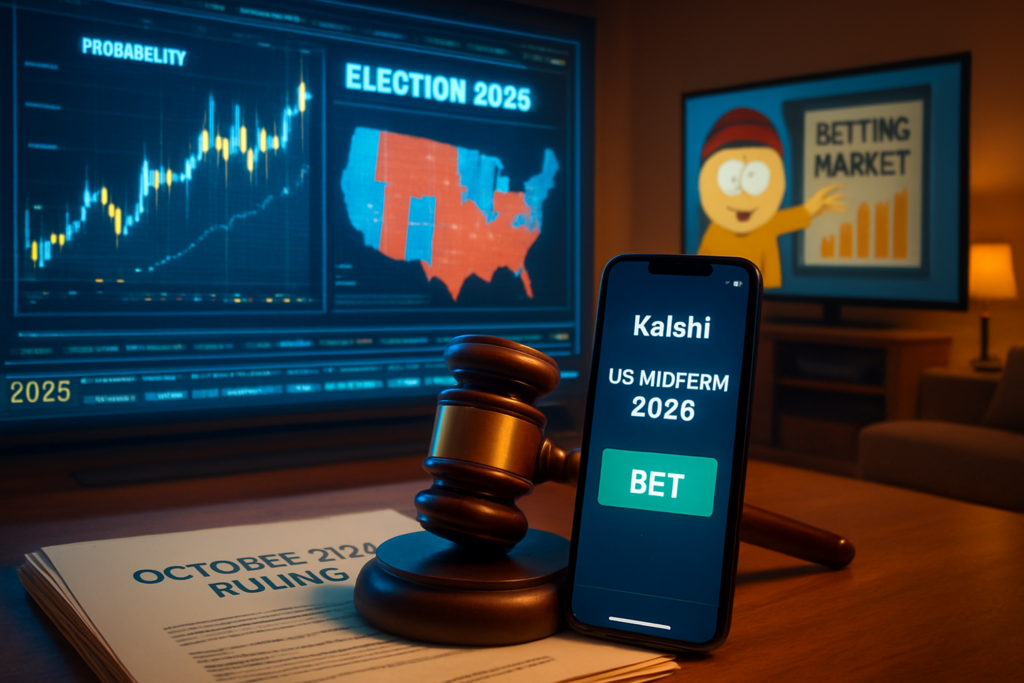
Currently, the primary focus for traders is the "2026 Midterm Power Balance" markets on Kalshi. Traders are currently pricing in a 68% probability that the GOP retains control of the House, while the Senate remains a toss-up at 51% for Democratic retention. Unlike the 2024 cycle, where liquidity was often fragmented, these markets now boast deep order books and institutional-grade stability.
Kalshi, the only U.S.-regulated exchange of its kind, has seen its daily active user base grow by 400% since January 2025. Alongside it, Polymarket continues to dominate global volume, though Kalshi’s integration into mainstream retail platforms has given it a distinct edge in "Main Street" participation. The current total value locked (TVL) across political markets has crossed the $12 billion mark this month, with resolution criteria for the Midterms set for the first Tuesday of November 2026.
The timeline for these markets has also shifted. In previous years, trading only heated up weeks before an election. In 2026, the markets are live and liquid two years out, providing a real-time "fear and greed" index for political sentiment that traditional polling—now largely relegated to a secondary data point—simply cannot match.
Why Traders Are Betting
The explosion in betting volume is driven by the formalization of "Information Finance." Investors no longer view these bets as mere gambling; they are increasingly used as a hedge against policy shifts. For instance, institutional traders are using House control markets to hedge against potential changes in corporate tax law, while retail investors are betting on Federal Reserve rate cuts to offset their mortgage concerns.
This shift was accelerated by the integration of prediction markets into major brokerage apps. After Kalshi’s legal win, Robinhood Markets, Inc. (NASDAQ: HOOD) and Interactive Brokers Group, Inc. (NASDAQ: IBKR) moved quickly to offer event contracts to their millions of users. This provided a "firehose" of liquidity that permanently moved the needle on market accuracy.
The cultural mainstreaming of the industry was perhaps best captured in late 2025, when the long-running animated series South Park aired the episode "Conflict of Interest" (Season 27, Episode 5). The plot, which featured the townspeople betting on everything from school board meetings to the lunch menu, satirized the "betting on everything" culture that Kalshi helped create. In a meta-twist that only 2026 could produce, Kalshi actually hosted a market on how many times the word "prediction" would be uttered in the episode, with over $500,000 traded on the outcome.
Broader Context and Implications
To understand why 2026 is a "marquee year," one must look back to October 2, 2024. On that day, the D.C. Circuit Court of Appeals denied the Commodity Futures Trading Commission (CFTC) an emergency stay, effectively legalizing election trading in the United States. Judge Jia Cobb’s earlier ruling—which argued that the CFTC had exceeded its authority by labeling elections as "gaming"—became the "Magna Carta" of prediction markets.
By mid-2025, the CFTC officially dropped its remaining appeals, signaling a "white flag" moment that allowed for permanent regulatory clarity. This legal peace led to a massive influx of venture capital and the entry of traditional sports betting giants like DraftKings Inc. (NASDAQ: DKNG) and Flutter Entertainment PLC (NYSE: FLUT), the parent company of FanDuel, into the event-contract space.
The implications for public sentiment are profound. We have moved from an era of "manufactured consensus" via polls to "skin-in-the-game" reality. When a market moves today, people pay attention because money is changing hands. This has created a more resilient information ecosystem, where rumors are quickly "priced out" by those with better information, making the 2026 markets the most efficient we have ever seen.
What to Watch Next
As we head deeper into 2026, the next major catalysts for the market will be the primary season debates. Traditionally, these were television events; now, they are high-frequency trading sessions. Watch for "candidate survival" markets to fluctuate wildly as the first debates of the 2026 cycle begin this summer.
Furthermore, keep an eye on the "Regulatory Harmonization Act" currently being debated in Congress. This proposed legislation aims to create a unified federal framework for all event contracts, potentially merging the oversight duties of the CFTC and the SEC for this asset class. If passed, it would likely trigger another massive wave of institutional adoption.
Finally, the evolution of "Social Betting"—where users can create their own private markets for friends and communities—is expected to be the next big feature release from Kalshi. This could turn the 2026 Midterms into a localized experience, with neighbors betting on local city council races and school board seats with the same ease they trade the S&P 500.
Bottom Line
The retrospective on Kalshi’s 2024 victory reveals a simple truth: the genie is out of the bottle. What was once dismissed as a legal longshot has transformed into a $40 billion industry that has fundamentally changed how we process news and risk. 2026 is the year prediction markets became the "source of truth" for a world weary of partisan polling and media spin.
The "marquee year" is characterized by a fusion of entertainment, finance, and democracy. Whether it’s through a South Park parody or a Robinhood notification, prediction markets are now part of the American fabric. As we look toward the 2026 Midterms, the odds don't just tell us what might happen—they tell us what the world knows will happen.
This article is for informational purposes only and does not constitute financial or betting advice. Prediction market participation may be subject to legal restrictions in your jurisdiction.
PredictStreet focuses on covering the latest developments in prediction markets.
Visit the PredictStreet website at https://www.predictstreet.ai/.