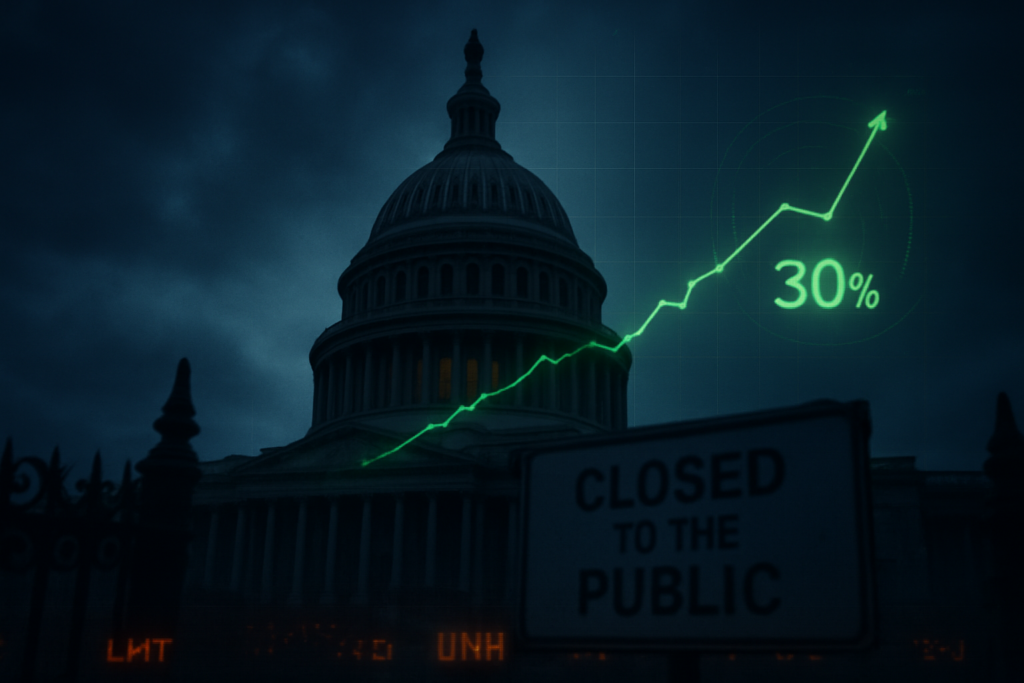
As the calendar turns toward late January 2026, a familiar sense of dread has returned to the halls of Congress and the screens of global investors. After the record-breaking 43-day shutdown that paralyzed the federal government in late 2025, a new "funding cliff" is fast approaching on January 31. This time, however, the uncertainty is being quantified in real-time by a surging prediction market on Kalshi, where traders are currently pricing the odds of a government shutdown at a precarious 30%.
The market is not just a niche interest for political junkies; it has become a high-stakes arena for institutional hedging and retail speculation. With over $1.6M in total volume traded and more than 880,000 open positions, the Kalshi contract "Will the government shut down on January 31?" has become a primary barometer for the success—or failure—of high-stakes budget negotiations between the White House and a divided Congress.
The Market: What’s Being Predicted
The specific market in question focuses on the midnight deadline of January 30, 2026. If a new funding agreement is not reached, the federal government will enter a partial shutdown on January 31. On Kalshi, the leading regulated prediction market in the U.S., the "Yes" contracts are currently trading at approximately 30 cents, implying a 30% probability of a shutdown. This represents a significant bounce from early January, when odds dipped to 20% following the passage of a bipartisan "minibus" spending package.
Unlike traditional polling, the Kalshi market provides a 24/7 liquidity pool that reacts instantly to legislative maneuvers. The resolution of the contract is tied specifically to the official website of the U.S. Office of Personnel Management (OPM). If the OPM site displays a notice of a lapse in appropriations at 10:00 AM ET on January 31, the market resolves to "Yes." Interestingly, Jan 31, 2026, falls on a Saturday—a detail that has led to a fascinating "technicality" gap between regulated platforms and decentralized ones like Polymarket, where traders are debating whether a weekend lapse without a formal Monday furlough notice counts as a "shutdown."
Why Traders Are Betting
The volatility in the odds is driven by three primary legislative "poison pills." First is the expiration of the Enhanced Premium Tax Credits for the Affordable Care Act (ACA), which officially lapsed on December 31, 2025. Democrats have signaled they will block any further funding bills unless these subsidies are restored, while Senate Republicans are demanding strict eligibility reforms. This "subsidy cliff" has already caused healthcare premiums to spike, and traders are watching the healthcare sector, particularly UnitedHealth Group (NYSE: UNH), for signals on how much pressure the industry is putting on lawmakers.
Second, the market is reacting to the shadow of the "One Big Beautiful Bill Act" (OBBBA), the massive tax and spending law passed in mid-2025. While that bill funded some agencies through late 2026, nine major appropriations bills—including those for Defense, Homeland Security, and Justice—remain on the chopping block for January 31.
Finally, the market has been influenced by "whale" activity. On decentralized platforms, a trader known by the pseudonym "Burdensome-Mix" has reportedly taken a massive "Yes" position, leading to rumors of insider information regarding the breakdown of Senate negotiations. This activity has been so pronounced that it spurred the introduction of the "Public Integrity in Financial Prediction Markets Act of 2026," a proposed bill by Rep. Ritchie Torres aimed at preventing federal officials from trading on non-public legislative timelines.
Broader Context and Implications
The 30% odds reflect a market that is skeptical but not yet panicked. For defense titans like Lockheed Martin (NYSE: LMT) and RTX Corporation (NYSE: RTX), the market serves as a "payment risk" index. Recent executive orders from the Trump administration have already restricted stock buybacks and dividends for defense contractors until production targets are met. A shutdown on January 31 would halt progress payments on major weapon systems, creating a liquidity crunch that these firms are desperate to avoid.
Historically, prediction markets have been remarkably accurate at front-running Congressional "deals." In the 2025 shutdown, the Kalshi market predicted the resolution four days before the final bill was signed. Today, the 30% probability suggests that while the rhetoric on Capitol Hill is heated, "smart money" still believes there is a 70% chance that a last-minute Continuing Resolution (CR) or a second "minibus" will be hammered out.
Furthermore, the divergence between Kalshi and Polymarket—where a "funding lapse" is priced at 56% but a "shutdown" at 29%—highlights the nuance of these markets. Traders expect the funding to technically expire, but many believe a deal will be reached over the weekend of January 31 before the "furlough" reality hits federal workers on Monday morning.
What to Watch Next
The most immediate catalyst for the market is scheduled for January 22, 2026, when the CEO of UnitedHealth Group is set to testify before a Senate committee regarding the expiration of ACA subsidies. If the testimony results in a breakthrough or a "hardening" of partisan lines, expect the 30% odds to move violently in either direction.
Another key milestone is the progress of the "Homeland Security and Border Security" funding bill. This has remained the most contentious piece of the appropriations puzzle. If a "clean" funding bill for this department fails to advance by January 25, the "Yes" odds on Kalshi will likely surge toward 50%. Traders are also keeping a close eye on the Senate's "minibus" package; its failure to clear a 60-vote threshold this week would be a clear signal that a lapse is imminent.
Bottom Line
The Kalshi market for the January 31 shutdown is more than just a betting pool; it is a sophisticated data point in an era of extreme political polarization. The current 30% probability suggests a "cautious optimism" among traders, but the $1.6M in volume indicates that the stakes could not be higher. For the first time, prediction markets are acting as a real-time check on Congressional grandstanding, forcing lawmakers to contend with a public and transparent probability of their own failure.
As we approach the January 30 deadline, the intersection of healthcare subsidies, defense spending restrictions, and prediction market transparency will define the start of 2026. Whether the government remains open or shutters its doors, the message from the markets is clear: the era of "wait and see" politics is being replaced by the era of "price it in."
This article is for informational purposes only and does not constitute financial or betting advice. Prediction market participation may be subject to legal restrictions in your jurisdiction.
PredictStreet focuses on covering the latest developments in prediction markets.
Visit the PredictStreet website at https://www.predictstreet.ai/.