Solar energy systems company Shoals (NASDAQ: SHLS) reported Q4 CY2025 results exceeding the market’s revenue expectations, with sales up 38.6% year on year to $148.3 million. On top of that, next quarter’s revenue guidance ($130 million at the midpoint) was surprisingly good and 9.6% above what analysts were expecting. Its non-GAAP profit of $0.10 per share was 28.4% below analysts’ consensus estimates.
Is now the time to buy Shoals? Find out by accessing our full research report, it’s free.
Shoals (SHLS) Q4 CY2025 Highlights:
- Revenue: $148.3 million vs analyst estimates of $144.9 million (38.6% year-on-year growth, 2.4% beat)
- Adjusted EPS: $0.10 vs analyst expectations of $0.14 (28.4% miss)
- Adjusted EBITDA: $30.28 million vs analyst estimates of $37.04 million (20.4% margin, 18.3% miss)
- Revenue Guidance for Q1 CY2026 is $130 million at the midpoint, above analyst estimates of $118.6 million
- EBITDA guidance for the upcoming financial year 2026 is $120 million at the midpoint, below analyst estimates of $134 million
- Operating Margin: 11.7%, down from 15.4% in the same quarter last year
- Free Cash Flow was -$11.25 million, down from $12.46 million in the same quarter last year
- Backlog: $747.6 million at quarter end, up 17.8% year on year
- Market Capitalization: $1.66 billion
“2025 was an exceptional year for Shoals. While the rapidly shifting political climate brought some volatility, the massive increase in demand for energy through the rest of the decade supports strong fundamentals for our business. We are beginning to see tangible results of executing our strategic plan; expanding our product portfolio, defending share within our core markets, and diversifying our presence into new, attractive market segments. We’ve made great progress and look forward to building on the momentum,” said Brandon Moss, CEO of Shoals.
Company Overview
Started in Huntsville, Alabama, Shoals (NASDAQ: SHLS) designs and manufactures products that make solar energy systems work more efficiently.
Revenue Growth
A company’s long-term performance is an indicator of its overall quality. Even a bad business can shine for one or two quarters, but a top-tier one grows for years. Over the last five years, Shoals grew its sales at an incredible 22% compounded annual growth rate. Its growth beat the average industrials company and shows its offerings resonate with customers.
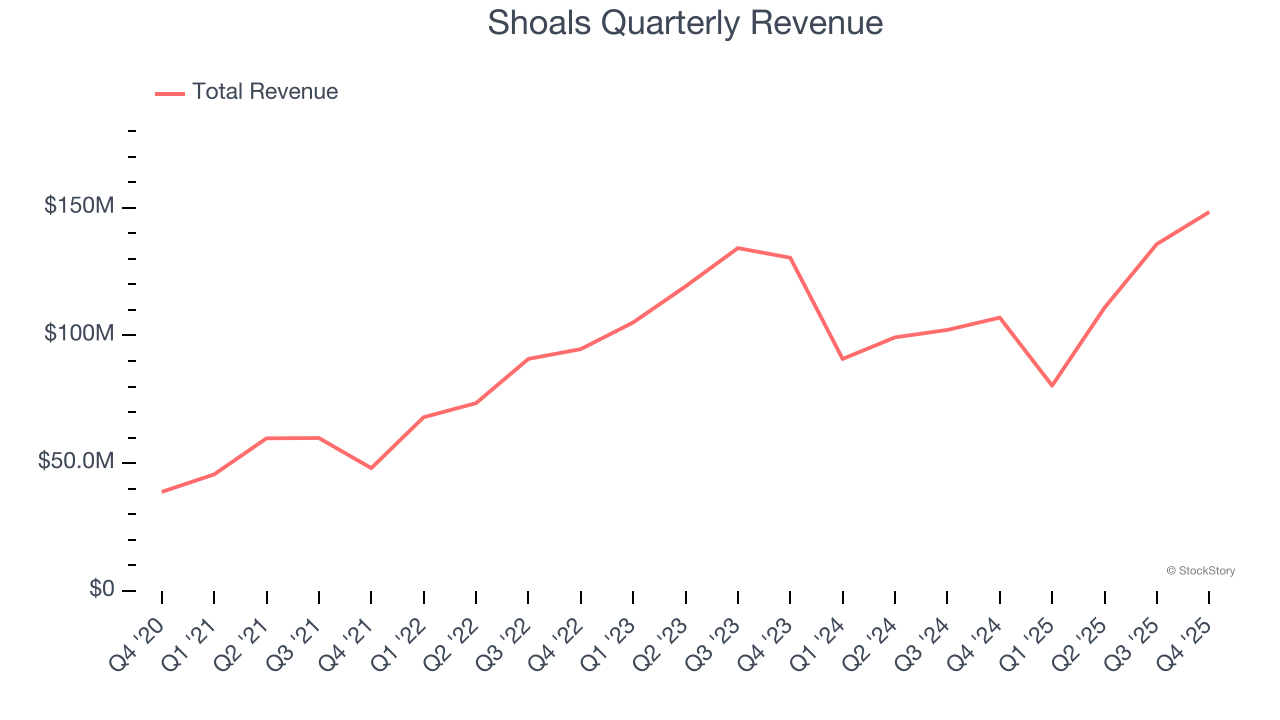
We at StockStory place the most emphasis on long-term growth, but within industrials, a half-decade historical view may miss cycles, industry trends, or a company capitalizing on catalysts such as a new contract win or a successful product line. Shoals’s recent performance marks a sharp pivot from its five-year trend as its revenue has shown annualized declines of 1.4% over the last two years. 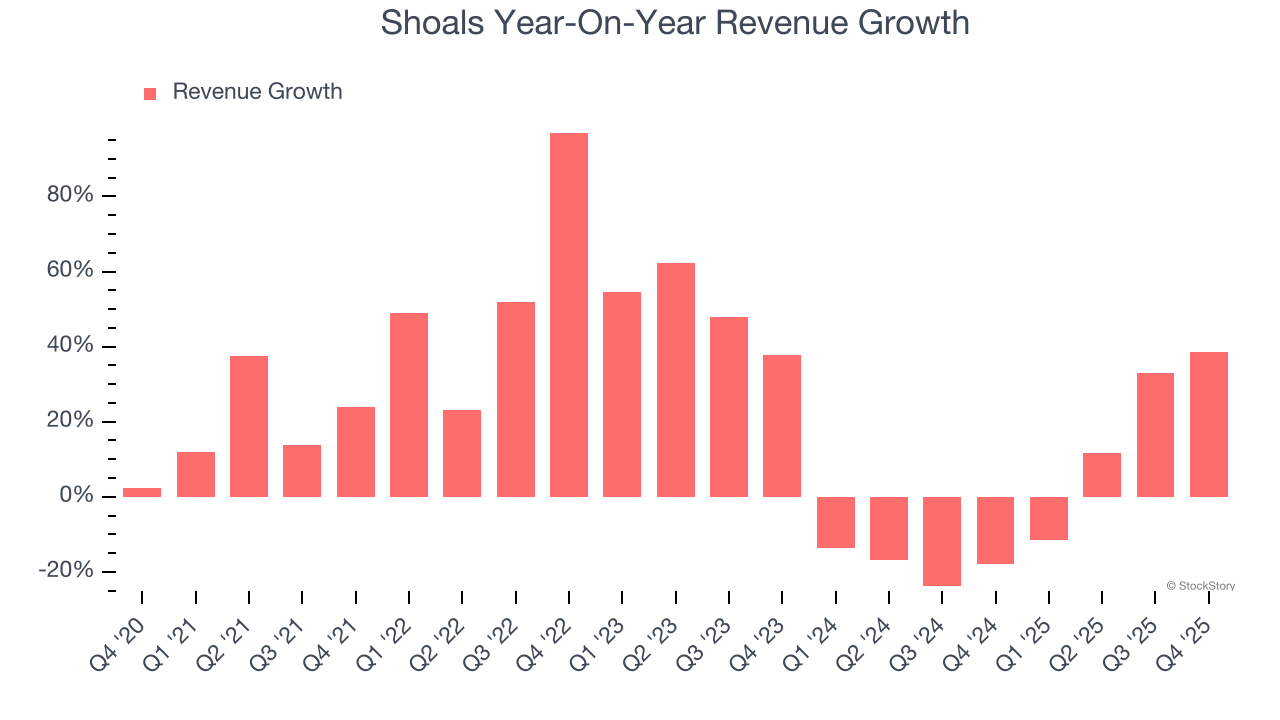
We can better understand the company’s revenue dynamics by analyzing its backlog, or the value of its outstanding orders that have not yet been executed or delivered. Shoals’s backlog reached $747.6 million in the latest quarter and averaged 9.7% year-on-year growth over the last two years. Because this number is better than its revenue growth, we can see the company accumulated more orders than it could fulfill and deferred revenue to the future. This could imply elevated demand for Shoals’s products and services but raises concerns about capacity constraints. 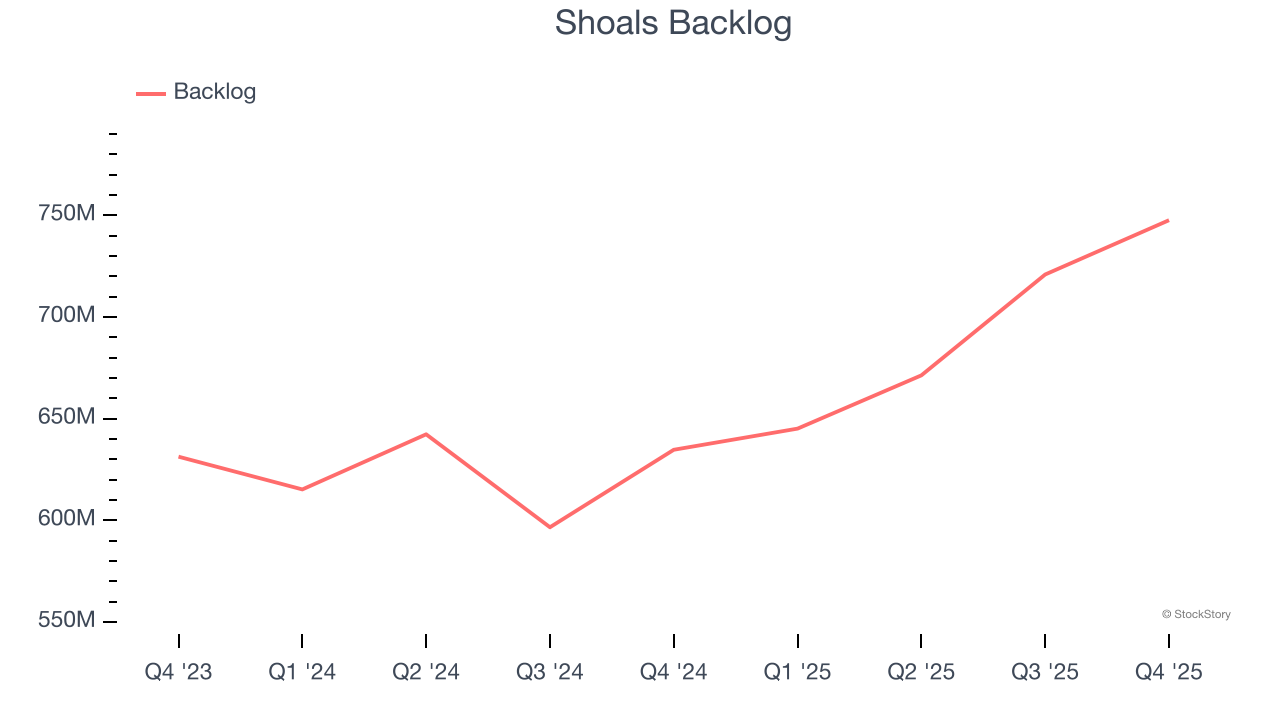
This quarter, Shoals reported wonderful year-on-year revenue growth of 38.6%, and its $148.3 million of revenue exceeded Wall Street’s estimates by 2.4%. Company management is currently guiding for a 61.8% year-on-year increase in sales next quarter.
Looking further ahead, sell-side analysts expect revenue to grow 18.3% over the next 12 months, an improvement versus the last two years. This projection is eye-popping and suggests its newer products and services will spur better top-line performance.
The 1999 book Gorilla Game predicted Microsoft and Apple would dominate tech before it happened. Its thesis? Identify the platform winners early. Today, enterprise software companies embedding generative AI are becoming the new gorillas. a profitable, fast-growing enterprise software stock that is already riding the automation wave and looking to catch the generative AI next.
Operating Margin
Operating margin is a key measure of profitability. Think of it as net income - the bottom line - excluding the impact of taxes and interest on debt, which are less connected to business fundamentals.
Shoals has been an efficient company over the last five years. It was one of the more profitable businesses in the industrials sector, boasting an average operating margin of 15.2%. This result isn’t surprising as its high gross margin gives it a favorable starting point.
Analyzing the trend in its profitability, Shoals’s operating margin decreased by 5.1 percentage points over the last five years. This raises questions about the company’s expense base because its revenue growth should have given it leverage on its fixed costs, resulting in better economies of scale and profitability.
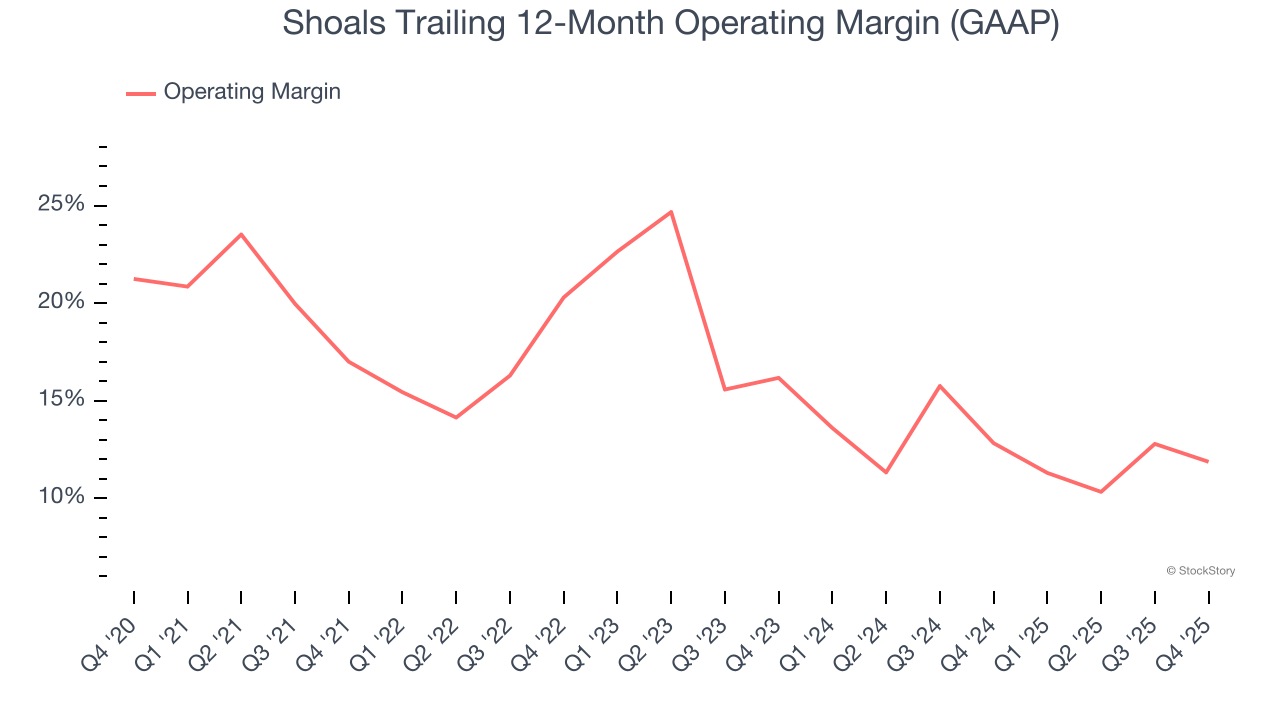
In Q4, Shoals generated an operating margin profit margin of 11.7%, down 3.7 percentage points year on year. Since Shoals’s gross margin decreased more than its operating margin, we can assume its recent inefficiencies were driven more by weaker leverage on its cost of sales rather than increased marketing, R&D, and administrative overhead expenses.
Earnings Per Share
We track the long-term change in earnings per share (EPS) for the same reason as long-term revenue growth. Compared to revenue, however, EPS highlights whether a company’s growth is profitable.
Shoals’s full-year EPS grew at a remarkable 12.3% compounded annual growth rate over the last four years, better than the broader industrials sector.
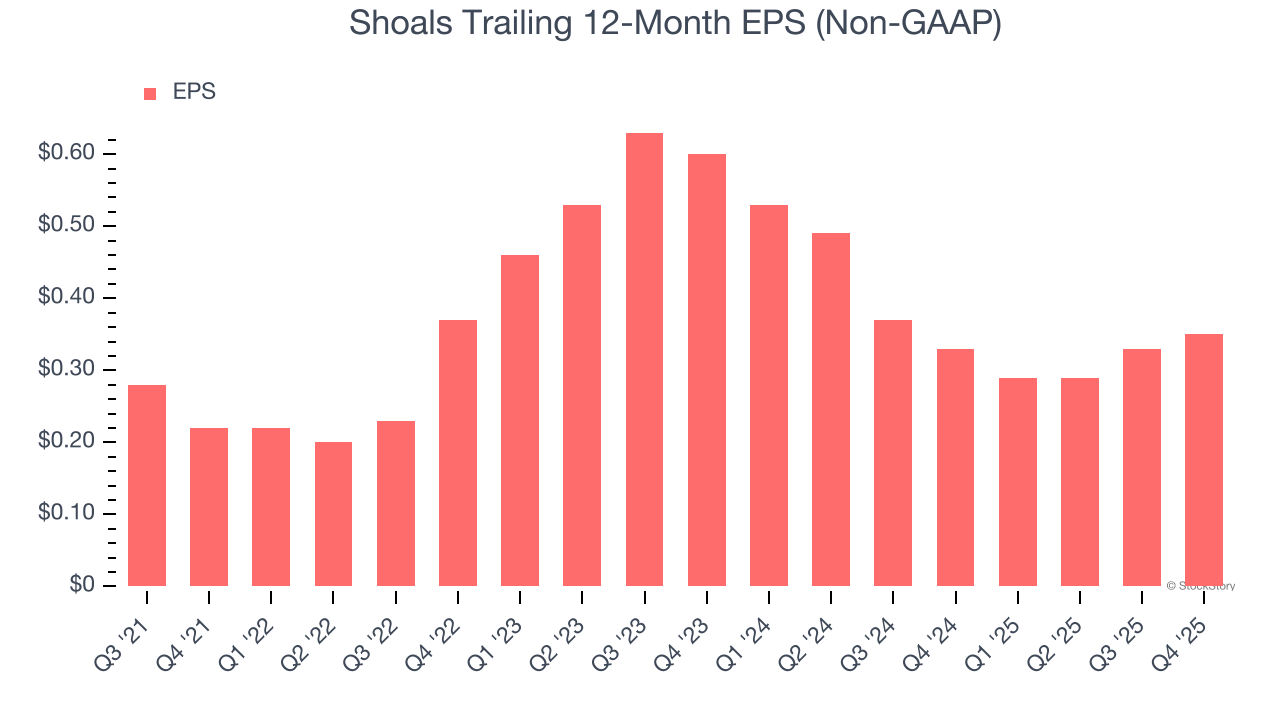
Like with revenue, we analyze EPS over a more recent period because it can provide insight into an emerging theme or development for the business.
Sadly for Shoals, its EPS declined by more than its revenue over the last two years, dropping 23.6%. This tells us the company struggled to adjust to shrinking demand.
Diving into the nuances of Shoals’s earnings can give us a better understanding of its performance. Shoals’s operating margin has declined over the last two years. This was the most relevant factor (aside from the revenue impact) behind its lower earnings; interest expenses and taxes can also affect EPS but don’t tell us as much about a company’s fundamentals.
In Q4, Shoals reported adjusted EPS of $0.10, up from $0.08 in the same quarter last year. Despite growing year on year, this print missed analysts’ estimates, but we care more about long-term adjusted EPS growth than short-term movements. Over the next 12 months, Wall Street expects Shoals’s full-year EPS of $0.35 to grow 44.8%.
Key Takeaways from Shoals’s Q4 Results
We were impressed by Shoals’s optimistic revenue guidance for next quarter, which blew past analysts’ expectations. We were also glad its full-year revenue guidance trumped Wall Street’s estimates. On the other hand, its full-year EBITDA guidance missed and its EBITDA fell short of Wall Street’s estimates. Overall, this was a softer quarter. The stock traded down 10.8% to $8.83 immediately following the results.
So do we think Shoals is an attractive buy at the current price? If you’re making that decision, you should consider the bigger picture of valuation, business qualities, as well as the latest earnings. We cover that in our actionable full research report which you can read here (it’s free).