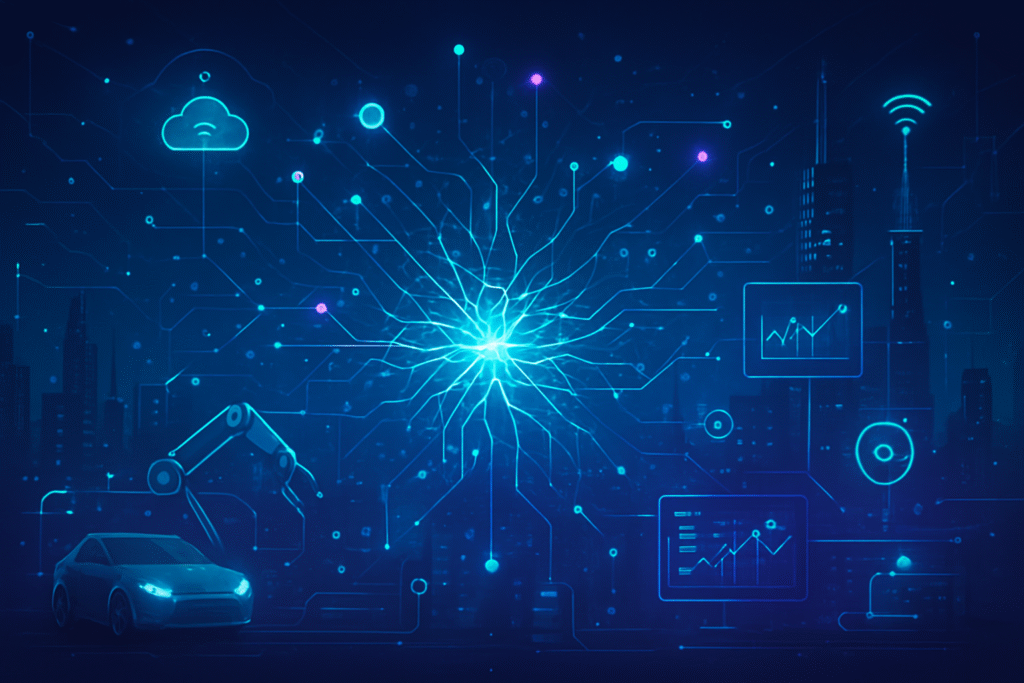
The convergence of Artificial Intelligence (AI) and the Internet of Things (IoT) is ushering in an unprecedented era of data-driven decision-making, fundamentally reshaping operational strategies across virtually every industry. This powerful synergy allows organizations to move beyond traditional reactive approaches, leveraging vast streams of real-time data from interconnected devices to generate actionable insights and sophisticated predictive analytics. The immediate significance lies in the ability to gather, process, and analyze information at speeds and scales previously unimaginable, transforming complex raw data into strategic intelligence.
This transformative shift empowers businesses to make agile, precise, and proactive decisions, leading to substantial improvements in efficiency, cost savings, and competitive advantage. From optimizing manufacturing processes with predictive maintenance to streamlining global supply chains and enhancing personalized customer experiences, AI and IoT are not just improving existing operations; they are redefining what's possible, driving a paradigm shift towards intelligent, adaptive, and highly responsive enterprise ecosystems.
The Technical Alchemy: How AI Unlocks IoT's Potential
The symbiotic relationship between AI and IoT positions IoT as the sensory layer of the digital world, continuously collecting vast and diverse datasets, while AI acts as the intelligent brain, transforming this raw data into actionable insights. IoT devices are equipped with an extensive array of sensors, including temperature, humidity, motion, pressure, vibration, GPS, optical, and RFID, which generate an unprecedented volume of data in various formats—text, images, audio, and time-series signals. Handling such massive, continuous data streams necessitates robust, scalable infrastructure, often leveraging cloud-based solutions and distributed processing.
AI algorithms process this deluge of IoT data through various advanced machine learning models to detect patterns, predict outcomes, and generate actionable insights. Machine Learning (ML) serves as the foundation, learning from historical and real-time sensor data for critical applications like predictive maintenance, anomaly detection, and resource optimization. For instance, ML models analyze vibration and temperature data from industrial equipment to predict failures, enabling proactive interventions that drastically reduce downtime and costs. Deep Learning (DL), a subset of ML, utilizes artificial neural networks to excel at complex pattern recognition, particularly effective for processing unstructured sensor data such as images from quality control cameras or video feeds, leading to higher accuracy in predictions and reduced human intervention.
A crucial advancement is Edge AI, which moves AI computation and inference closer to the data source—directly on IoT devices or edge computing nodes. This significantly reduces latency and bandwidth usage, critical for applications requiring immediate responses like autonomous vehicles or industrial automation. Edge AI facilitates real-time processing and predictive modeling, allowing AI systems to rapidly process data as it's generated, identify patterns instantly, and forecast future trends. This capability fundamentally shifts operations from reactive to proactive, enabling businesses to anticipate issues, optimize resource allocation, and plan strategically. Unlike traditional Business Intelligence (BI) which focuses on "what happened" through batch processing of historical data, AI-driven IoT emphasizes "what will happen" and "what should be done" through real-time streaming data, automated analysis, and continuous learning.
The AI research community and industry experts have met this integration with immense enthusiasm, hailing it as a "monumental leap forward" and a path to "pervasive environmental intelligence." While acknowledging the immense potential, experts also highlight challenges such as the AI skill gap, the critical need for high-quality data, and pressing concerns around cybersecurity, data privacy, and algorithmic bias. Despite these hurdles, the prevailing sentiment is that the benefits of improved performance, reduced costs, enhanced efficiency, and predictive capabilities far outweigh the risks when addressed strategically and ethically.
Corporate Chessboard: Impact on Tech Giants, AI Companies, and Startups
The proliferation of AI and IoT in data-driven decision-making is fundamentally reshaping the competitive landscape, creating both immense opportunities and significant strategic shifts across the technology sector. This AIoT convergence is driving innovation, efficiency, and new business models.
AI Companies are at the forefront, leveraging AI and IoT data to enhance their core offerings. They benefit from developing more sophisticated algorithms, accurate predictions, and intelligent automation for specialized solutions like predictive maintenance or smart city analytics. Companies like Samsara (NYSE: IOT), which provides IoT and AI solutions for operational efficiency, and UiPath Inc. (NYSE: PATH), a leader in robotic process automation increasingly integrating generative AI, are prime examples. The competitive implications for major AI labs include a "data moat" for those who can effectively utilize large volumes of IoT data, and the ongoing challenge of the AI skill gap. Disruption comes from the obsolescence of static AI models, a shift towards Edge AI, and the rise of integrated AIoT platforms, pushing companies towards full-stack expertise and industry-specific customization. Innodata Inc. (NASDAQ: INOD) is also well-positioned to benefit from this AI adoption trend.
Tech Giants possess the vast resources, infrastructure, and existing customer bases to rapidly scale AIoT initiatives. Companies like Amazon (NASDAQ: AMZN), through AWS IoT Analytics, and Microsoft (NASDAQ: MSFT), with its Azure IoT suite, leverage their cloud computing platforms to offer comprehensive solutions for predictive analytics and anomaly detection. Google (NASDAQ: GOOGL) utilizes AI and IoT in its data centers for efficiency and has initiatives like Project Brillo for IoT OS. Their strategic advantages include ecosystem dominance, real-time data processing at scale, and cross-industry application. However, they face intense platform wars, heightened scrutiny over data privacy and regulation, and fierce competition for AI and IoT talent. Arm Holdings plc (NASDAQ: ARM) benefits significantly by providing the architectural backbone for AI hardware across various devices, while BlackBerry (TSX: BB, NASDAQ: BB) integrates AI into secure IoT and automotive solutions.
Startups can be highly agile and disruptive, quickly identifying niche markets and offering innovative solutions. Companies like H2Ok Innovations, which uses AI to analyze factory-level data, and Yalantis, an IoT analytics company delivering real-time, actionable insights, exemplify this. AIoT allows them to streamline operations, reduce costs, and offer hyper-personalized customer experiences from inception. However, startups face challenges in securing capital, accessing large datasets, talent scarcity, and ensuring scalability and security. Their competitive advantage lies in a data-driven culture, agile development, and specialization in vertical markets where traditional solutions are lacking. Fastly Inc. (NYSE: FSLY), as a mid-sized tech company, also stands to benefit from market traction in AI, data centers, and IoT. Ultimately, the integration of AI and IoT is creating a highly dynamic environment where companies that embrace AIoT effectively gain significant strategic advantages, while those that fail to adapt risk being outpaced.
A New Frontier: Wider Significance and Societal Implications
The convergence of AI and IoT is not merely an incremental technological advancement; it represents a profound shift in the broader AI landscape, driving a new era of pervasive intelligence and autonomous systems. This synergy creates a robust framework where IoT devices continuously collect data, AI algorithms analyze it to identify intricate patterns, and systems move beyond descriptive analytics to offer predictive and prescriptive insights, often automating complex decision-making processes.
This integration is a cornerstone of several critical AI trends. Edge AI is crucial, deploying AI algorithms directly on local IoT devices to reduce latency, enhance data security, and enable real-time decision-making for time-sensitive applications like autonomous vehicles. Digital Twins, dynamic virtual replicas of physical assets continuously updated by IoT sensors and made intelligent by AI, facilitate predictive maintenance, operational optimization, and scenario planning, with Edge AI further enhancing their autonomy. The combination is also central to the development of fully Autonomous Systems in transportation, manufacturing, and robotics, allowing devices to operate effectively without constant human oversight. Furthermore, the proliferation of 5G connectivity is supercharging AIoT, providing the necessary speed, ultra-low latency, and reliable connections to support vast numbers of connected devices and real-time, AI-driven applications.
The impacts across industries are transformative. In Manufacturing, AIoT enables real-time machine monitoring and predictive maintenance. Retail and E-commerce benefit from personalized recommendations and optimized inventory. Logistics and Supply Chain gain real-time tracking and route optimization. Smart Cities leverage it for efficient traffic management, waste collection, and public safety. In Healthcare, IoT wearables combined with AI allow for continuous patient monitoring and early detection of issues. Agriculture sees precision farming with AI-guided irrigation and pest control, while Banking utilizes advanced AI-driven fraud detection.
However, this transformative power comes with significant societal implications and concerns. Job displacement is a major worry as AI and automation take over routine and complex tasks, necessitating ethical frameworks, reskilling programs, and strategies to create new job opportunities. Ethical AI is paramount, addressing algorithmic bias that can perpetuate societal prejudices and ensuring transparency and accountability in AI's decision-making processes. Data privacy is another critical concern, with the extensive data collection by IoT devices raising risks of breaches, unauthorized use, and surveillance. Robust data governance practices and adherence to regulations like GDPR and CCPA are essential. Other concerns include security risks (expanded attack surfaces, adversarial AI), interoperability challenges between diverse systems, potential over-reliance and loss of control in autonomous systems, and the slow pace of regulatory frameworks catching up with rapid technological advancements.
Compared to previous AI milestones—from early symbolic reasoning (Deep Blue) to the machine learning era (IBM Watson) and the deep learning/generative AI explosion (GPT models, Google Gemini)—the AIoT convergence represents a distinct leap. It moves beyond isolated intelligent tasks or cloud-centric processing to imbue the physical world with pervasive, real-time intelligence and the capacity for autonomous action. This fusion is not just an evolution; it is a revolution, fundamentally reshaping how we interact with our environment and solve complex problems in our daily lives.
The Horizon of Intelligence: Future Developments and Predictions
The convergence of AI and IoT is poised to drive an even more profound transformation in data-driven decision-making, promising a future where connected devices not only collect vast amounts of data but also intelligently analyze it in real-time to enable proactive, informed, and often autonomous decisions.
In the near-term (1-3 years), we can expect a widespread proliferation of AI-driven decision support systems across businesses, offering real-time, context-aware insights for quicker and more informed decisions. Edge computing and distributed AI will surge, allowing advanced analytics to be performed closer to the data source, drastically reducing latency for applications like autonomous vehicles and industrial automation. Enhanced real-time data integration and automation will become standard, coupled with broader adoption of Digital Twin technologies for optimizing complex systems. The ongoing global rollout of 5G networks will significantly boost AIoT capabilities, providing the necessary speed and low latency for real-time processing and analysis.
Looking further into the long-term (beyond 3 years), the evolution of AI ethics and governance frameworks will be pivotal in shaping responsible AI practices, ensuring transparency, accountability, and addressing bias. The advent of 6G will further empower IoT devices for mission-critical applications like autonomous driving and precision healthcare. Federated Learning will enable decentralized AI, allowing devices to collaboratively train models without exchanging raw data, preserving privacy. This will contribute to the democratization of intelligence, shifting AI from centralized clouds to distributed devices. Generative AI, powered by large language models, will be embedded into IoT devices for conversational interfaces and predictive agents, leading to the emergence of autonomous AI Agents that interact, make decisions, and complete tasks. Experts even predict the rise of entirely AI-native firms that could displace today's tech giants.
Potential applications and use cases on the horizon are vast. In Manufacturing and Industrial IoT (IIoT), expect more sophisticated predictive maintenance, automated quality control, and enhanced worker safety through AI and wearables. Smart Cities will see more intelligent traffic management and environmental monitoring. Healthcare will benefit from real-time patient monitoring via AI-equipped wearables and predictive analytics for facility planning. Retail and E-commerce will offer hyper-personalized customer experiences and highly optimized inventory and supply chain management. Precision Farming will leverage AIoT for targeted irrigation, fertilization, and livestock monitoring, while Energy and Utility Management will see smarter grids and greater energy efficiency.
However, significant challenges must be addressed. Interoperability remains a hurdle, requiring clear standards for integrating diverse IoT devices and legacy systems. Ethics and bias in AI algorithms, along with the need for transparency and public acceptance, are paramount. The rapidly increasing energy consumption of AI-driven data centers demands innovative solutions. Data privacy and security will intensify, requiring robust protocols against cyberattacks and data poisoning, especially with the rise of Shadow AI (unsanctioned generative AI use by employees). Skill gaps in cross-disciplinary professionals, demands for advanced infrastructure (5G, 6G), and the complexity of data quality also pose challenges.
Experts predict the AIoT market will expand significantly, projected to reach $79.13 billion by 2030 from $18.37 billion in 2024. This growth will be fueled by accelerated adoption of digital twins, multimodal AI for context-aware applications, and the integration of AI with 5G and edge computing. While short-term job market disruptions are expected, AI is also anticipated to spark many new roles, driving economic growth. The increasing popularity of synthetic data will address privacy concerns in IoT applications. Ultimately, autonomous IoT systems, leveraging AI, will self-manage, diagnose, and optimize with minimal human intervention, leading the forefront of industrial automation and solidifying the "democratization of intelligence."
The Intelligent Nexus: A Comprehensive Wrap-Up
The convergence of Artificial Intelligence (AI) and the Internet of Things (IoT) represents a monumental leap in data-driven decision-making, fundamentally transforming how organizations operate and strategize. This synergy, often termed AIoT, ushers in an era where interconnected devices not only gather vast amounts of data but also intelligently analyze, learn, and often act autonomously, leading to unprecedented levels of efficiency, intelligence, and innovation across diverse sectors.
Key takeaways from this transformative power include the ability to derive real-time insights with enhanced accuracy, enabling businesses to shift from reactive to proactive strategies. AIoT drives smarter automation and operational efficiency through applications like predictive maintenance and optimized supply chains. Its predictive and prescriptive capabilities allow for precise forecasting and strategic resource allocation. Furthermore, it facilitates hyper-personalization for enhanced customer experiences and provides a significant competitive advantage through innovation. The ability of AI to empower IoT devices with autonomous decision-making capabilities, often at the edge, marks a critical evolution in distributed intelligence.
In the grand tapestry of AI history, the AIoT convergence marks a pivotal moment. It moves beyond the early symbolic reasoning and machine learning eras, and even beyond the initial deep learning breakthroughs, by deeply integrating intelligence into the physical world. This is not just about processing data; it's about imbuing the "nervous system" of the digital world (IoT) with the "brain" of smart technology (AI), creating self-learning, adaptive ecosystems. This profound integration is a defining characteristic of the Fourth Industrial Revolution, allowing devices to perceive, act, and learn, pushing the boundaries of automation and intelligence to unprecedented levels.
The long-term impact will be profound and pervasive, creating a smarter, self-learning world. Industries will undergo continuous intelligent transformation, optimizing operations and resource utilization across the board. However, this evolution necessitates a careful navigation of ethical and societal shifts, particularly concerning privacy protection, data security, and algorithmic bias. Robust governance frameworks will be crucial to ensure transparency and responsible AI deployment. The workforce will also evolve, requiring continuous upskilling to bridge the AI skill gap. Ultimately, the future points towards a world where intelligent, data-driven systems are the backbone of most human activities, enabling more adaptive, efficient, and personalized interactions with the physical world.
In the coming weeks and months, several key trends will continue to shape this trajectory. Watch for the increasing proliferation of Edge AI and distributed AI models, bringing real-time decision-making closer to the data source. Expect continued advancements in AI algorithms, with greater integration of generative AI into IoT applications, leading to more sophisticated and context-aware decision support systems. The ongoing rollout of 5G networks will further amplify AIoT capabilities, while the focus on cybersecurity and data governance will intensify to protect against evolving threats and ensure compliance. Crucially, the development of effective human-AI collaboration models will be vital, ensuring that AI augments, rather than replaces, human judgment. Finally, addressing the AI skill gap through targeted training and the growing popularity of synthetic data for privacy-preserving AI model training will be critical indicators of progress. The immediate future promises a continued push towards more intelligent, autonomous, and integrated systems, solidifying AIoT as the foundational backbone of modern data-driven strategies.
This content is intended for informational purposes only and represents analysis of current AI developments.
TokenRing AI delivers enterprise-grade solutions for multi-agent AI workflow orchestration, AI-powered development tools, and seamless remote collaboration platforms.
For more information, visit https://www.tokenring.ai/.