As the artificial intelligence industry closes out 2025, the narrative of "bigger is better" regarding compute power has shifted toward a more fundamental physical constraint: the "Memory Wall." For years, the raw processing speed of GPUs has outpaced the rate at which data can be moved from memory to the processor, leaving the world’s most advanced AI chips idling for significant portions of their operation. However, a series of breakthroughs in late 2025—headlined by the mass production of HBM4 and the commercial debut of Processing-in-Memory (PIM) architectures—marks a pivotal moment where the industry is finally beginning to dismantle this bottleneck.
The immediate significance of these developments cannot be overstated. As Large Language Models (LLMs) like GPT-5 and Llama 4 push toward multi-trillion parameter scales, the cost and energy required to move data between components have become the primary limiters of AI performance. By integrating compute capabilities directly into the memory stack and doubling the data bus width, the industry is moving from a "compute-centric" to a "memory-centric" architecture. This shift is expected to reduce the energy consumption of AI inference by up to 70%, effectively extending the life of current data center power grids while enabling the next generation of "Agentic AI" that requires massive, persistent memory contexts.
The Technical Breakthrough: HBM4 and the 2,048-Bit Leap
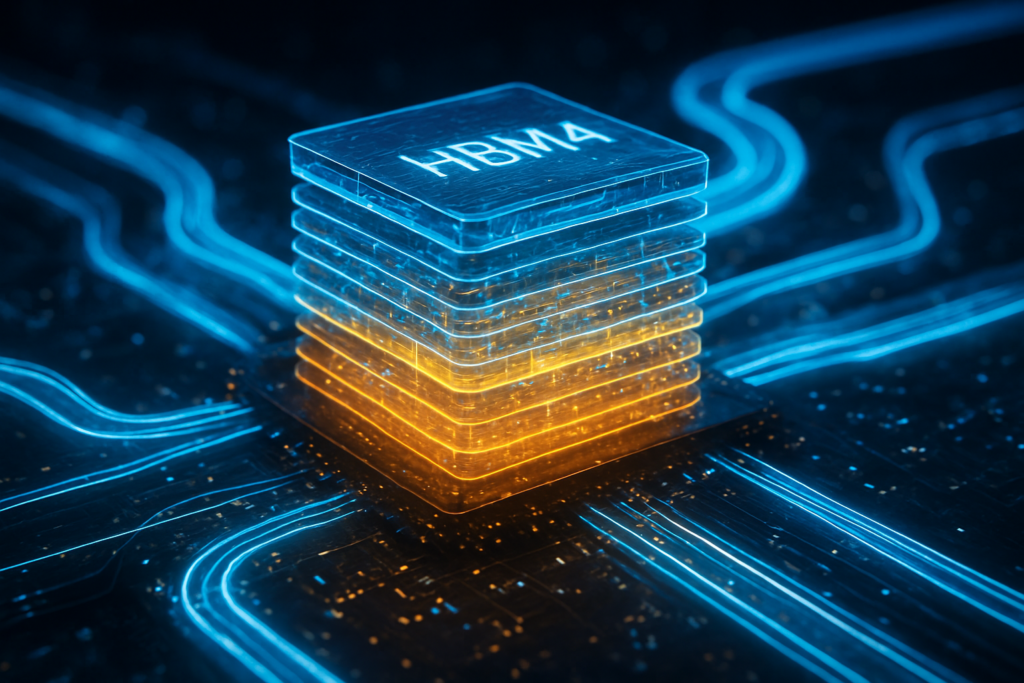
The technical cornerstone of this evolution is High Bandwidth Memory 4 (HBM4). Unlike its predecessor, HBM3E, which utilized a 1,024-bit interface, HBM4 doubles the width of the data highway to 2,048 bits. This change, showcased prominently at the Supercomputing Conference (SC25) in November, allows for bandwidths exceeding 2 TB/s per stack. SK Hynix (KRX: 000660) led the charge this year by demonstrating the world's first 12-layer HBM4 stacks, which utilize a base logic die manufactured on advanced foundry processes to manage the massive data flow.
Beyond raw bandwidth, the emergence of Processing-in-Memory (PIM) represents a radical departure from the traditional Von Neumann architecture, where the CPU/GPU and memory are separate entities. Technologies like SK Hynix's AiMX and Samsung (KRX: 005930) Mach-1 are now embedding AI processing units directly into the memory chips themselves. This allows the memory to handle specific tasks—such as the "Attention" mechanisms in LLMs or Key-Value (KV) cache management—without ever sending the data back to the main GPU. By performing these operations "in-place," PIM chips eliminate the latency and energy overhead of the data bus, which has historically been the "wall" preventing real-time performance in long-context AI applications.
Initial reactions from the research community have been overwhelmingly positive. Dr. Elena Rossi, a senior hardware analyst, noted at SC25 that "we are finally seeing the end of the 'dark silicon' era where GPUs sat waiting for data. The integration of a 4nm logic die at the base of the HBM4 stack allows for a level of customization we’ve never seen, essentially turning the memory into a co-processor." This "Custom HBM" trend allows companies like NVIDIA (NASDAQ: NVDA) to co-design the memory logic with foundries like TSMC (NYSE: TSM), ensuring that the memory architecture is perfectly tuned for the specific mathematical kernels used in modern transformer models.
The Competitive Landscape: NVIDIA’s Rubin and the Memory Giants
The shift toward memory-centric computing is redrawing the competitive map for tech giants. NVIDIA (NASDAQ: NVDA) remains the dominant force, but its strategy has pivoted toward a yearly release cadence to keep pace with memory advancements. The recently detailed "Rubin" R100 GPU architecture, slated for full mass production in early 2026, is designed from the ground up to leverage HBM4. With eight HBM4 stacks providing a staggering 13 TB/s of system bandwidth, NVIDIA is positioning itself not just as a chip maker, but as a system architect that controls the entire data path via its NVLink 7 interconnects.
Meanwhile, the "Memory War" between SK Hynix, Samsung, and Micron (NASDAQ: MU) has reached a fever pitch. Samsung, which trailed in the HBM3E cycle, has signaled a massive comeback in December 2025 by reporting 90% yields on its HBM4 logic dies. Samsung is also pushing the "AI at the edge" frontier with its SOCAMM2 and LPDDR6-PIM standards, reportedly in collaboration with Apple (NASDAQ: AAPL) to bring high-performance AI memory to future mobile devices. Micron, while slightly behind in the HBM4 ramp, announced that its 2026 supply is already sold out, underscoring the insatiable demand for high-speed memory across the industry.
This development is also a boon for specialized AI startups and cloud providers. The introduction of CXL 3.2 (Compute Express Link) allows for "Memory Pooling," where multiple GPUs can share a massive bank of external memory. This effectively disrupts the current limitation where an AI model's size is capped by the VRAM of a single GPU. Startups focusing on inference-dedicated ASICs are now using PIM to offer "LLM-in-a-box" solutions that provide the performance of a multi-million dollar cluster at a fraction of the power and cost, challenging the dominance of traditional hyperscale data centers.
Wider Significance: Sustainability and the Rise of Agentic AI
The broader implications of dismantling the Memory Wall extend far beyond technical benchmarks. Perhaps the most critical impact is on sustainability. In 2024, the energy consumption of AI data centers was a growing global concern. By late 2025, the 10x to 20x reduction in "Energy per Token" enabled by PIM and HBM4 has provided a much-needed reprieve. This efficiency gain allows for the "democratization" of AI, as smaller, more efficient hardware can now run models that previously required massive power-hungry clusters.
Furthermore, solving the memory bottleneck is the primary enabler of "Agentic AI"—systems capable of long-term reasoning and multi-step task execution. Agents require a "working memory" (the KV-cache) that can span millions of tokens. Previously, the Memory Wall made maintaining such a large context window prohibitively slow and expensive. With HBM4 and CXL-based memory pooling, AI agents can now "remember" hours of conversation or thousands of pages of documentation in real-time, moving AI from a simple chatbot interface to a truly autonomous digital colleague.
However, this breakthrough also brings concerns. The concentration of the HBM4 supply chain in the hands of three major players (SK Hynix, Samsung, and Micron) and one major foundry (TSMC) creates a significant geopolitical and economic choke point. Furthermore, as hardware becomes more efficient, the "Jevons Paradox" may take hold: the increased efficiency could lead to even greater total energy consumption as the sheer volume of AI deployment explodes across every sector of the economy.
The Road Ahead: 3D Stacking and Optical Interconnects
Looking toward 2026 and beyond, the industry is already eyeing the next set of hurdles. While HBM4 and PIM have provided a temporary bridge over the Memory Wall, the long-term solution likely involves true 3D integration. Experts predict that the next major milestone will be "bumpless" bonding, where memory and logic are stacked directly on top of each other with such high density that the distinction between the two virtually disappears.
We are also seeing the early stages of optical interconnects moving from the rack-to-rack level down to the chip-to-chip level. Companies are experimenting with using light instead of electricity to move data between the memory and the processor, which could theoretically provide infinite bandwidth with zero heat generation. In the near term, expect to see the "Custom HBM" trend accelerate, with AI labs like OpenAI and Meta (NASDAQ: META) designing their own proprietary memory logic to gain a competitive edge in model performance.
Challenges remain, particularly in the software layer. Current programming models like CUDA are optimized for moving data to the compute; re-writing these frameworks to support "computing in the memory" is a monumental task that the industry is only beginning to address. Nevertheless, the consensus among experts is clear: the architecture of the next decade of AI will be defined not by how fast we can calculate, but by how intelligently we can store and move data.
A New Foundation for Intelligence
The dismantling of the Memory Wall marks a transition from the "Brute Force" era of AI to the "Architectural Refinement" era. By doubling bandwidth with HBM4 and bringing compute to the data through PIM, the industry has successfully bypassed a physical limit that many feared would stall AI progress by 2025. This achievement is as significant as the transition from CPUs to GPUs was a decade ago, providing the physical foundation necessary for the next leap in machine intelligence.
As we move into 2026, the success of these technologies will be measured by their deployment in the wild. Watch for the first HBM4-powered "Rubin" systems to hit the market and for the integration of PIM into consumer devices, which will signal the arrival of truly capable on-device AI. The Memory Wall has not been completely demolished, but for the first time in the history of modern computing, we have found a way to build a door through it.
This content is intended for informational purposes only and represents analysis of current AI developments.
TokenRing AI delivers enterprise-grade solutions for multi-agent AI workflow orchestration, AI-powered development tools, and seamless remote collaboration platforms.
For more information, visit https://www.tokenring.ai/.