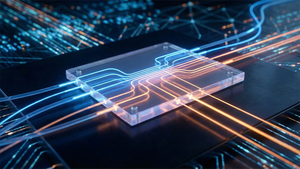
As of December 18, 2025, the artificial intelligence industry has reached a pivotal inflection point where the speed of light is no longer a theoretical limit, but a production requirement. For years, the industry has warned of a looming "interconnect bottleneck"—a physical wall where the electrical wires connecting GPUs could no longer keep pace with the massive data demands of trillion-parameter models. This week, that wall was officially dismantled as the tech industry fully embraced silicon photonics, shifting the fundamental medium of AI communication from electrons to photons.
The significance of this transition cannot be overstated. With the recent announcement that Marvell Technology (NASDAQ: MRVL) has finalized its landmark acquisition of Celestial AI for $3.25 billion, the race to integrate "Photonic Fabrics" into the heart of AI silicon has moved from the laboratory to the center of the global supply chain. By replacing copper traces with microscopic lasers and fiber optics, AI clusters are now achieving bandwidth densities and energy efficiencies that were considered impossible just twenty-four months ago, effectively unlocking the next era of "cluster-scale" computing.
The End of the Copper Era: Technical Breakthroughs in Optical I/O
The primary driver behind the shift to silicon photonics is the dual crisis of the "Shoreline Limitation" and the "Power Wall." In traditional GPU architectures, such as the early iterations of the Blackwell series from Nvidia (NASDAQ: NVDA), data must travel through the physical edges (the shoreline) of the chip via electrical pins. As logic density increased, the perimeter of the chip simply ran out of room for more pins. Furthermore, pushing electrical signals through copper at speeds exceeding 200 Gbps requires massive amounts of power for signal retiming. In 2024, nearly 30% of an AI cluster's energy was wasted just moving data between chips; in late 2025, silicon photonics has slashed that "optics tax" by over 80%.
Technically, this is achieved through Co-Packaged Optics (CPO) and Optical I/O chiplets. Instead of using external pluggable transceivers, companies are now 3D-stacking Photonic Integrated Circuits (PICs) directly onto the GPU or switch die. This allows for "Edgeless I/O," where data can be beamed directly from the center of the chip using light. Leading the charge is Broadcom (NASDAQ: AVGO), which recently began mass-shipping its Tomahawk 6 "Davidson" switch, the industry’s first 102.4 Tbps CPO platform. By integrating optical engines onto the substrate, Broadcom has reduced interconnect power consumption from 30 picojoules per bit (pJ/bit) to less than 5 pJ/bit.
This shift differs fundamentally from previous networking upgrades. While past transitions moved from 400G to 800G using the same electrical principles, silicon photonics changes the physics of the connection. Startups like Lightmatter have introduced the Passage M1000, a photonic interposer that supports a staggering 114 Tbps of optical bandwidth. This "photonic superchip" allows thousands of individual accelerators to behave as a single, unified processor with near-zero latency, a feat the AI research community has hailed as the most significant hardware breakthrough since the invention of the High Bandwidth Memory (HBM) stack.
Market Warfare: Who Wins the Photonic Arms Race?
The competitive landscape of the semiconductor industry is being redrawn by this optical pivot. Nvidia remains the titan to beat, having integrated silicon photonics into its Rubin architecture, slated for wide release in 2026. By leveraging its Spectrum-X networking fabric, Nvidia is moving toward a future where the entire back-end of an AI supercomputer is a seamless web of light. However, the Marvell acquisition of Celestial AI signals a direct challenge to Nvidia’s dominance. Marvell’s new "Photonic Fabric" aims to provide an open, high-bandwidth alternative that allows third-party AI accelerators to compete with Nvidia’s proprietary NVLink on performance and scale.
Broadcom and Intel (NASDAQ: INTC) are also carving out massive territories in this new market. Broadcom’s lead in CPO technology makes them the indispensable partner for "Hyperscalers" like Google and Meta, who are building custom AI silicon (XPUs) that require optical attaches to scale. Meanwhile, Intel has successfully integrated its Optical Compute Interconnect (OCI) chiplets into its latest Xeon and Gaudi lines. Intel’s milestone of shipping over 8 million PICs demonstrates a manufacturing maturity that many startups still struggle to match, positioning the company as a primary foundry for the photonic era.
For AI startups and labs, this development is a strategic lifeline. The ability to scale clusters to 100,000+ GPUs without the exponential power costs of copper allows smaller players to train increasingly sophisticated models. However, the high capital expenditure required to transition to optical infrastructure may further consolidate power among the "Big Tech" firms that can afford to rebuild their data centers from the ground up. We are seeing a shift where the "moat" for an AI company is no longer just its algorithm, but the photonic efficiency of its underlying hardware fabric.
Beyond the Bottleneck: Global and Societal Implications
The broader significance of silicon photonics extends into the realm of global energy sustainability. As AI energy consumption became a flashpoint for environmental concerns in 2024 and 2025, the move to light-based communication offers a rare "green" win for the industry. By reducing the energy required for data movement by 5x to 10x, silicon photonics is the primary reason the tech industry can continue to scale AI capabilities without triggering a collapse of local power grids. It represents a decoupling of performance growth from energy growth.
Furthermore, this technology is the key to achieving "Disaggregated Memory." In the electrical era, a GPU could only efficiently access the memory physically located on its board. With the low latency and long reach of light, 2025-era data centers are moving toward pools of memory that can be dynamically assigned to any processor in the rack. This "memory-centric" computing model is essential for the next generation of Large Multimodal Models (LMMs) that require petabytes of active memory to process real-time video and complex reasoning tasks.
However, the transition is not without its concerns. The reliance on silicon photonics introduces new complexities in the supply chain, particularly regarding the manufacturing of high-reliability lasers. Unlike traditional silicon, these lasers are often made from III-V materials like Indium Phosphide, which are more difficult to integrate and have different failure modes. There is also a geopolitical dimension; as silicon photonics becomes the "secret sauce" of AI supremacy, export controls on photonic design software and manufacturing equipment are expected to tighten, mirroring the restrictions seen in the EUV lithography market.
The Road Ahead: What’s Next for Optical Computing?
Looking toward 2026 and 2027, the industry is already eyeing the next frontier: all-optical computing. While silicon photonics currently handles the communication between chips, companies like Ayar Labs and Lightmatter are researching ways to perform certain computations using light itself. This would involve optical matrix-vector multipliers that could process neural network layers at the speed of light with almost zero heat generation. While still in the early stages, the success of optical I/O has provided the commercial foundation for these more radical architectures.
In the near term, expect to see the "UCIe (Universal Chiplet Interconnect Express) over Light" standard become the dominant protocol for chip-to-chip communication. This will allow a "Lego-like" ecosystem where a customer can pair an Nvidia GPU with a Marvell photonic chiplet and an Intel memory controller, all communicating over a standardized optical bus. The main challenge remains the "yield" of these complex 3D-stacked packages; as manufacturing processes mature throughout 2026, we expect the cost of optical I/O to drop, eventually making it standard even in consumer-grade edge AI devices.
Experts predict that by 2028, the term "interconnect bottleneck" will be a relic of the past. The focus will shift from how to move data to how to manage the sheer volume of intelligence that these light-speed clusters can generate. The "Optical Era" of AI is not just about faster chips; it is about the creation of a global, light-based neural fabric that can sustain the computational demands of Artificial General Intelligence (AGI).
A New Foundation for the Intelligence Age
The transition to silicon photonics marks the end of the "Electrical Bottleneck" that has constrained computer architecture since the 1940s. By successfully replacing copper with light, the AI industry has bypassed a physical limit that many feared would stall the progress of machine intelligence. The developments we have witnessed in late 2025—from Marvell’s strategic acquisitions to Broadcom’s record-breaking switches—confirm that the future of AI is optical.
As we look forward, the significance of this milestone will likely be compared to the transition from vacuum tubes to transistors. It is a fundamental shift in the physics of information. While the challenges of laser reliability and manufacturing costs remain, the momentum is irreversible. For the coming months, keep a close watch on the deployment of "Rubin" systems and the first wave of 100-Tbps optical switches; these will be the yardsticks by which we measure the success of the photonic revolution.
This content is intended for informational purposes only and represents analysis of current AI developments.
TokenRing AI delivers enterprise-grade solutions for multi-agent AI workflow orchestration, AI-powered development tools, and seamless remote collaboration platforms.
For more information, visit https://www.tokenring.ai/.