In a move that sent shockwaves through Silicon Valley on Christmas Eve 2025, NVIDIA (NASDAQ: NVDA) announced a transformative $20 billion strategic partnership with Groq, the pioneer of Language Processing Unit (LPU) technology. Structured as a "reverse acqui-hire," the deal involves NVIDIA paying a massive licensing fee for Groq’s intellectual property while simultaneously bringing on Groq’s founder and CEO, Jonathan Ross—the legendary inventor of Google’s (NASDAQ: GOOGL) Tensor Processing Unit (TPU)—to lead a new high-performance inference division. This tactical masterstroke effectively neutralizes one of NVIDIA’s most potent architectural rivals while positioning the company to dominate the burgeoning AI inference market.
The timing and structure of the deal are as significant as the technology itself. By opting for a licensing and talent-acquisition model rather than a traditional merger, NVIDIA CEO Jensen Huang has executed a sophisticated "regulatory arbitrage" play. This maneuver is designed to bypass the intense antitrust scrutiny from the Department of Justice and global regulators that has previously dogged the company’s expansion efforts. As the AI industry shifts its focus from the massive compute required to train models to the efficiency required to run them at scale, NVIDIA’s move signals a definitive pivot toward an inference-first future.
Breaking the Memory Wall: LPU Technology and the Vera Rubin Integration
At the heart of this $20 billion deal is Groq’s proprietary LPU technology, which represents a fundamental departure from the GPU-centric world NVIDIA helped create. Unlike traditional GPUs that rely on High Bandwidth Memory (HBM)—a component currently plagued by global supply chain shortages—Groq’s architecture utilizes on-chip SRAM (Static Random Access Memory). This "software-defined" hardware approach eliminates the "memory bottleneck" by keeping data on the chip, allowing for inference speeds up to 10 times faster than current state-of-the-art GPUs while reducing energy consumption by a factor of 20.
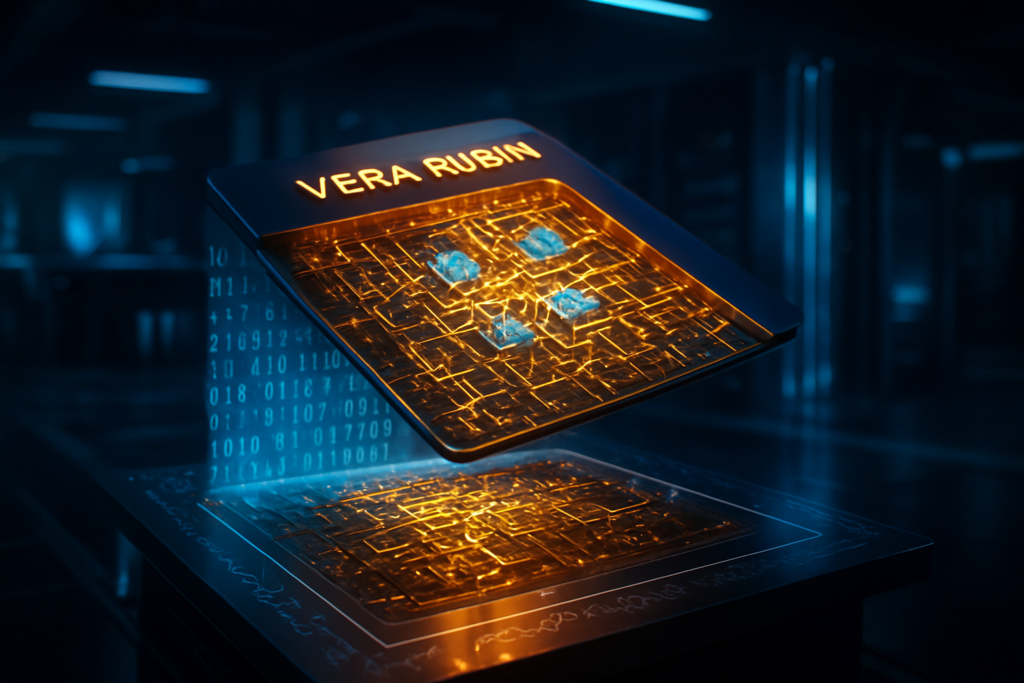
The technical implications are profound. Groq’s architecture is entirely deterministic, meaning the system knows exactly where every bit of data is at any given microsecond. This eliminates the "jitter" and latency spikes common in traditional parallel processing, making it the gold standard for real-time applications like autonomous agents and high-speed LLM (Large Language Model) interactions. NVIDIA plans to integrate these LPU cores directly into its upcoming 2026 "Vera Rubin" architecture. The Vera Rubin chips, which are already expected to feature HBM4 and the new Vera CPU (NASDAQ: ARM), will now become hybrid powerhouses capable of utilizing GPUs for massive training workloads and LPU cores for lightning-fast, deterministic inference.
Industry experts have reacted with a mix of awe and trepidation. "NVIDIA just bought the only architecture that threatened their inference moat," noted one senior researcher at OpenAI. By bringing Jonathan Ross into the fold, NVIDIA isn't just buying technology; it's acquiring the architectural philosophy that allowed Google to stay competitive with its TPUs for a decade. Ross’s move to NVIDIA marks a full-circle moment for the industry, as the man who built Google’s AI hardware foundation now takes the reins of the world’s most valuable semiconductor company.
Neutralizing the TPU Threat and Hedging Against HBM Shortages
This strategic move is a direct strike against Google’s (NASDAQ: GOOGL) internal hardware advantage. For years, Google’s TPUs have provided a cost and performance edge for its own AI services, such as Gemini and Search. By incorporating LPU technology, NVIDIA is effectively commoditizing the specialized advantages that TPUs once held, offering a superior, commercially available alternative to the rest of the industry. This puts immense pressure on other cloud competitors like Amazon (NASDAQ: AMZN) and Microsoft (NASDAQ: MSFT), who have been racing to develop their own in-house silicon to reduce their reliance on NVIDIA.
Furthermore, the deal serves as a critical hedge against the fragile HBM supply chain. As manufacturers like SK Hynix and Samsung struggle to keep up with the insatiable demand for HBM3e and HBM4, NVIDIA’s move into SRAM-based LPU technology provides a "Plan B" that doesn't rely on external memory vendors. This vertical integration of inference technology ensures that NVIDIA can continue to deliver high-performance AI factories even if the global memory market remains constrained. It also creates a massive barrier to entry for competitors like AMD (NASDAQ: AMD) and Intel (NASDAQ: INTC), who are still heavily reliant on traditional GPU and HBM architectures to compete in the high-end AI space.
Regulatory Arbitrage and the New Antitrust Landscape
The "reverse acqui-hire" structure of the Groq deal is a direct response to the aggressive antitrust environment of 2024 and 2025. With the US Department of Justice and European regulators closely monitoring NVIDIA’s market dominance, a standard $20 billion acquisition of Groq would have likely faced years of litigation and a potential block. By licensing the IP and hiring the talent while leaving Groq as a semi-independent cloud entity, NVIDIA has followed the playbook established by Microsoft’s earlier deal with Inflection AI. This allows NVIDIA to absorb the "brains" and "blueprints" of its competitor without the legal headache of a formal merger.
This move highlights a broader trend in the AI landscape: the consolidation of power through non-traditional means. As the barrier between software and hardware continues to blur, the most valuable assets are no longer just physical factories, but the specific architectural designs and the engineers who create them. However, this "stealth consolidation" is already drawing the attention of critics who argue that it allows tech giants to maintain monopolies while evading the spirit of antitrust laws. The Groq deal will likely become a landmark case study for regulators looking to update competition frameworks for the AI era.
The Road to 2026: The Vera Rubin Era and Beyond
Looking ahead, the integration of Groq’s LPU technology into the Vera Rubin platform sets the stage for a new era of "Artificial Superintelligence" (ASI) infrastructure. In the near term, we can expect NVIDIA to release specialized "Inference-Only" cards based on Groq’s designs, targeting the edge computing and enterprise sectors that prioritize latency over raw training power. Long-term, the 2026 launch of the Vera Rubin chips will likely represent the most significant architectural shift in NVIDIA’s history, moving away from a pure GPU focus toward a heterogeneous computing model that combines the best of GPUs, CPUs, and LPUs.
The challenges remain significant. Integrating two fundamentally different architectures—the parallel-processing GPU and the deterministic LPU—into a single, cohesive software stack like CUDA will require a monumental engineering effort. Jonathan Ross will be tasked with ensuring that this transition is seamless for developers. If successful, the result will be a computing platform that is virtually untouchable in its versatility, capable of handling everything from the world’s largest training clusters to the most responsive real-time AI agents.
A New Chapter in AI History
NVIDIA’s Christmas Eve announcement is more than just a business deal; it is a declaration of intent. By securing the LPU technology and the leadership of Jonathan Ross, NVIDIA has addressed its two biggest vulnerabilities: the memory bottleneck and the rising threat of specialized inference chips. This $20 billion move ensures that as the AI industry matures from experimental training to mass-market deployment, NVIDIA remains the indispensable foundation upon which the future is built.
As we look toward 2026, the significance of this moment will only grow. The "reverse acqui-hire" of Groq may well be remembered as the move that cemented NVIDIA’s dominance for the next decade, effectively ending the "inference wars" before they could truly begin. For competitors and regulators alike, the message is clear: NVIDIA is not just participating in the AI revolution; it is architecting the very ground it stands on.
This content is intended for informational purposes only and represents analysis of current AI developments.
TokenRing AI delivers enterprise-grade solutions for multi-agent AI workflow orchestration, AI-powered development tools, and seamless remote collaboration platforms.
For more information, visit https://www.tokenring.ai/.