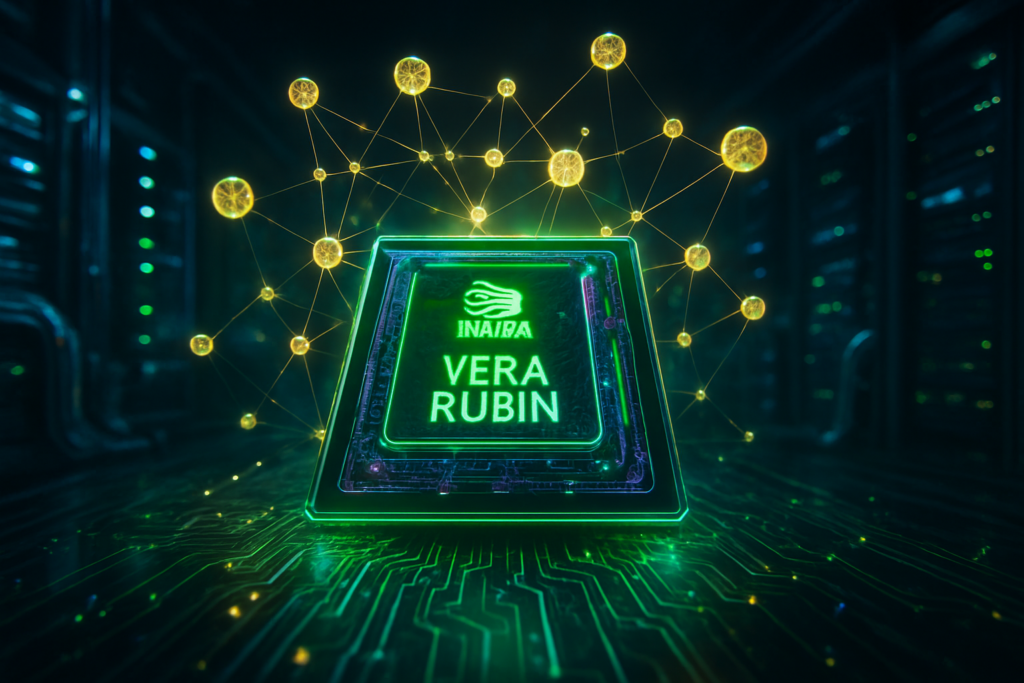
In a landmark presentation at CES 2026 that has sent shockwaves through the global technology sector, NVIDIA (NASDAQ: NVDA) CEO Jensen Huang officially unveiled the "Vera Rubin" architecture. Named after the pioneering astronomer who provided the first evidence for dark matter, the Rubin platform represents more than just an incremental upgrade; it is a fundamental reconfiguration of the AI data center designed to power the next generation of autonomous "agentic" AI and trillion-parameter models.
The announcement, delivered to a capacity crowd in Las Vegas, signals a definitive end to the traditional two-year silicon cycle. By committing to a yearly release cadence, NVIDIA is forcing a relentless pace of innovation that threatens to leave competitors scrambling. With a staggering 5x increase in raw performance over the previous Blackwell generation and a 10x reduction in inference costs, the Rubin architecture aims to make advanced artificial intelligence not just more capable, but economically ubiquitous across every major industry.
Technical Mastery: 336 Billion Transistors and the Dawn of HBM4
The Vera Rubin architecture is built on Taiwan Semiconductor Manufacturing Company’s (NYSE: TSM) cutting-edge 3nm process, allowing for an unprecedented 336 billion transistors on a single Rubin GPU—a 1.6x density increase over the Blackwell series. At its core, the platform introduces the Vera CPU, featuring 88 custom "Olympus" cores based on the Arm v9 architecture. This new CPU delivers three times the memory capacity of its predecessor, the Grace CPU, ensuring that data bottlenecks do not stifle the GPU’s massive computational potential.
The most critical technical breakthrough, however, is the integration of HBM4 (High Bandwidth Memory 4). By partnering with the "HBM Troika" of SK Hynix, Samsung, and Micron (NASDAQ: MU), NVIDIA has outfitted each Rubin GPU with up to 288GB of HBM4, utilizing a 2048-bit interface. This nearly triples the memory bandwidth of early HBM3 devices, providing the massive throughput required for real-time reasoning in models with hundreds of billions of parameters. Furthermore, the new NVLink 6 interconnect offers 3.6 TB/s of bidirectional bandwidth, effectively doubling the scale-up capacity of previous systems and allowing thousands of GPUs to function as a single, cohesive supercomputer.
Industry experts have expressed awe at the inference metrics released during the keynote. By leveraging a 3rd-Generation Transformer Engine and a specialized "Inference Context Memory Storage" platform, NVIDIA has achieved a 10x reduction in the cost per token. This optimization is specifically tuned for Mixture-of-Experts (MoE) models, which have become the industry standard for efficiency. Initial reactions from the AI research community suggest that Rubin will be the first architecture capable of running sophisticated, multi-step agentic reasoning without the prohibitive latency and cost barriers that have plagued the 2024-2025 era.
A Competitive Chasm: Market Impact and Strategic Positioning
The strategic implications for the "Magnificent Seven" and the broader tech ecosystem are profound. Major cloud service providers, including Microsoft (NASDAQ: MSFT), Alphabet (NASDAQ: GOOGL), and Amazon (NASDAQ: AMZN), have already announced plans to deploy Rubin-based "AI Factories" by the second half of 2026. For these giants, the 10x reduction in inference costs is a game-changer, potentially turning money-losing AI services into highly profitable core business units.
For NVIDIA’s direct competitors, such as Advanced Micro Devices (NASDAQ: AMD) and Intel (NASDAQ: INTC), the move to a yearly release cycle creates an immense engineering and capital hurdle. While AMD’s MI series has made significant gains in memory capacity, NVIDIA’s "full-stack" approach—integrating custom CPUs, DPUs, and proprietary interconnects—solidifies its moat. Startups focused on specialized AI hardware may find it increasingly difficult to compete with a moving target that refreshes every twelve months, likely leading to a wave of consolidation in the AI chip space.
Furthermore, server manufacturers like Dell Technologies (NYSE: DELL) and Super Micro Computer (NASDAQ: SMCI) are already pivoting to accommodate the Rubin architecture's requirements. The sheer power density of the Vera Rubin NVL72 racks means that liquid cooling is no longer an exotic option but an absolute enterprise standard. This shift is creating a secondary boom for industrial cooling and data center infrastructure companies as the world races to retrofit legacy facilities for the Rubin era.
Beyond the Silicon: The Broader AI Landscape
The unveiling of Vera Rubin marks a pivot from "Chatbot AI" to "Physical and Agentic AI." The architecture’s focus on power efficiency and long-context reasoning addresses the primary criticisms of the 2024 AI boom: energy consumption and "hallucination" in complex tasks. By providing dedicated hardware for "inference context," NVIDIA is enabling AI agents to maintain memory over long-duration tasks, a prerequisite for autonomous research assistants, complex coding agents, and advanced robotics.
However, the rapid-fire release cycle raises significant concerns regarding the environmental footprint of the AI industry. Despite a 4x improvement in training efficiency for MoE models, the sheer volume of Rubin chips expected to hit the market in late 2026 will put unprecedented strain on global power grids. NVIDIA’s focus on "performance per watt" is a necessary defense against mounting regulatory scrutiny, yet the aggregate energy demand of the "AI Industrial Revolution" remains a contentious topic among climate advocates and policymakers.
Comparing this milestone to previous breakthroughs, Vera Rubin feels less like the transition from the A100 to the H100 and more like the move from mainframe computers to distributed networking. It is the architectural realization of "AI as a Utility." By lowering the barrier to entry for high-end inference, NVIDIA is effectively democratizing the ability to run trillion-parameter models, potentially shifting the center of gravity from a few elite AI labs to a broader range of enterprise and mid-market players.
The Road to 2027: Future Developments and Challenges
Looking ahead, the shift to a yearly cadence means that the "Rubin Ultra" is likely already being finalized for a 2027 release. Experts predict that the next phase of development will focus even more heavily on "on-device" integration and the "edge," bringing Rubin-class reasoning to local workstations and autonomous vehicles. The integration of BlueField-4 DPUs in the Rubin platform suggests that NVIDIA is preparing for a world where the network itself is as intelligent as the compute nodes it connects.
The primary challenges remaining are geopolitical and logistical. The reliance on TSMC’s 3nm nodes and the "HBM Troika" leaves NVIDIA vulnerable to supply chain disruptions and shifting trade policies. Moreover, as the complexity of these systems grows, the software stack—specifically CUDA and the new NIM (NVIDIA Inference Microservices)—must evolve to ensure that developers can actually harness the 5x performance gains without a corresponding 5x increase in development complexity.
Closing the Chapter on the Old Guard
The unveiling of the Vera Rubin architecture at CES 2026 will likely be remembered as the moment NVIDIA consolidated its status not just as a chipmaker, but as the primary architect of the world’s digital infrastructure. The metrics—5x performance, 10x cost reduction—are spectacular, but the true significance lies in the acceleration of the innovation cycle itself.
As we move into the second half of 2026, the industry will be watching for the first volume shipments of Rubin GPUs. The question is no longer whether AI can scale, but how quickly society can adapt to the sudden surplus of cheap, high-performance intelligence. NVIDIA has set the pace; now, the rest of the world must figure out how to keep up.
This content is intended for informational purposes only and represents analysis of current AI developments.
TokenRing AI delivers enterprise-grade solutions for multi-agent AI workflow orchestration, AI-powered development tools, and seamless remote collaboration platforms.
For more information, visit https://www.tokenring.ai/.