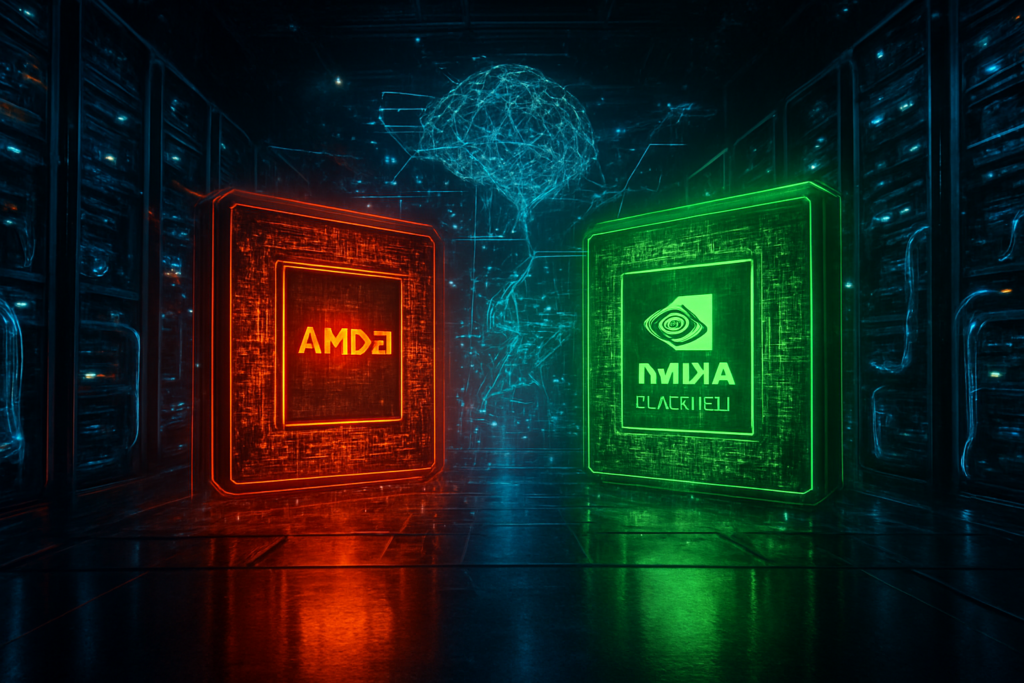
As of January 2026, the artificial intelligence landscape has transitioned from a period of desperate hardware scarcity to an era of fierce architectural competition. While NVIDIA Corporation (NASDAQ: NVDA) maintained a near-monopoly on high-end AI training for years, the narrative has shifted in the enterprise data center. The arrival of the Advanced Micro Devices, Inc. (NASDAQ: AMD) Instinct MI325X and the subsequent MI350 series has created the first genuine duopoly in the AI accelerator market, forcing a direct confrontation over memory density and inference throughput.
The immediate significance of this battle lies in the democratization of massive-scale inference. With the release of the MI350 series, built on the cutting-edge 3nm CDNA 4 architecture, AMD has effectively neutralized NVIDIA’s traditional software moat by offering raw hardware specifications—specifically in High Bandwidth Memory (HBM) capacity—that make it mathematically more efficient to run trillion-parameter models on AMD hardware. This shift has prompted major cloud providers and enterprise leaders to diversify their silicon portfolios, ending the "NVIDIA-only" era of the AI boom.
Technical Superiority through Memory and Precision
The technical skirmish between AMD and NVIDIA is currently centered on two critical metrics: HBM3e density and FP4 (4-bit floating point) throughput. The AMD Instinct MI350 series, headlined by the MI355X, boasts a staggering 288GB of HBM3e memory and a peak memory bandwidth of 8.0 TB/s. This allows the chip to house massive Large Language Models (LLMs) entirely within a single GPU's memory, reducing the latency-heavy data transfers between chips that plague smaller-memory architectures. In response, NVIDIA accelerated its roadmap, releasing the Blackwell Ultra (B300) series in late 2025, which finally matched AMD’s 288GB density by utilizing 12-high HBM3e stacks.
AMD’s generational leap from the MI300 to the MI350 is perhaps the most significant in the company’s history, delivering a 35x improvement in inference performance. Much of this gain is attributed to the introduction of native FP4 support, a precision format that allows for higher throughput without a proportional loss in model accuracy. While NVIDIA’s Blackwell architecture (B200) initially set the gold standard for FP4, AMD’s MI350 has achieved parity in dense compute performance, claiming up to 20 PFLOPS of FP4 throughput. This technical parity has turned the "Instinct vs. Blackwell" debate into a question of TCO (Total Cost of Ownership) rather than raw capability.
Industry experts initially reacted with skepticism to AMD’s aggressive roadmap, but the mid-2025 launch of the CDNA 4 architecture proved that AMD could maintain a yearly cadence to match NVIDIA’s breakneck speed. The research community has particularly praised AMD’s commitment to open standards via ROCm 7.0. By late 2025, ROCm reached feature parity with NVIDIA’s CUDA for the vast majority of PyTorch and JAX-based workloads, effectively lowering the "switching cost" for developers who were previously locked into NVIDIA’s ecosystem.
Strategic Realignment in the Enterprise Data Center
The competitive implications of this hardware parity are profound for the "Magnificent Seven" and emerging AI startups. For companies like Microsoft Corporation (NASDAQ: MSFT) and Meta Platforms, Inc. (NASDAQ: META), the MI350 series provides much-needed leverage in price negotiations with NVIDIA. By deploying thousands of AMD nodes, these giants have signaled that they are no longer beholden to a single vendor. This was most notably evidenced by OpenAI's landmark 2025 deal to utilize 6 gigawatts of AMD-powered infrastructure, a move that provided the MI350 series with the ultimate technical validation.
For NVIDIA, the emergence of a potent MI350 series has forced a shift in strategy from selling individual GPUs to selling entire "AI Factories." NVIDIA's GB200 NVL72 rack-scale systems remain the industry benchmark for large-scale training due to the superior NVLink 5.0 interconnect, which offers 1.8 TB/s of chip-to-chip bandwidth. However, AMD’s acquisition of ZT Systems, completed in 2025, has allowed AMD to compete at this system level. AMD can now deliver fully integrated, liquid-cooled racks that rival NVIDIA’s DGX systems, directly challenging NVIDIA’s dominance in the plug-and-play enterprise market.
Startups and smaller enterprise players are the primary beneficiaries of this competition. As NVIDIA and AMD fight for market share, the cost per token for inference has plummeted. AMD has aggressively marketed its MI350 chips as providing "40% more tokens-per-dollar" than the Blackwell B200. This pricing pressure has prevented NVIDIA from further expanding its already record-high margins, creating a more sustainable economic environment for companies building application-layer AI services.
The Broader AI Landscape: From Scarcity to Scale
This battle fits into a broader trend of "Inference-at-Scale," where the industry’s focus has shifted from training foundational models to serving them to millions of users efficiently. In 2024, the bottleneck was getting any chips at all; in 2026, the bottleneck is the power density and cooling capacity of the data center. The MI350 and Blackwell Ultra series both push the limits of power consumption, with peak TDPs reaching between 1200W and 1400W. This has sparked a massive secondary industry in liquid cooling and data center power management, as traditional air-cooled racks can no longer support these top-tier accelerators.
The significance of the 288GB HBM3e threshold cannot be overstated. It marks a milestone where "frontier" models—those with 500 billion to 1 trillion parameters—can be served with significantly less hardware overhead. This reduces the physical footprint of AI data centers and mitigates some of the environmental concerns surrounding AI’s energy consumption, as higher memory density leads to better energy efficiency per inference task.
However, this rapid advancement also brings concerns regarding electronic waste and the speed of depreciation. With both NVIDIA and AMD moving to annual release cycles, high-end accelerators purchased just 18 months ago are already being viewed as legacy hardware. This "planned obsolescence" at the silicon level is a new phenomenon for the enterprise data center, requiring a complete rethink of how companies amortize their massive capital expenditures on AI infrastructure.
Looking Ahead: Vera Rubin and the MI400
The next 12 to 24 months will see the introduction of NVIDIA’s "Vera Rubin" architecture and AMD’s Instinct MI400. Experts predict that NVIDIA will attempt to reclaim its undisputed lead by introducing even more proprietary interconnect technologies, potentially moving toward optical interconnects to overcome the physical limits of copper. NVIDIA is expected to lean heavily into its "Grace" CPU integration, pushing the Superchip model even harder to maintain a system-level advantage that AMD’s MI350, which often relies on third-party CPUs, may struggle to match.
AMD, meanwhile, is expected to double down on its "chiplet" advantage. The MI400 is rumored to utilize an even more modular design, allowing for customizable ratios of compute to memory. This would allow enterprise customers to order "inference-heavy" or "training-heavy" versions of the same chip, a level of flexibility that NVIDIA’s more monolithic Blackwell architecture does not currently offer. The challenge for both will remain the supply chain; while HBM shortages have eased by early 2026, the sub-3nm fabrication capacity at TSMC remains a tightly contested resource.
A New Era of Silicon Competition
The battle between the AMD Instinct MI350 and NVIDIA Blackwell marks the end of the first phase of the AI revolution and the beginning of a mature, competitive industry. NVIDIA remains the revenue leader, holding approximately 85% of the market share, but AMD’s projected climb to a 10-12% share by mid-2026 represents a massive shift in the data center power dynamic. The "GPU War" has successfully moved the needle from theoretical performance to practical, enterprise-grade reliability and cost-efficiency.
As we move further into 2026, the key metric to watch will be the adoption of these chips in the "sovereign AI" sector—nationalized data centers and regional cloud providers. While the US hyperscalers have led the way, the next wave of growth for both AMD and NVIDIA will come from global markets seeking to build their own independent AI infrastructure. For the first time in the AI era, those customers truly have a choice.
This content is intended for informational purposes only and represents analysis of current AI developments.
TokenRing AI delivers enterprise-grade solutions for multi-agent AI workflow orchestration, AI-powered development tools, and seamless remote collaboration platforms.
For more information, visit https://www.tokenring.ai/.