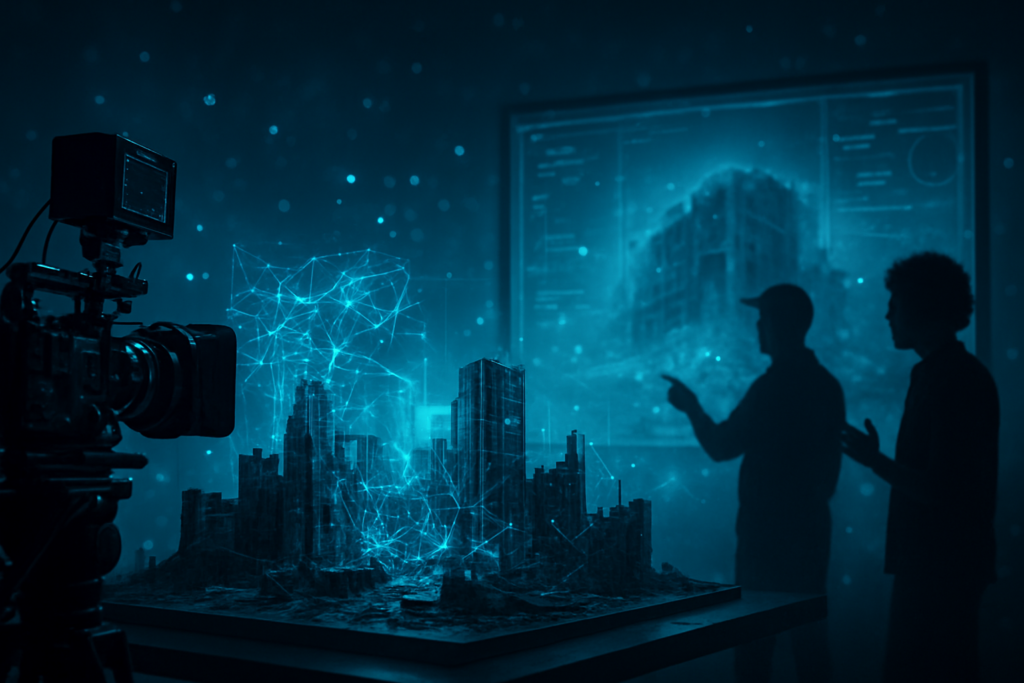
The release of Netflix’s (NASDAQ: NFLX) El Eternauta has marked a definitive "before and after" moment for the global film industry. While generative AI has been a buzzword in creative circles for years, the Argentine sci-fi epic—released in April 2025—is the first major production to successfully integrate AI-generated "final pixel" footage into a high-stakes, big-budget sequence. By utilizing a suite of proprietary and third-party AI tools, the production team achieved a staggering tenfold reduction in production time for complex visual effects, a feat that has sent shockwaves through Hollywood and the global VFX community.
The significance of this development cannot be overstated. For decades, high-end visual effects were the exclusive domain of blockbuster films with nine-figure budgets and multi-year production cycles. El Eternauta has shattered that barrier, proving that generative AI can produce cinema-quality results in a fraction of the time and at a fraction of the cost. As of January 8, 2026, the series stands not just as a critical triumph with a 96% Rotten Tomatoes score, but as a technical manifesto for the future of digital storytelling.
The technical breakthrough centered on a pivotal sequence in Episode 6, featuring a massive building collapse in Buenos Aires triggered by a train collision. Just ten days before the final delivery deadline, the production team at Eyeline Studios—Netflix’s in-house innovation unit—realized the sequence needed a scale that traditional CGI could not deliver within the remaining timeframe. Under the leadership of Kevin Baillie, the team pivoted to a "human-in-the-loop" generative AI workflow. This approach replaced months of manual physics simulations and frame-by-frame rendering with AI models capable of generating high-fidelity environmental destruction in mere days.
At the heart of this workflow were technologies like 3D Gaussian Splatting (3DGS) and Eyeline’s proprietary "Go-with-the-Flow" system. 3DGS allowed the team to reconstruct complex 3D environments from limited video data, providing real-time, high-quality rendering that surpassed traditional photogrammetry. Meanwhile, the "Go-with-the-Flow" tool gave directors precise control over camera movement and object motion within video diffusion models, solving the "consistency problem" that had long plagued AI-generated video. By integrating tools from partners like Runway AI, the team was able to relight scenes and add intricate debris physics that would have traditionally required a small army of artists.
Initial reactions from the AI research community have been overwhelmingly positive, hailing the project as the first true validation of "AI-native" cinematography. However, the VFX industry remains divided. While some experts praise the "democratization" of high-end visuals, others in the professional community—particularly on platforms like r/vfx—have voiced skepticism. Critics argue that the "tenfold" speed was achieved by bypassing traditional quality-control layers, and some have labeled the output "automated slop," pointing to perceived inaccuracies in secondary dust clouds and debris physics. Despite these critiques, the industry consensus is that the "uncanny valley" is rapidly being bridged.
For Netflix, the success of El Eternauta is a strategic masterstroke that solidifies its lead in the streaming wars. By bringing advanced VFX capabilities in-house through Eyeline Studios, Netflix has reduced its reliance on external vendors and created a blueprint for producing "blockbuster-level" content at mid-range price points. This development poses a direct challenge to legacy VFX powerhouses, who must now race to integrate similar AI efficiencies or risk being priced out of the market. The ability to slash production timelines also allows Netflix to be more agile, responding to viewer trends with high-quality content faster than its competitors.
The market implications extend beyond streaming. Tech giants like Alphabet Inc. (NASDAQ: GOOGL) and Meta Platforms, Inc. (NASDAQ: META), which are heavily invested in generative video research, now have a clear real-world benchmark for their technologies. The success of El Eternauta validates the massive R&D investments these companies have made in AI. Furthermore, startups in the AI video space are seeing a surge in venture interest, as the "proof of concept" provided by a global hit like El Eternauta makes the sector significantly more attractive to investors looking for the next disruption in the $500 billion media and entertainment industry.
However, this shift also signals a potential disruption to the traditional labor market within film production. As AI takes over the "heavy lifting" of rendering and basic simulation, the demand for junior-level VFX artists may dwindle, shifting the industry's focus toward "AI orchestrators" and senior creative directors who can steer the models. This transition is likely to spark renewed tensions with labor unions, as the industry grapples with the balance between technological efficiency and the protection of human craft.
Beyond the technical and financial metrics, El Eternauta represents a cultural milestone in the broader AI landscape. It marks the transition of generative AI from a "gimmick" or a tool for pre-visualization into a legitimate medium for final artistic expression. This fits into a broader trend of "AI-augmented creativity," where the barrier between an artist’s vision and the final image is increasingly thin. The impact is particularly felt in international markets, where creators can now compete on a global scale without the need for Hollywood-sized infrastructure.
However, the use of AI on this specific project has not been without controversy. El Eternauta is based on a seminal Argentine comic whose author, Héctor Germán Oesterheld, was "disappeared" during the country's military dictatorship. Critics have argued that using "automated" tools to render a story so deeply rooted in human resistance and political struggle is ethically fraught. This debate mirrors the wider societal concern that AI may strip the "soul" out of cultural heritage, replacing human nuance with algorithmic averages.
Comparisons are already being drawn to previous milestones like the introduction of Pixar’s Toy Story or the motion-capture revolution of Avatar. Like those films, El Eternauta has redefined what is possible, but it has also raised fundamental questions about the nature of authorship. As AI models are trained on the collective history of human cinema, the industry must confront the legal and ethical ramifications of a technology that "creates" by synthesizing the work of millions of uncredited artists.
Looking ahead, the "El Eternauta model" is expected to become the standard for high-end television and independent film. In the near term, we can expect to see "real-time AI filmmaking," where directors can adjust lighting, weather, and even actor performances instantly on set using tools like "DiffyLight." Netflix has already renewed El Eternauta for a second season, with rumors suggesting the production will use AI to create even more complex sequences involving alien telepathy and non-linear time travel that would be nearly impossible to film traditionally.
Long-term, the potential applications for this technology are vast. We are moving toward a world of "personalized content," where AI could theoretically generate custom VFX or even alternate endings based on a viewer’s preferences. However, several challenges remain, including the need for standardized ethical frameworks and more robust copyright protections for the data used to train these models. Experts predict that the next two years will see a "gold rush" of AI integration, followed by a period of intense regulatory and legal scrutiny.
The next step for the industry will likely be the integration of AI into the very early stages of screenwriting and storyboarding, creating a seamless "end-to-end" AI production pipeline. As these tools become more accessible, the definition of a "film studio" may change entirely, moving from physical lots and massive server farms to lean, cloud-based teams of creative prompts and AI engineers.
In summary, Netflix’s El Eternauta has proven that generative AI is no longer a futuristic concept—it is a present-day reality that has fundamentally altered the economics of filmmaking. By delivering a 10x reduction in production time and costs for high-end VFX, it has set a new benchmark for efficiency and creative possibility. The project stands as a testament to the power of human-AI collaboration, even as it serves as a lightning rod for debates over labor, ethics, and the future of art.
As we move further into 2026, the industry will be watching closely to see how other major studios respond to this shift. The success of El Eternauta Season 2 and the inevitable wave of "AI-first" productions that follow will determine whether this was a singular breakthrough or the start of a total cinematic transformation. For now, the message is clear: the AI revolution in Hollywood has moved past the experimental phase and is now ready for its close-up.
This content is intended for informational purposes only and represents analysis of current AI developments.
TokenRing AI delivers enterprise-grade solutions for multi-agent AI workflow orchestration, AI-powered development tools, and seamless remote collaboration platforms.
For more information, visit https://www.tokenring.ai/.