On February 17, 2026—just days after the launch of its flagship Claude Opus 4.6—Anthropic released Claude Sonnet 4.6, heralding it as the "most capable Sonnet model yet." This mid-tier powerhouse is now the default for Free and Pro users on claude.ai, Claude Cowork, and via APIs on platforms like Amazon Bedrock and Google Vertex AI. Priced at a accessible $3 per million input tokens and $15 per million output tokens, Sonnet 4.6 delivers near-flagship intelligence with breakthroughs in adaptive reasoning, computer use, and agentic planning, making advanced AI accessible at scale.
The immediate significance is seismic: Sonnet 4.6's human-level performance in navigating spreadsheets, multi-step web forms, and autonomous workflows—scoring 72.5% on OSWorld (up from 14.9% in Claude 3.5 Sonnet)—positions it as a production-ready "workhorse" for enterprises. Early integrations with Snowflake Cortex AI and reports of stock dips in SaaS giants underscore its potential to automate white-collar tasks, challenging the status quo in coding, knowledge work, and office automation.
Claude Sonnet 4.6 introduces the Adaptive Thinking Engine, a dynamic reasoning mode that allows the model to "pause" for internal monologues, self-correct logic, and adjust effort levels (Low, Medium, High, Max) based on task complexity. This replaces static prompting with real-time recursive reasoning, drastically reducing hallucinations in multi-step problems. Technical specs include a 1 million token context window (beta), knowledge cutoff of August 2025, and expanded output capabilities beyond the 128K of prior Opus models.
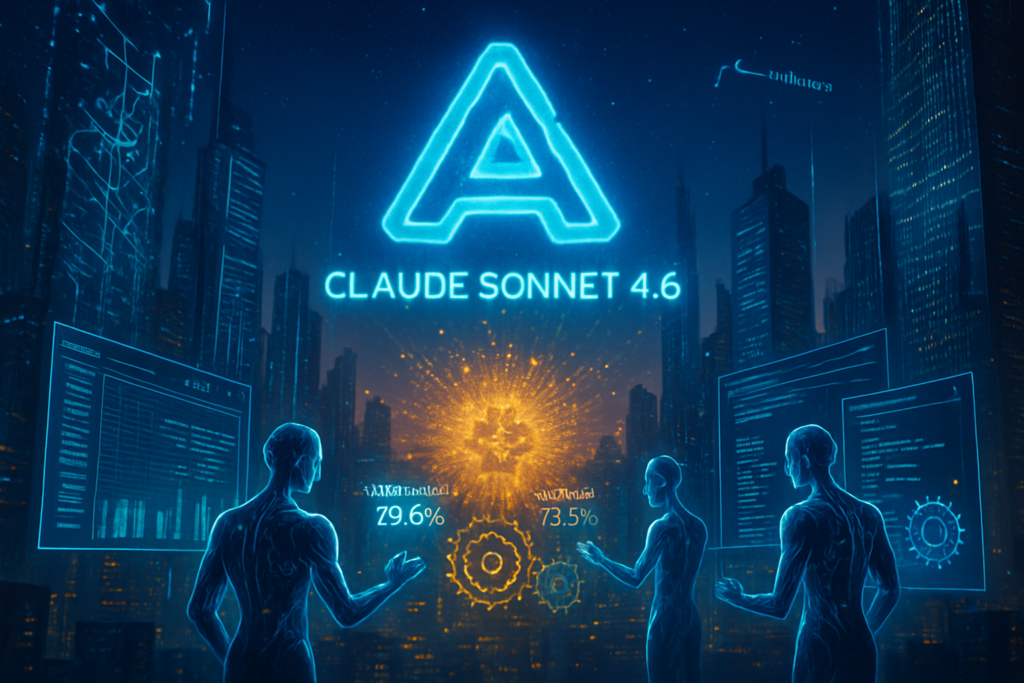
Benchmark results showcase its leaps: 79.6% on SWE-bench Verified (coding, edging GPT-5.2's 80.0%), 72.5% on OSWorld (computer use, 5x Claude 3.5 Sonnet's 14.9%), 88.0% on MATH, and a leading 1633 Elo on GDPval-AA (office tasks, surpassing Opus 4.6's 1606). Compared to predecessors, it vastly outstrips Claude 3.5 Sonnet in context (200K to 1M tokens) and agentic tasks, fixes Sonnet 4.5's "laziness" in instruction-following, and matches Opus 4.6 in efficiency while being cheaper. New features like Context Compaction (beta) enable "infinite" agent sessions by summarizing old context, and enhanced search with dynamic filtering verifies facts via internal code execution.
Initial reactions from the AI community are ecstatic, with developers calling it "Opus-level intelligence at a fraction of the price." Analysts at MarkTechPost dubbed it the dawn of Anthropic's "Thinking Era," shifting from speed to reasoning. Blinded tests show 59% user preference over Opus 4.5 for long-horizon tasks, and experts praise its safety profile—ASL-3 rated, "warm, honest, prosocial"—with major gains in prompt injection resistance critical for computer use.
Industry figures like Snowflake's team highlight 90%+ accuracy in text-to-SQL, while Box CEO Aaron Levie notes jumps in healthcare (60% to 78%) and legal tasks (57% to 69%). The release has been hailed for rendering niche coding tools "obsolete" by mid-2026.
Anthropic's Sonnet 4.6 rollout benefits partners first: Snowflake (NYSE: SNOW) gained same-day access in Cortex AI via a $200M expanded partnership, powering Snowflake Intelligence and Cortex Code for 12,600+ customers. Amazon Web Services (NASDAQ: AMZN) via Bedrock emphasizes its role in multi-agent pipelines, while Google Cloud (NASDAQ: GOOG) (NASDAQ: GOOGL) integrates it on Vertex AI despite Gemini competition. Apple (NASDAQ: AAPL) leverages it for agentic coding in Xcode, signaling a developer ecosystem shift.
Competitively, it pressures OpenAI—whose GPT-5.2 lags in computer use (38.2% OSWorld)—prompting a rapid GPT-5.3 Codex response. Google DeepMind's Gemini 3 Pro holds a 2M context edge but trails in agentic planning; xAI's Grok 5 differentiates via real-time data; Meta Platforms (NASDAQ: META) pushes open-source Llama 4. Anthropic's multi-cloud strategy and $30B raise at $380B valuation solidify its positioning.
Disruption ripples through SaaS: Shares of Salesforce (NYSE: CRM) (-2.7%), Oracle (NYSE: ORCL) (-3.4%), Intuit (NASDAQ: INTU) (-5.2%), and Adobe (NASDAQ: ADBE) (-1.4%) dipped as investors fear automation of enterprise workflows. Sonnet 4.6's efficiency gives Anthropic a "high-trust" moat, doubling revenue run-rate since January.
Sonnet 4.6 fits squarely into the agentic AI trend, evolving from chatbots to autonomous "teammates" capable of planning, executing, and self-correcting. It embodies 2026's "arithmetic disruption"—frontier smarts at mid-tier cost—accelerating white-collar automation in coding, finance, and docs.
Societal impacts include boosted productivity but job displacement risks in data entry, admin, and routine analysis. Economic shifts favor "AI supervisors" over individual coders, with $1B run-rate from Claude Code alone. Concerns center on safety: ASL-3 mitigates misalignment, but dual-use for cyber threats (65.2% CyberGym) and "context rot" in long sessions persist.
Compared to milestones like Claude 3 Opus (2024, 200K context) or GPT-4, Sonnet 4.6 closes the "intelligence gap," matching 2025 flagships while pioneering computer use graduation from experimental.
Near-term, expect Claude Haiku 4.6 in Q1/Q2 2026 for low-latency agentics, full Context Compaction rollout, and integrations like Microsoft PowerPoint/Excel add-ins. Long-term, Claude 5 (2027) eyes "emotional intelligence" and superhuman feats per CEO Dario Amodei.
Applications span agentic coding (entire workflows), enterprise Q&A (15pt gains), and office agents (94% insurance intake accuracy). Challenges: Energy demands rivaling aviation, regulatory needs (Anthropic's $20M advocacy), and scaling safety amid resignations over existential risks.
Experts predict a "quality over velocity" shift, with engineers as agent overseers; competitors like Gemini 3 Ultra will counter.
In summary, Claude Sonnet 4.6's key takeaways are its benchmark dominance (79.6% SWE-bench, 72.5% OSWorld), 1M context, Adaptive Thinking, and cost parity—delivering Opus smarts affordably. This cements its place in AI history as the "workhorse revolution," democratizing agentic AI.
Its significance rivals GPT-4's 2023 splash, but accelerates toward human-level ops. Long-term, it commoditizes intelligence, reshaping labor and software markets.
Watch competitor salvos (GPT-5.3), ecosystem rollouts (Claude Code), benchmark evolutions, and "Fennec" leaks in weeks ahead.
This content is intended for informational purposes only and represents analysis of current AI developments.
TokenRing AI delivers enterprise-grade solutions for multi-agent AI workflow orchestration, AI-powered development tools, and seamless remote collaboration platforms.
For more information, visit https://www.tokenring.ai/.